
First drive in the Geely E2: An agile compact car with rear-wheel drive and C-segment interior space
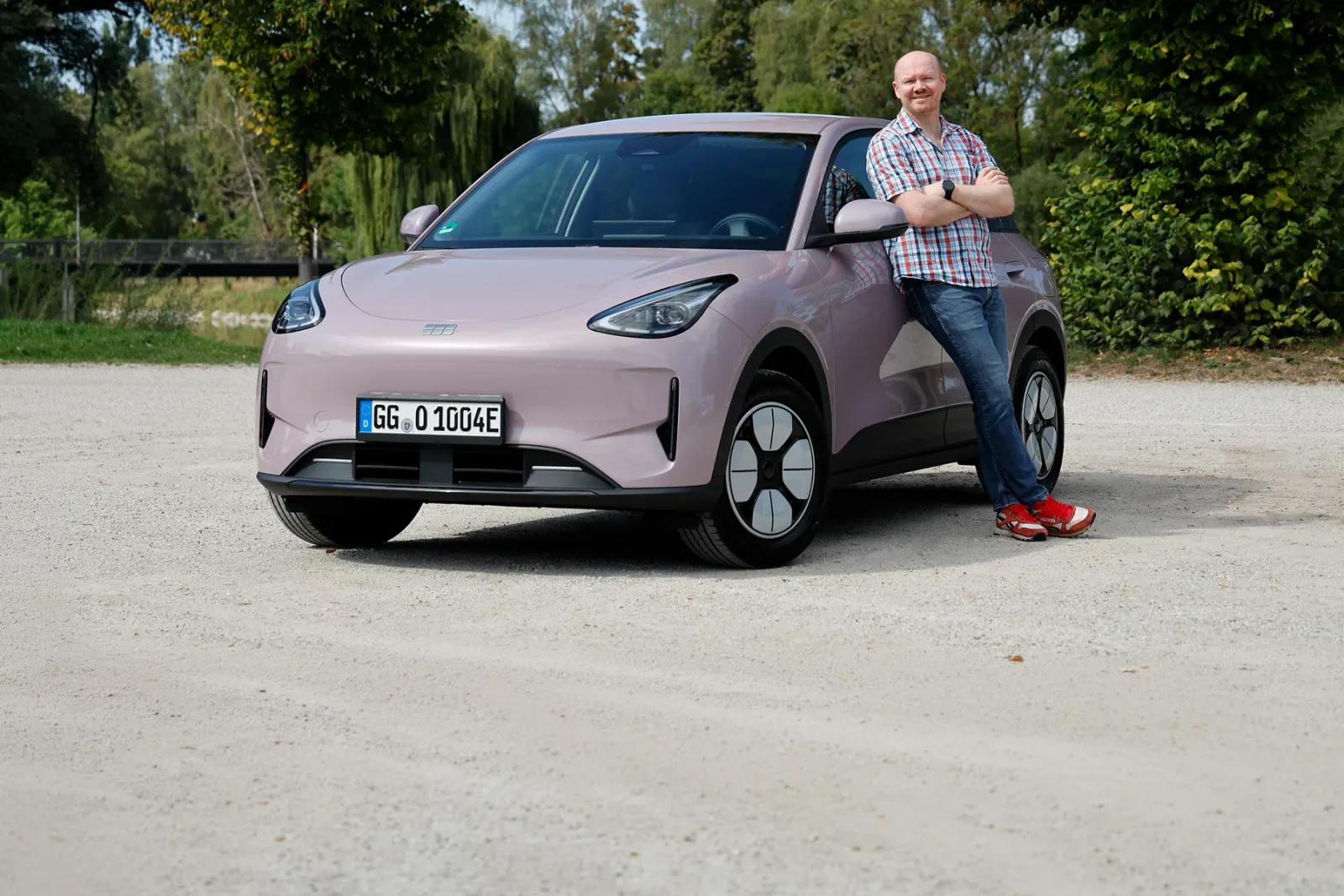
On a winding country road east of Landshut, the new Geely E2 approaches an empty roundabout that I am supposed to exit via the opposite ramp. It’s like navigating a series of turns—right, left, right. Although the test vehicle was equipped with roll-resistance optimized Yokohama BluEarth-GT tires in the 205/60 R16 size, it dips slightly into the outer suspension springs when turning, then precisely follows the steering input with slight understeer—without any drivetrain influence affecting the steering during acceleration out of turns.
How is that possible? The E2 is currently the only model with rear-wheel drive in the B-segment — at least when compared to its direct competitors. These include the BYD Dolphin Surf, Hyundai Ioniq 5, VW ID. Polo, and Renault 5. The E2 is not intended to excel in driving dynamics primarily; rather, according to Geely, it focuses on its interior space, aiming to offer C-segment dimensions in a B-segment vehicle. And this is true: With a length of just under 1.80 meters, sitting in the left rear seat, I neither hit my knees against the driver’s seat backrest nor my head against the ceiling.
Two power levels at the rear, LFP cells in the floor
The E2’s powertrain options come in two performance levels. The entry-level “Pro” version is powered by an electric motor producing 60 kW (81 hp) and delivering 150 Newton meters of torque. It uses a lithium-iron-phosphate (LFP) battery with a gross capacity of 35.35 kWh and a usable net capacity of 34.28 kWh as the energy storage system. In the top version “Ultra,” also tested by electrive, the electric motor delivers 85 kW (116 hp), powered by a battery with a gross capacity of 47.14 kWh (45.72 kWh net). The Chinese manufacturer adopts this configuration for the mid-tier “Max” version as well. Even the entry-level model performs quite well. During our tests in urban areas, no noticeable difference in acceleration was perceived between the 60-kW and 85-kW motors subjectively.
Agile handling, but reduced top speed
On winding country roads, the E2 greatly benefits from its rear-wheel drive and a neutral 50:50 weight distribution across the axles. Combined with the more sophisticated European suspension tuning, which involved around 7,200 hours of development work, the E2 responds very directly to steering input from a neutral position. To handle higher stresses, including highway driving, the E2 comes equipped with larger brakes at the front, among other features, for the European market.
A drawback becomes apparent when looking at the top speed. It is electronically limited to 130 km/h across all variants. A comparison with the entry-level models of competitors shows that the E2 falls short in this regard: while the Hyundai Ioniq 1 reaches 140 km/h, the BYD Dolphin Surf and Renault 5 Evolution can go up to 150 km/h. The VW ID. Polo even offers a top speed of 160 km/h. For a hatchback as spacious as the E2, longer highway trips are certainly feasible for many users. Therefore, it would be desirable to have a slightly higher maximum speed limit.
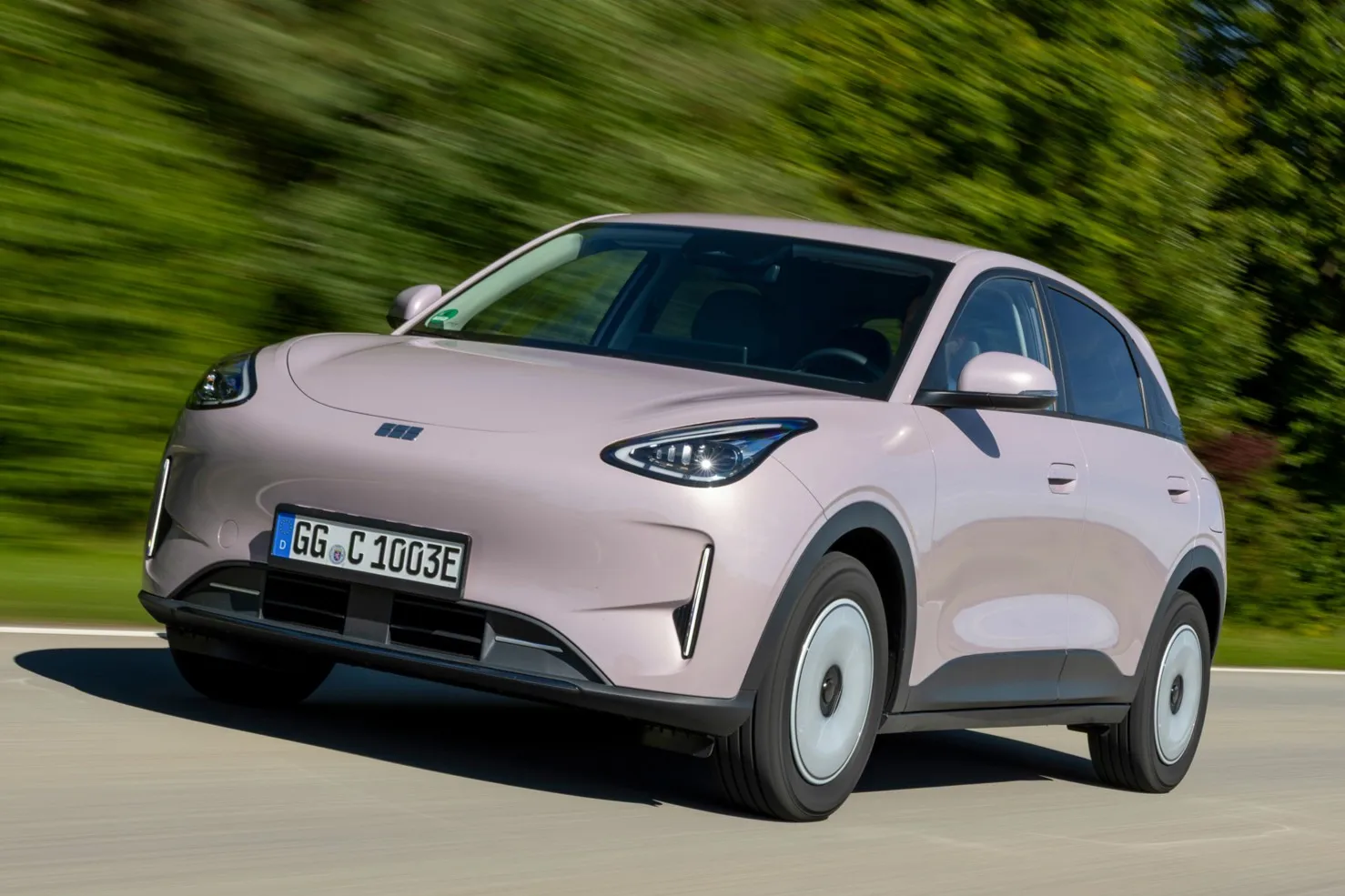
Image: Geely
- 1/7
- 2/7
- 3/7
- 4/7
Complex technology, but no true one-pedal driving
The precise handling and compact turning radius of just 9.9 meters stem from the combination of rear-wheel drive and a modern multi-link rear axle. However, drivers will be disappointed as there is no true one-pedal driving capability that allows the vehicle to come to a stop completely. Although the brake energy recovery can be adjusted in intensity via the central display, the brake pedal remains essential even at the highest setting in urban driving conditions. On the positive side, it offers the ability to power external devices via V2L with up to 3.3 kW of power—enough for almost all devices that can be powered by a standard household outlet.
High efficiency in summer and excellent fuel consumption
The efficiency of the Geely E2 proved to be a clear strength during our first outing. On an 52.1-kilometer route starting from the old town of Landshut, via country roads and back, with extremely sporty driving under high summer temperatures of 34 °C outside and 23 °C inside, we achieved a maximum fuel consumption of 17.0 kWh/100 km with the “Ultra” version. With the entry-level “Pro” version, this figure dropped to an excellent 13.6 kWh/100 km when driving cautiously along the same route.
Even more impressive was a 64-kilometer trip on the A92 highway from Landshut to Dingolfing and back: there, at 130 km/h — just below the speed limit — we achieved a fuel consumption of only 13.3 kWh/100 km in Ultra mode. The WLTP standard values of 15.5 to 15.9 kWh/100 km, which also include charging losses, can thus be surpassed in real-world conditions. The official range varies depending on the battery, ranging from 252 to 345 kilometers.
Detailed charging curves for LFP batteries
At the DC fast charging station, the base Pro version charges at up to 60 kW, while the Max and Ultra versions reach up to 80 kW. A look at the actual charging curve shows a very similar pattern for both battery sizes, with a steadily modulated charge trajectory. For both the 35-kWh and 47-kWh batteries, the charging power quickly rises to a plateau of just under 60 kW (small battery) or 80 kW (large battery). This level is maintained consistently until about 50 percent SoC. As charging progresses further, the curve declines, dropping from 60 to 70 percent SoC to around 40 kW (small battery) or 60 kW (large battery), and then drops significantly beyond 80 percent SoC.
The charge level range of 20 to 80 percent, which is relevant for practical comparisons, can be achieved in 23:35 minutes with the large 47-kWh battery. The smaller 35-kWh battery takes 23:08 minutes to reach the same charge level. At the AC wall charger, the onboard charger limits the charging power to a maximum of 6.6 kW, resulting in an AC full charge taking between 5.3 and 7.1 hours. Cleverly, Geely provides German customers with an EnBW starter package that covers the base fee of the mobility+ Tarif L for twelve months and allows DC charging at German EnBW stations for 39 cents per kWh.
Simple interior with ample storage space
The interior of this compact car, which is only 4.135 meters long, features a minimalist design and clear layout. The proprietary Flyme Auto operating system is used, which works seamlessly with Apple CarPlay and Android Auto. Its structure closely resembles that of the group’s Volvo and Polestar brands. Geely effectively leverages its synergies here, bringing benefits to both the company and its customers. For example, the E2 can be pre-conditioned via app across all three trim levels.
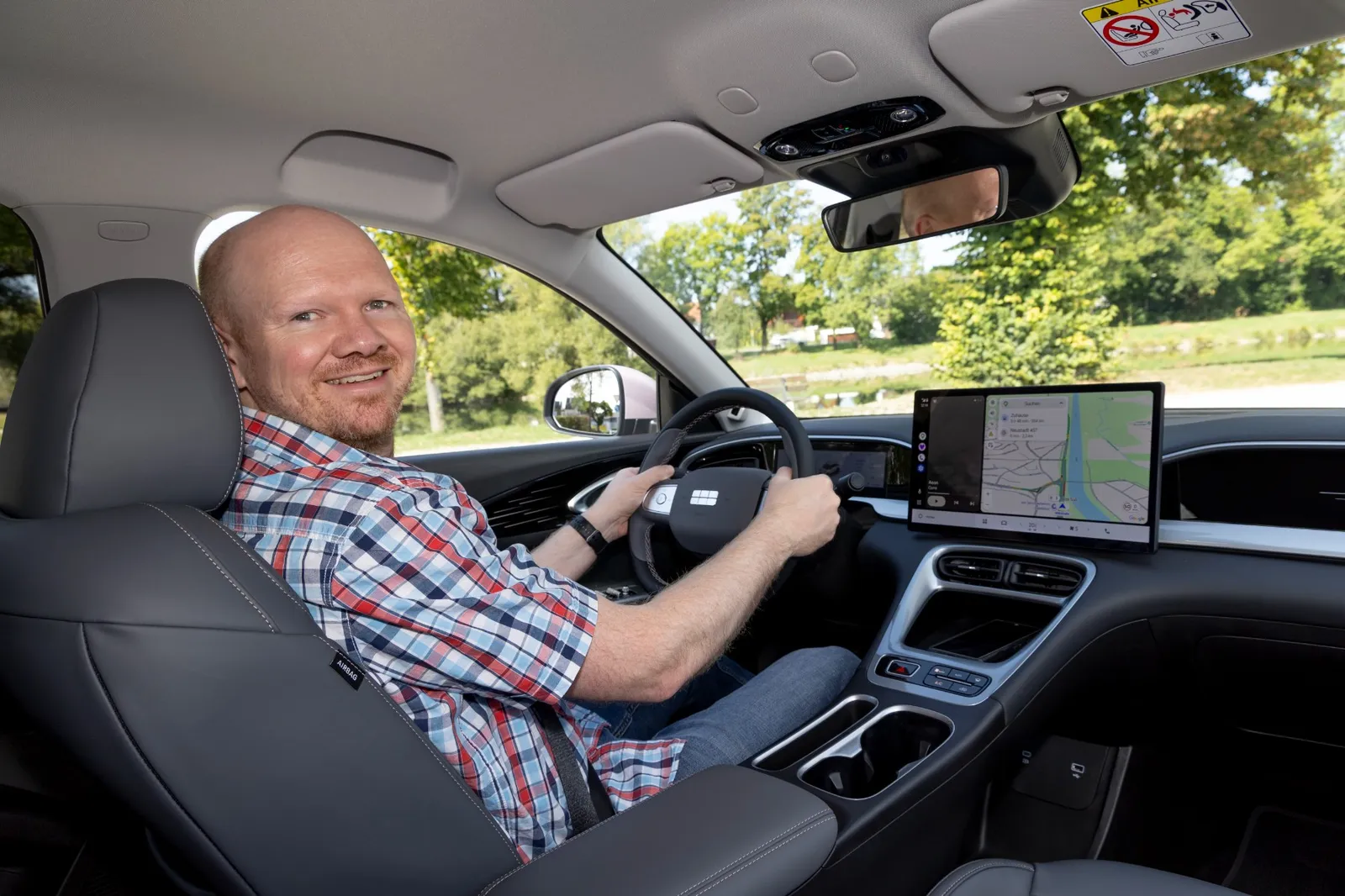
Image: Geely
- 1/15
- 2/15
- 3/15
- 4/15
- 5/15
- 6/15
- 7/15
- 8/15
- 9/15
- 10/15
- 11/15
- 12/15
- 13/15
- 14/15
In daily use, however, minor issues with the software occasionally cause annoyance: For example, when adjusting the volume, the sound is initially greatly muted before the system plays at the newly set level. Since the system supports over-the-air updates, improvements should appear soon. That said, the E2 isn’t easily outdone by competitors in terms of cargo capacity. In addition to the standard trunk space of 375 to 1320 liters, there are practical additional storage areas such as a 28-liter compartment under the rear seat and a 70-liter frunk area under the front hood — which is useful in everyday life for much more than just charging cables.
Three trim levels are available
The entry-level “Pro” version already comes with a comprehensive standard equipment package. It includes features such as the large 14.6-inch central display, an 8.8-inch driver display, automatic climate control, a rearview camera, and electrically adjustable synthetic leather seats. The mid-tier “Max” model not only boasts a larger battery and more powerful engine but also offers greater comfort on cold days thanks to heated steering wheels and heated front seats. The top-tier “Ultra” model stands out visually with 16-inch alloy wheels and a two-tone paint finish. It also provides passengers with amenities such as an electric rear hatch, a 540-degree panoramic camera, inductive smartphone charging up to 15 watts, 256-color ambient lighting, and an upgraded audio system with six speakers.
Excellent value for money
The Geely E2 offers a compelling overall package in the B-segment at first glance. Its ample interior space, efficient powertrain, and agile handling thanks to rear-wheel drive set it apart significantly in this price range. The drawbacks we identified—primarily the limited top speed of 130 km/h, the absence of one-pedal driving, and minor software quirks—carry little weight considering its price point. Its safety performance is also at the top tier, earning five stars in the latest Euro NCAP crash test (2026 protocol). The entry-level Pro version starts at 19,990 euros. The Max model with greater range costs 23,990 euros, while the top-tier Ultra is available from 26,990 euros.