
EnBW is recruiting taxi drivers as customers for fast chargers
The charging provider EnBW mobility+ has entered into a partnership with the Taxi and Car Rental Association of Germany (TMV). The goal is to improve the operating conditions for electric vehicles in commercial passenger transport — particularly through a discounted business rate for EnBW’s fast charging stations.
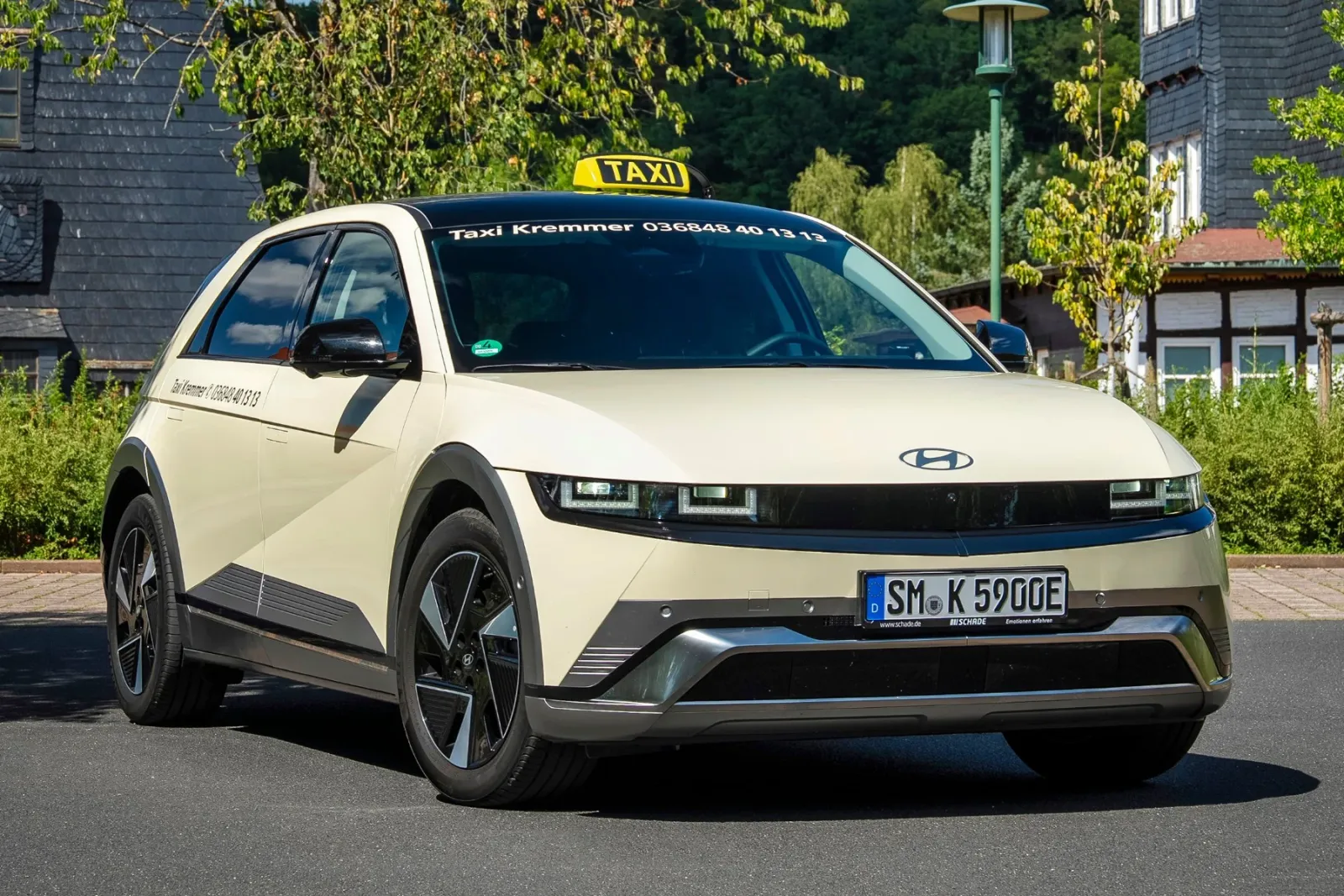
Hyundai Ioniq 5 electric taxi in use (illustrative image)
Image: Hyundai
As part of a nationwide partnership, the approximately 5,000 member companies of the association gain access to a special business customer tariff from EnBW mobility+. This is called the “EnBW Business TMV-Tarif” and resembles EnBW mobility+’s regular Business-L-Tarif. Additionally, new customers receive a charging voucher worth 50 euros by the end of the year.
Specifically, EnBW charges TMV members 31.93 cents per kilowatt hour net, or 38 cents gross, at its own charging stations. For the regular Business L plan, the cost is 32.77 cents net or 39 cents gross, which matches the L tariff for private customers as well. The monthly base fee is 11.76 euros net or 13.99 euros gross per user for both the regular Business L and TMV tariffs. Thus, the actual price advantage of the special tariff amounts to only 0.84 cents net or 1 cent gross per kilowatt hour. At charging points operated by other providers, there is no special TMV price: roaming charges range from 47.06 to 74.79 cents net per kilowatt hour, which equals 56 to 89 cents including VAT.
EnBW mobility+ links the cooperation primarily to the high daily mileage of taxis and rental cars. The charging provider does the math: at a diesel price of 2.40 euros per liter and a consumption of seven liters per 100 kilometers, the fuel cost amounts to 16.80 euros per 100 kilometers. In contrast, for an electric taxi with a consumption of 20 kWh and the regular business L tariff of 32.77 cents per kWh, the electricity cost is around 6.55 euros per 100 kilometers. According to this calculation, the energy cost of the electric taxi is about 60 percent lower.
However, the example chosen is somewhat unfortunate: First, diesel prices at gas stations are displayed including VAT, while the mentioned business L-tariff is shown without VAT. Moreover, due to the new fuel discount, the average diesel price nationwide is currently only around 2.24 euros. But VAT still needs to be deducted for companies such as taxi services, leaving only 1.88 euros net. Thus, the overall savings are currently lower.
"Electromobility can be economically attractive for many taxi and rental car companies, especially when fuel prices are high, because the electricity costs of an electric vehicle can be lower compared to a vehicle with an internal combustion engine," says Ertan Karakoc, Head of Fleet Sales Management at EnBW mobility+.
In addition to price, EnBW emphasizes the availability of its fast-charging network. The provider cites over 9,000 of its own fast-charging stations, where charging capacities of up to 480 kW are now possible, at least in the new reference charging park in Karlsruhe. At regular locations, the maximum capacity is currently 400 kW. For taxi and rental car services, however, the maximum charging power of the stations is just one factor: what matters most is also how much power each vehicle can actually absorb and how much driving time remains before the next trip.
To manage electric fleets, EnBW also provides the Smart Mobility Portal. There, charging processes, charging cards, and fleet data can be centrally managed and analyzed. The TMV tariff is thus less of a fundamentally new charging product and more of a customized version of the existing Business L offering for association members. As mentioned, the permanent price advantage over this standard tariff at EnBW charging stations is only 1 cent per kilowatt hour. The cooperation becomes particularly attractive for taxi companies due to the combination of high charging demands, fleet management, access to the fast-charging network, and a time-limited 50-euro startup bonus.
The adoption of electric taxis in Germany varies greatly: For example, in Leipzig, as of October 2025, only 7 out of 530 taxis were fully electric, and the city introduced a small subsidy program for new electric taxis in February 2026. In contrast, Hamburg already has 750 E-taxis thanks to the Zukunftstaxi project, accounting for 27 percent of the total taxi fleet.
enbw.com, tmv-deutschland.de (PDF, p. 9)
