
EnBW opens reference charging park with XCharge chargers
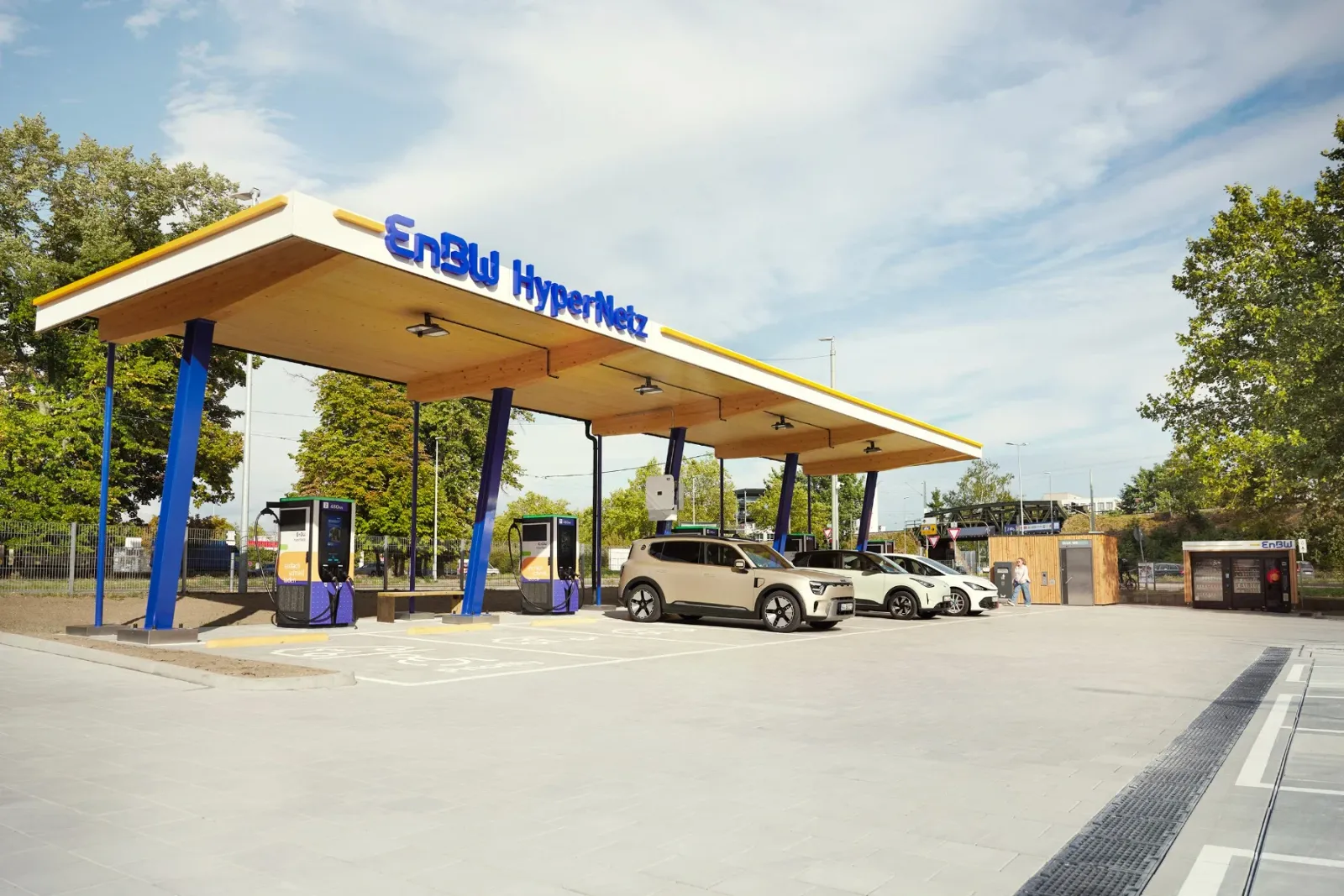
EnBW has opened a reference charging park with twelve fast-charging stations at its headquarters in Karlsruhe. The new XCharge C7 type charging columns are used there. This location is also intended to serve as a testing ground for charging technology, design, and amenities in future charging parks.
Image: EnBW / Photographer: Endre Dulic
The publicly accessible charging park is located at the company headquarters at the Gerwigstraße/Ostring intersection in Karlsruhe’s Oststadt district. The initial twelve HPC charging stations can potentially be expanded to up to 20. This allows EnBW to meet the timeline outlined when construction began in June, as operations were scheduled for autumn at that time.
A notable feature is the charging hardware used. EnBW is deploying the new generation of XCharge’s C7 fast charger with a capacity of up to 480 kW at its Karlsruhe site for the first time.
The company announced in June that the Karlsruhe charging station would be its first facility equipped with chargers capable of 480 kW, though it did not name the manufacturer at the time. Shortly after, XCharge revealed that its upgraded C7 model would be used there. Previously, the maximum charging capacity of fast chargers in EnBW’s network was 400 kW.
From ten test stations to a 480-kW rollout
The installation in Karlsruhe follows a longer period of testing the XCharge technology at EnBW. In August 2025, the first C7 unit went into operation at the EnBW City location in Stuttgart, and in December, field testing was expanded to a total of ten XCharge fast chargers at four locations in Baden-Württemberg. The generation used at that time could deliver up to 400 kW.
At the beginning of 2026, EnBW and charging infrastructure manufacturer XCharge signed a long-term framework agreement. This was preceded by field testing involving over 20,000 charging sessions. However, in March, the focus was still on fast chargers with 400 kW “and potentially more.” In June, XCharge finally introduced the upgraded C7 model capable of delivering up to 480 kW.
"With the new C7, we have introduced a product to the European market that reliably meets the high technical requirements of operators and their customers," said Albina Iljasov, XCharge’s European CEO. "In EnBW’s fast charging network, the new 480 kW fast charging technology will primarily be used in locations where customers only stay for a short time and want to gain as much range as possible during that time—such as at EnBW charging stations along German highways," added Lars Jacobs, Chief Commercial Officer and acting Technical Director of EnBW’s electric mobility division.
By the end of 2026, EnBW plans to equip another two-digit number of fast charging stations with the 480-kW technology. However, the energy company has not yet specified any particular locations.
Reference site for construction and operation
The new XCharge hardware is merely one part of what aims to turn the Karlsruhe location into a reference charging park. EnBW also wants to test new solutions for building and operating charging parks there. The location right next to the company’s headquarters and its on-site testing lab makes this ideal: new charging technology can first be tested under laboratory conditions before being evaluated in real operation at the publicly accessible charging park.
EnBW is also adopting new approaches in designing the site. According to the company, the new canopy is largely made of sustainably certified wood. When construction began in June, EnBW had announced a partial canopy with a photovoltaic capacity of 16 kWp. The current announcement does not clarify whether the photovoltaic system was implemented in this form, meaning EnBW’s typical glass roof with integrated PV modules will not be used.
The construction site itself also served as a testing ground. EnBW utilized electric and alternative fuel-powered construction machinery, according to the company. A local solar and storage system supplied electricity to parts of the site. According to general contractor Leonhard Weiss, this approach allowed up to 50 tons of CO2 to be saved compared to a conventionally operated construction site.
More than just a charging station
The reference concept also includes the design of the break area. At this 24/7 accessible location, there is an automated restroom facility as well as vending machines for drinks, coffee, and snacks. Seating is also available. A pizza vending machine is planned to further enhance the offerings in the future.
This approach ensures that the location serves not only as a testing ground for new charging technologies. EnBW aims to gain experience in terms of spatial design and additional services for charging parks in Karlsruhe as well. However, such amenities are not entirely new to the company: EnBW already operates small Rewe-to-go stores at certain locations, and restroom facilities are also present in other charging parks.
Further Expansion
According to the company, EnBW currently operates more than 9,000 own fast charging stations in Germany. When the XCharge framework contract was announced in early March, there were still over 8,000.
For the long-term expansion, EnBW is currently communicating two target figures simultaneously. On its website, EnBW still states a goal of up to 20,000 fast charging stations by 2030. However, E-Mobility chief Martin Roemheld told electrive in May that the company had deliberately decided not to focus the expansion solely on the absolute number of charging stations.