
Record emissions worldwide (and in Italy). The UN warns: toward an additional 2.8 degrees
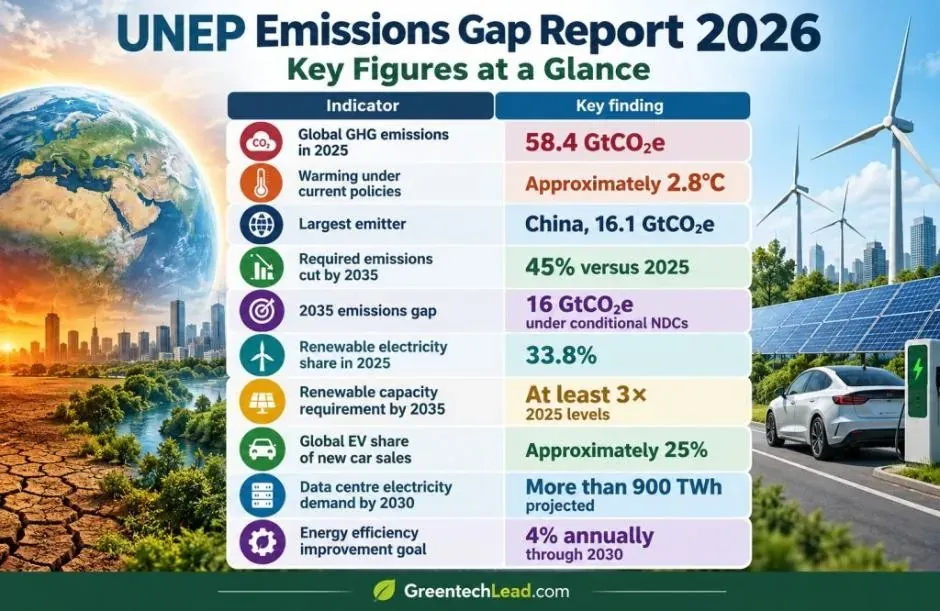
Record global emissions in 2025. Governments’ climate plans are not enough to curb global warming: according to the UN, current policies could lead to a temperature rise of +2.8°C by 2100. In Italy, emissions have increased by 9 million tons; to meet European targets, we need to cut them by 95 million tons over five years.
The world continues to emit greenhouse gases at record levels, and governments’ climate commitments remain insufficient. This is the warning issued by the United Nations in the annual report from UNEP, the United Nations Environment Programme, about the gap between actual emissions and those required to limit global warming.
According to the document, even if countries fulfilled their existing emission reduction commitments, the global average temperature could rise by about 2.6°C by the end of the century compared to pre-industrial levels. Therefore, a much more ambitious decarbonization policy than what has been promised would be necessary. But if only current policies are considered, without accounting for future targets declared by governments, the warming could reach 2.8°C.
"Emissions remain at record levels, and national climate plans and current policies are dangerously insufficient," said UN Secretary-General António Guterres while presenting the report. The world is "dangerously far from the target" and can no longer avoid exceeding the 1.5°C threshold set by the 2015 Paris Agreement.
The 1.5°C Target Growing Further Out of Reach
The new projections are worse than those from last year, when the expected warming under national commitments was estimated to be between 2.3°C and 2.5°C. Factors contributing to this revision include the United States' withdrawal from the Paris Agreement and updated estimates of historical emissions.
Preliminary data for 2025 also show varying trends among the world’s major emitters: emissions have increased in the United States, Indonesia, and China, while they have declined in India, Russia, and the European Union.
The report emphasizes particularly the responsibility of the richest G20 countries, which together account for about three-quarters of global emissions. Decades of insufficient action have drastically reduced the chances of meeting the more ambitious targets set by the Paris Agreement.
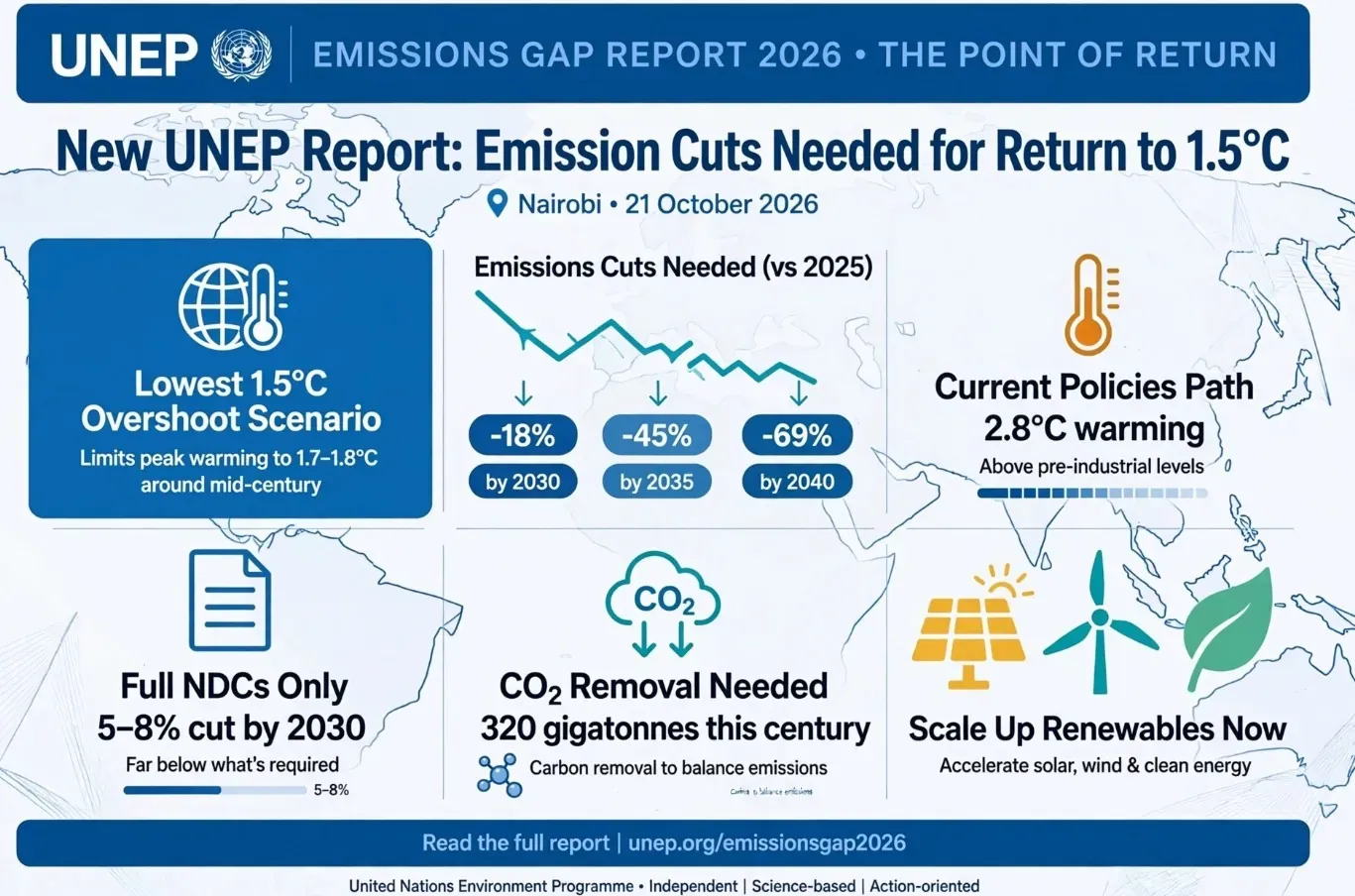
Temporarily exceeding 1.5°C does not mean that all chances of limiting damage are lost. The report outlines a more optimistic scenario in which warming peaks between 1.7°C and 1.8°C before falling back below 1.5°C by 2100. However, this would require emissions reductions much faster than those planned under current national programs.
Cutting emissions by 69% by 2040
To make this scenario possible, global emissions would need to drop by 18% by 2030 compared to 2025 levels, by 45% by 2035, and by 69% by 2040. This roughly aligns with the path outlined in Europe’s Green Deal, which aims for net-zero emissions by 2050.
The gap between current efforts and what’s needed is significant: according to UNEP, fulfilling governments’ climate pledges would result in only a 5-8% reduction in global emissions by 2030 and an 11-15% reduction by 2035.
The difference between these scenarios highlights how urgent it is to accelerate the decarbonization of energy systems, industry, and transportation by gradually reducing reliance on fossil fuels and increasing the use of renewable sources.
Italy, rising emissions: 95 million tons of CO₂ must be cut
The international situation reflects a concerning trend in Italy as well. Despite the approaching 2030 European deadline, the country’s energy transition is progressing slowly, and greenhouse gas emissions, according to the Progress Report on the National Integrated Energy and Climate Plan (Pniec) prepared by the Italian think tank Ecco, increased by about 9 million tons of CO₂ in 2025 compared to the previous year.
To meet its European commitments by 2030, Italy must reduce its emissions by approximately 95 million tons from 2025 levels—a figure equivalent to about a quarter of the country’s total emissions, to be cut within just five years.
The current pace does not seem sufficient. According to the projections cited by Ispra in the report, between 2021 and 2025 Italy would already have accumulated an excess of emissions of about 30 million tons of CO₂ compared to the planned trajectory. The deficit could rise to 39 million by 2030, with potential costs ranging from 3.8 to 5.7 billion euros for purchasing emission rights.
Electric cars save $20 billion in oil costs in six months
This figure highlights that delays in decarbonization are not only an environmental issue but can also result in economic burdens for the country.
Gas: consumption declining but no exit strategy
Among the challenges identified by Ecco is the lack of a coherent strategy to phase out natural gas, a necessary step to achieve climate neutrality by 2050.
Investment decisions continue to suggest a reliance on gas beyond 2030. Examples cited in the report include the methanization of Sardinia, which is not expected to be completed before 2033. The think tank also believes that delaying the phaseout of coal until 2038 risks sending signals of uncertainty to investors.
Reducing emissions also depends on gradually replacing fossil fuels with electricity and on the ability to increase the share of renewable energy in the national system.
414 MW storage project: Lazio rejects it, Besstarq disagrees
The dual perspective, global and Italian, highlights the same urgency: climate goals require faster actions that align with set deadlines. Without concrete acceleration in reducing emissions, there are twin risks: worsening the impacts of global warming and increasing the cost of delaying the energy transition.
READ ALSO: “Climate change is here. Enough talking, let’s address it” and watch the VIDEO