
Used Chinese electric vehicles: Discounts and high fuel prices cause prices to rise by more than 280% in Europe
Used Chinese electric cars are gaining ground in the European market thanks to their particularly competitive prices and the trade restrictions affecting new vehicles. According to data from China EV Marketplace (CEVM), a platform specialized in selling Chinese vehicles, sales of used cars to customers in the European Union rose by 280% between January and September 2026 compared to the same period in 2025, reaching 7,900 units.
During the same period, according to the company, direct sales of new vehicles to European customers dropped by 44%. These figures relate to CEVM’s business activities, not the overall registration of Chinese cars in the European Union. Nevertheless, this growth indicates a possible alternative for those seeking affordable electric vehicles, even through direct imports from China.
China EV Marketplace 2025: Xiaomi leads direct imports to Europe
Tariffs and restrictions are changing purchasing strategies
The turning point is related to the tariffs introduced in 2024 by the European Union on new battery electric vehicles produced in China, with rates as high as 35.3%. Including regular customs duties, the total levy can reach 45.3%. This has promoted alternatives not subject to these same compensatory tariffs, such as used electric vehicles and plug-in hybrids.
Now, according to CEVM, even the Chinese plug-in hybrid market must deal with a new European import limit. The restrictions on new vehicles are thus further increasing interest in used ones.
Used electric vehicles are indeed not covered by the European compensatory tariffs on new BEVs. However, other costs related to importation, such as transportation, certification, and registration, must also be considered.
Discounts of up to 40% compared to the original price
In return, the starting prices have become increasingly attractive. The price war among Chinese manufacturers has indeed reduced the list prices of new vehicles and also helped drive down the prices of used cars.
According to Jakub Geršl, operations director at China EV Marketplace, the company’s team based in Shanghai regularly finds vehicles with significant discounts. Some cars with around 6,000 kilometers on them are offered at prices 40% lower than their original Chinese list price.
The platform claims to have over 2,600 used electric cars available on its site, from brands such as Xiaomi, BYD, iCar, Denza, Lynk & Co, and Avatr.
For European drivers, the potential advantage is clear: access to relatively recent models, often equipped with advanced technologies, at a price significantly lower than that of a new car. However, the comparison should be based on the total cost of ownership rather than just the price advertised in China.
Which electric cars retain their value best in China
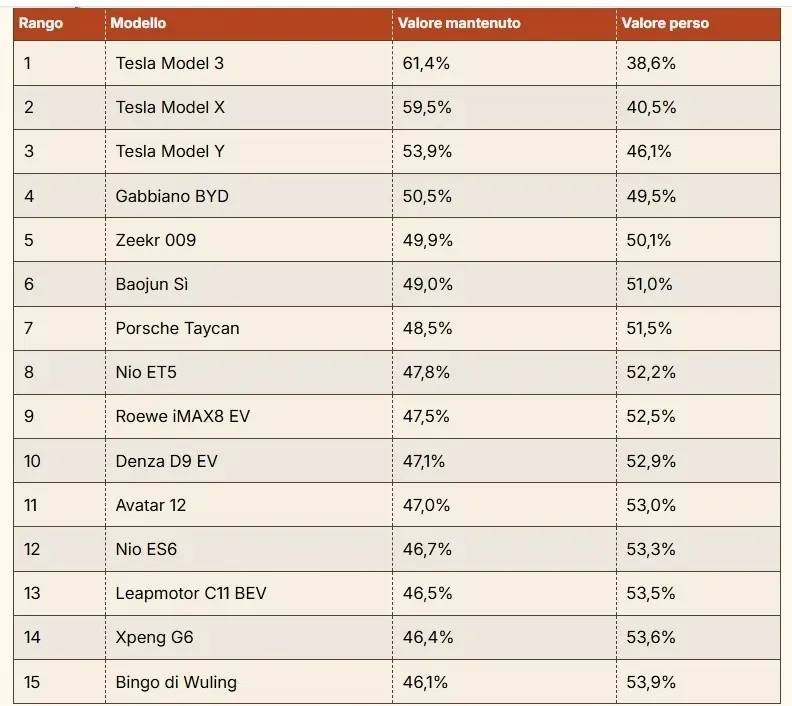
The Chinese market also provides insight into the differences in depreciation of electric vehicles. A September 2026 report by the China Automobile Dealers Association (CADA), conducted in collaboration with Jingzhengu, compared the residual value of electric cars after three years.
Tesla Model 3 leads the rankings, retaining 61.4% of its original price, followed by Tesla Model X at 59.5% and Tesla Model Y at 53.9%. Among Chinese models, BYD Seagull holds 50.5% of its original value, while Zeekr 009 is at 49.9%.
The data shows how much the depreciation can vary from one model to another. Even among Chinese electric vehicles, there is no uniform pattern: original price, market positioning, and market dynamics all influence the residual value.
A delivery center in Prague to reduce waiting times
To simplify purchasing, China EV Marketplace announced the opening of a delivery center in Prague, Czech Republic. The facility initially has 20 vehicles available for customers to pick up, eliminating the need to wait for the import process from China, which the company states takes about three months.
This center represents a first step toward providing services closer to European buyers, for whom transportation, customs procedures, and certification can pose significant obstacles.
It remains crucial to verify, before purchasing, whether the vehicle meets European requirements, if it can be registered in the destination country, what the warranty coverage is, and whether support and spare parts are available. A very low purchase price alone does not necessarily guarantee equivalent savings in the long term.
It is still unclear how much this channel can grow and whether European institutions will intervene if imports of used cars are seen as a means to circumvent the effects of trade measures.
Watch Marco Berti Quattrini’s VIDEO as well