
Electric PV7 with a 96.2 kWh battery. Kia is preparing as many as 23 versions
In short:
The Koreans have officially unveiled the PV7
The van will feature a 96.2 kWh battery, an 800 V electrical system, and in the Cargo version, it can carry up to 1200 kg of cargo
Range? The PV7 Cargo Long Range version offers over 460 km of range
In the passenger variant, the car can seat nine people
European sales will begin in the second half of 2027.
Kia starts building its family
Kia is just beginning to develop its own lineup of electric commercial vehicles, but it doesn’t plan to stop at one model. Following the PV5, which won the International Van of the Year 2026 title, a significantly larger PV7 made its debut at the IAA Transportation in Hanover.
The vehicle will primarily serve as a cargo delivery vehicle and a passenger van, but the Koreans plan for much more variants in the future. The PV7 is intended for logistics companies, fleets, transport providers, service teams, hotels, and entrepreneurs who need a vehicle with specialized modifications. The first units will arrive in Europe in the second half of 2027.
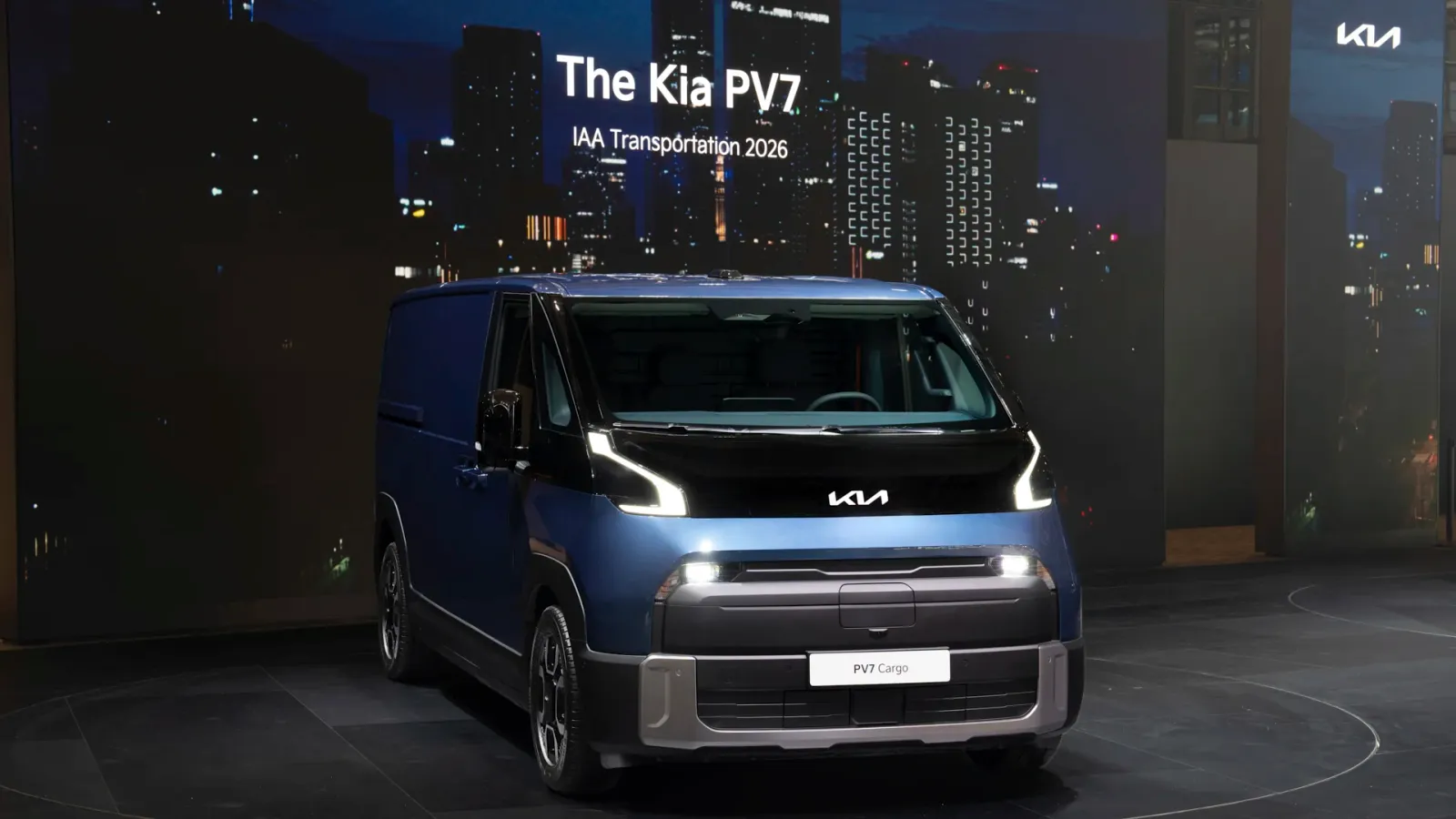
This is not a cargo version of the Kia sedan
The PV7 is built on the E-GMP.S platform, created specifically for Kia’s PBV family of vehicles, or Platform Beyond Vehicle. Behind this marketing name lies a modular design intended from the start to accommodate various body lengths, seating capacities, and configurations.
Kia uses a solution called the Flexible Body System. Simply put, it allows different body versions to be developed using a common base, eliminating the need to design each vehicle from scratch. This enables the creation of both regular vans and passenger versions, as well as refrigerated units, service vehicles, and other specialized types.
The PV7 Long has a length of 5350 mm, width of 2030 mm, and height of 1990 mm. The wheelbase is as long as 3500 mm. With a height of just under two meters, this makes it important when entering lower-level garage spaces.
Two Batteries and Up to 272 HP
Two batteries with NCM cells will be available for selection. The smaller one has a capacity of 71.5 kWh, while the larger one has 96.2 kWh.
The largest battery in the PV7 Cargo Long Range version is said to enable a range of over 460 km in the WLTP mixed cycle. It should be noted, however, that this is not yet the final homologation figure — Kia provides a value obtained from its own tests.
The powertrain will deliver a maximum of 272 HP and 420 Nm of torque. Initially, power will be sent to the front wheels, but the manufacturer has already hinted at a version with all-wheel drive.
In a delivery vehicle, power is of course not the most important parameter. Much more interesting is the 800 V electrical system, which is still rare in this class of vehicles.
Large Battery, but Charging Takes About 20 Minutes
At a 350 kW DC charging station, it should take about 20 minutes to charge from 10% to 80%. This figure was provided by Kia based on internal measurements.
PV7 will also be the first Kia equipped with two charging ports. The main port is located at the front and supports both AC and DC charging. Optionally, the vehicle will have an additional AC port at the back.
In a passenger car, this would be more of a novelty. In a commercial vehicle, it might make sense: a delivery truck parked at a ramp, against a warehouse wall, or among other vehicles isn’t always positioned so that the cable can easily reach the single port.
There’s also V2L, which allows drawing power from the traction battery to power external devices. Thus, tools or equipment used during work can be powered by the car.
Up to 8 m³ and three euro pallets
The Cargo Long version offers 6.1 m³ of cargo space according to VDA standards. The High Roof model with an elevated roof increases this to 8 m³.
The maximum payload varies by version. The Long model can carry up to 1165 kg, while the shorter Compact version—referred to as Standard in Europe—can carry up to 1200 kg. The loading threshold of the longer version is 550 mm above the ground. Three euro pallets measuring 800 × 1200 mm can be loaded simultaneously.
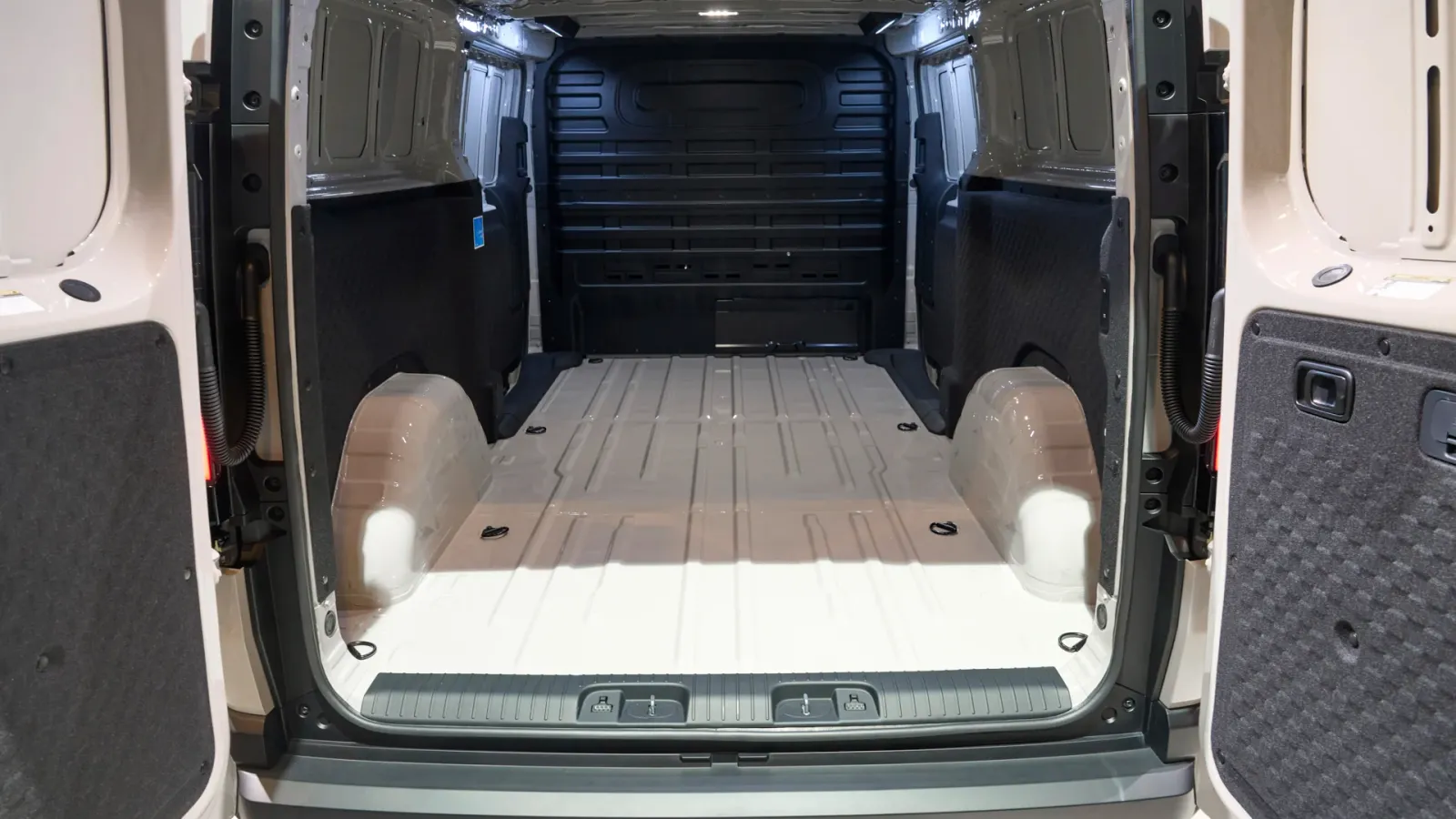
Kia has also developed a special heavy-load driving mode. The vehicle is designed to adjust its powertrain and control systems based on the weight of the cargo being transported.
The customer will be able to choose between classic double-door rear doors or a large hinged door that opens upward. In the three-seater version, a sliding partition will also be available, allowing part of the cabin space to be used for transporting long items.
The Smart Walk Away system is also interesting. After the driver leaves, the electric side doors can automatically close and lock. The status of the cargo area doors can be checked remotely.
Kia PV7 – Preliminary Technical Specs
Parameter
PV7 Passenger Long
PV7 Cargo Long
Battery
71.5 or 96.2 kWh
71.5 or 96.2 kWh
Length
5350 mm
5350 mm
Width
2030 mm
2030 mm
Height
1990 mm
1990 mm
Wheelbase
3500 mm
3500 mm
Drive Type
Front-wheel drive
Front-wheel drive
Maximum power
272 HP
272 HP
Maximum torque
420 Nm
420 Nm
Maximum passengers
9
3
Cargo space
–
6.1 m³
Maximum payload
–
1165 kg
Cargo Long Range range
–
over 460 km*
DC charging 10-80%
about 20 minutes*
about 20 minutes*
*Preliminary data from Kia, before final homologation.
The PV7 can carry nine people
The PV7 Passenger will be available in global markets in configurations that can seat up to nine people, while a 11-seater version will also be produced in Korea.
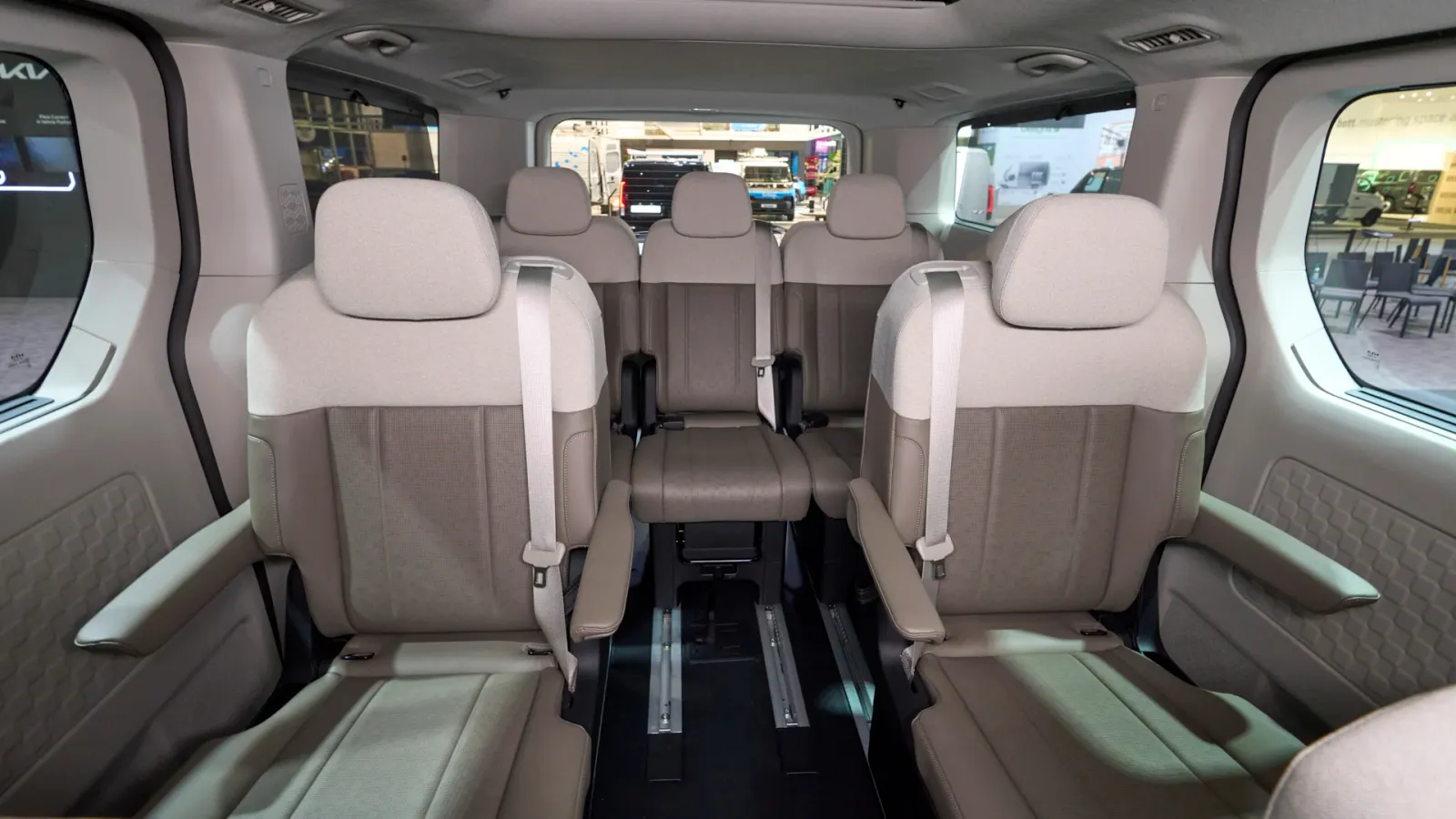
In the seven-seater version, seats on long slides are used, which can be removed to adjust the cabin layout. The nine-seater model will feature a fourth row of seats. Passengers in the back will have separate climate control, and the cabin will include USB-C ports with up to 100 W of power.
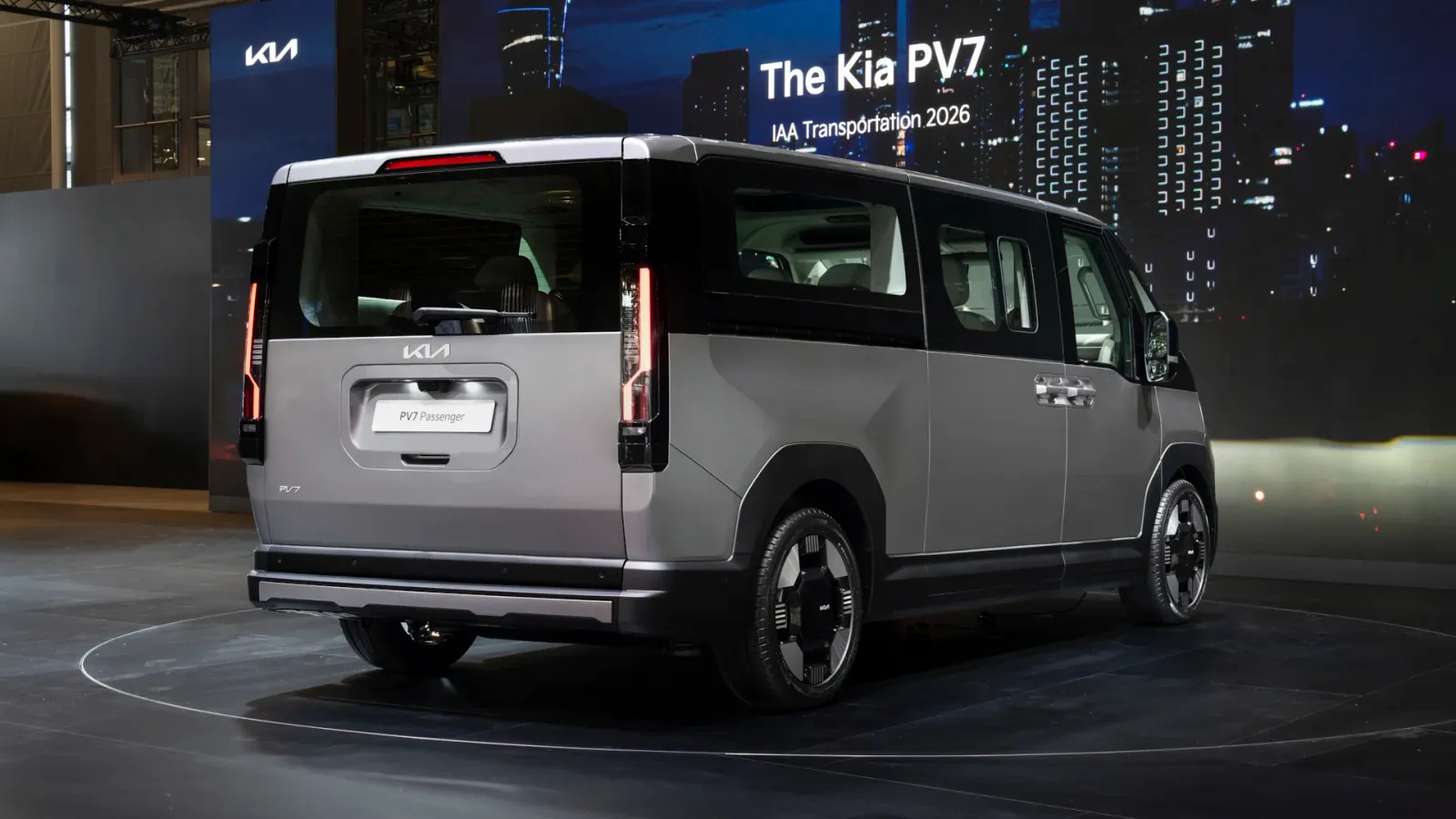
Two screens, but buttons remain
The driver will have access to two displays with 12.9 and 14.6 inches in diameter. The Pleos Connect system is based on Android Automotive OS and supports features such as navigation, apps, and remote OTA updates.
Importantly for a utility vehicle, Kia hasn’t moved all functions to the touchscreen. The most frequently used elements still have physical buttons.
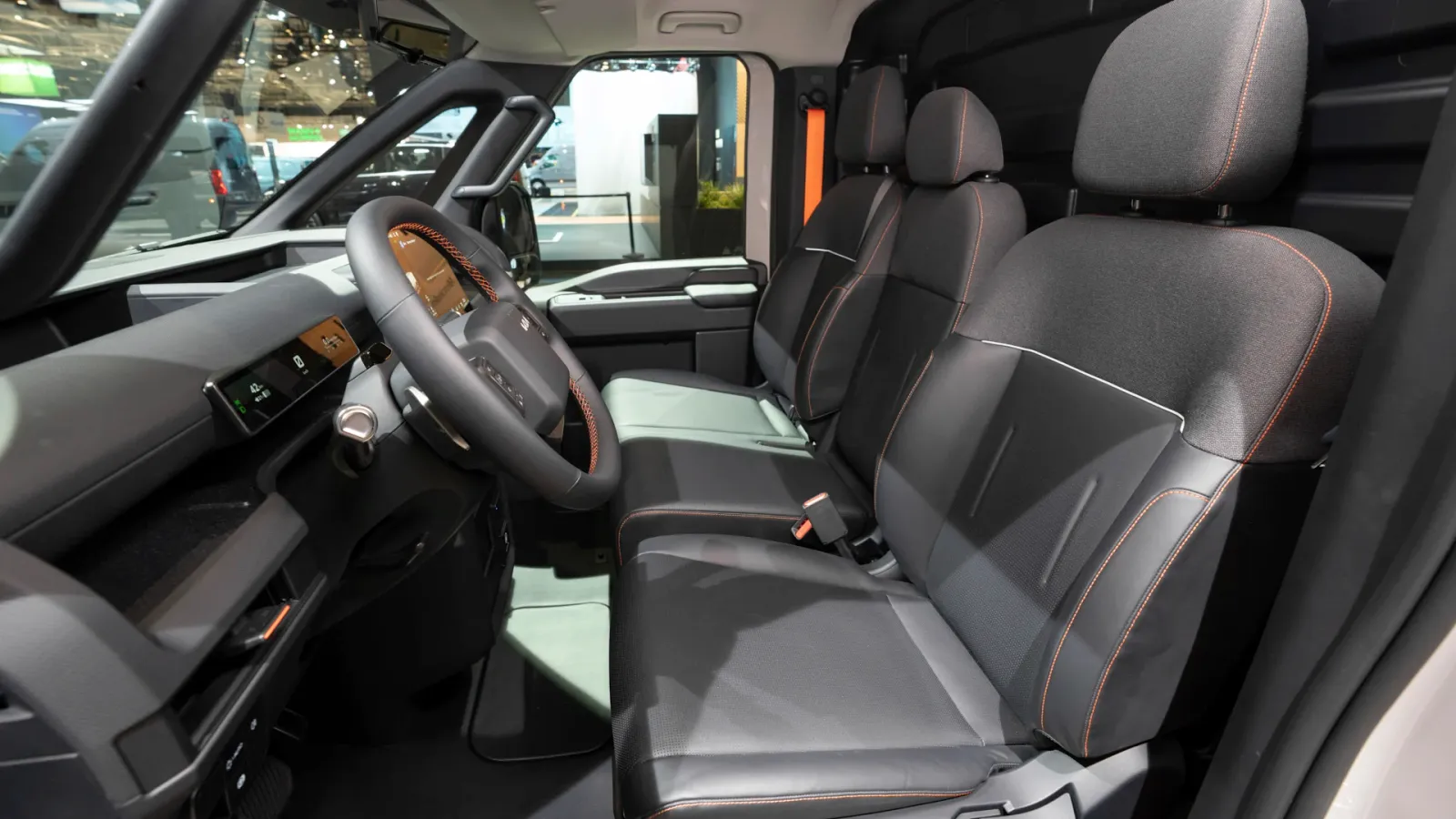
The driver’s seat is also designed for people who may get in and out of the car dozens of times during a single shift. There’s an additional grip on the A-pillar, a specially shaped step, and a repositioned seat.
The Cargo model will have plenty of open storage compartments, and in the three-seater configuration, the backrest of the middle seat can be folded down to serve as an additional shelf. The passenger-focused PV7 places more emphasis on enclosed storage, interior lighting, and an optional console that can function as a table while parked.
Kia also thinks about repairs for minor dents
Delivery trucks spend a lot of time in cities, under ramps, and in tight parking spaces, so minor body damage is a common part of their existence. That’s why Kia designed the bumper corners, fender elements, and door panel sections to be replaceable separately.
This is intended to reduce the cost and time required for repairs after minor collisions or scratches, rather than forcing owners to replace an entire large component.
Seven airbags and advanced assist systems
The PV7 will be equipped with seven airbags. An unusual feature is the front passenger airbag located in the headliner, which allows more space to be created for storage compartments in the dashboard.
The list of assist systems includes automatic braking with detection of cars, pedestrians, and cyclists, lane-keeping assistant, adaptive cruise control using navigation data, highway driving assist, front, side, and rear parking sensors, as well as 360-degree cameras. Remote parking and a factory-installed camera for recording driving are also available.
The car itself is just part of the offering
Kia aims to enter the fleet market not only with the car itself. A fleet management system has been developed for the PV7 that can transmit vehicle data to external systems used by companies.
The Kia Business Solutions Portal is designed to integrate vehicle management, charging, and maintenance. The manufacturer also announces a Uptime service that uses remote monitoring of technical condition and diagnostics to enable proactive planning for repairs and maintenance.
It’s here that it becomes clear the Koreans are targeting fleets for whom not only vehicle purchase but also minimizing downtime in service is important.
How does it compare to competitors?
The biggest advantage of the PV7 over today’s competitors might be the combination of a large battery with an 800 V architecture.
The Ford E-Transit Custom, after recent updates, offers a WLTP range of up to 373 km. Its fast charging capability reaches 125 kW, with Ford claiming around 29 minutes to go from 10% to 80% charge in the latest specifications.
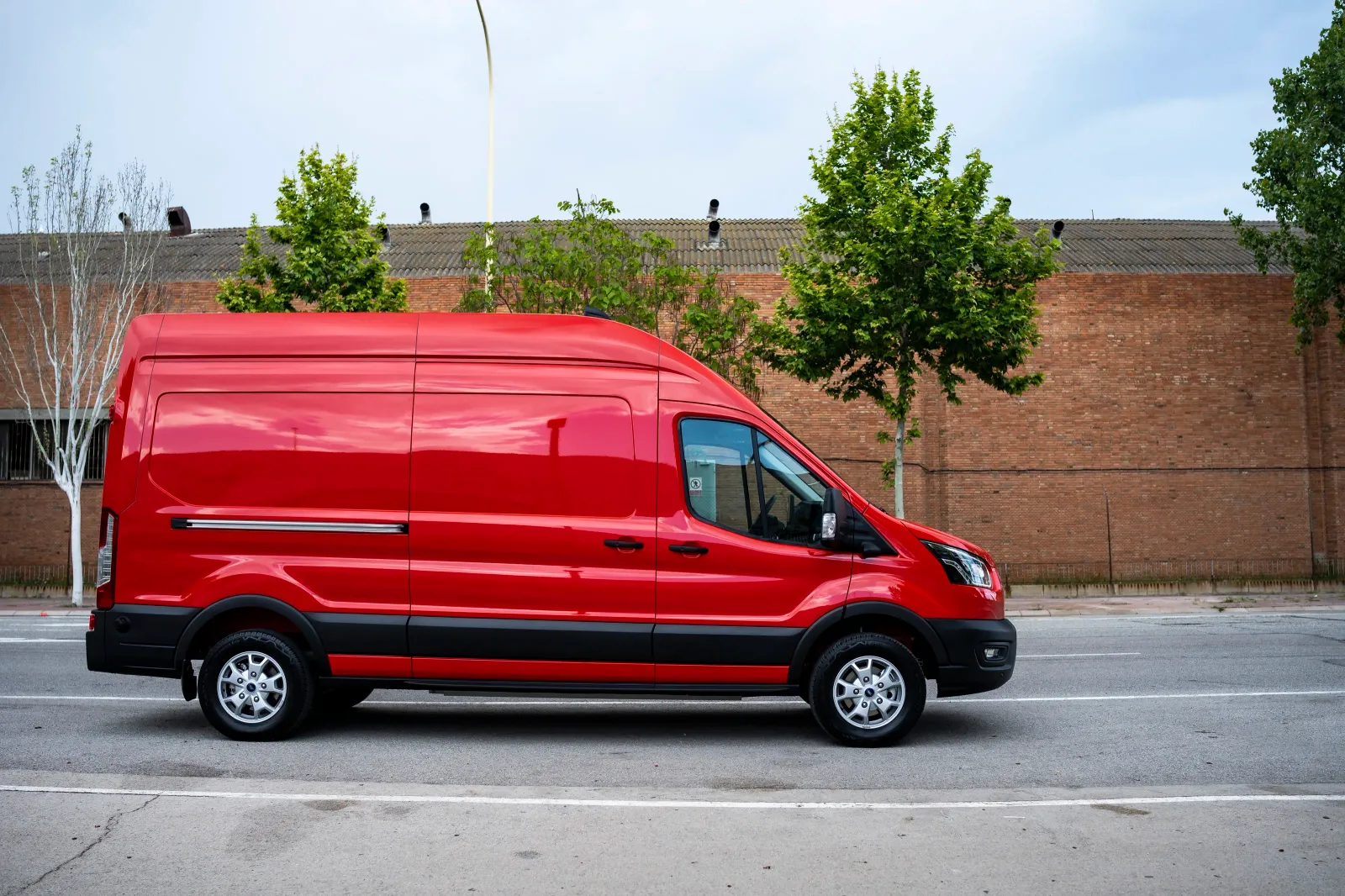
The Volkswagen e-Transporter with a 70 kWh battery achieves a maximum range of 362 km WLTP.
Against this backdrop, Kia’s claimed range of over 460 km looks very promising, along with a charging time of around 20 minutes. However, it should be remembered that the PV7 will not go on sale until the second half of 2027. Thus, competitors still have time for further improvements.
A total of as many as 23 variants
The PV7 Cargo Long and PV7 Passenger Long shown in Hanover are just the beginning.
Kia aims to offer as many as 23 variants in the end. The lineup will include Cargo Compact, Long, and High Roof models, as well as Compact and Long passenger versions, plus a chassis with a cab designed for further customization. A separate conversion center and external partners are set to support the production of these special editions. Additionally, the additional equipment can be controlled from inside the vehicle.
In 2029, Kia’s range of commercial electric vehicles is expected to expand with another model, the PV9.
The PV7 will be launched first. The Cargo and passenger versions are scheduled to arrive in Europe in the second half of 2027, with more variants following later. Kia has not yet disclosed prices or details regarding its Polish offering. We’ll have to wait—besides technology, factors such as purchase cost, financing, energy usage, and maintenance over several years of intensive use will determine its success.
Piotr Sobczyk