
Electric cars cost 33% less than gasoline cars.
Last year, operating electric vehicles in the EU was 33 percent cheaper than operating gasoline cars. This is shown by the “EV Transition Check” study conducted by the renowned think tank ICCT. Given the oil crisis, the cost difference is likely to be even larger this year.
The International Council on Clean Transportation (ICCT) highlights Europe’s progress toward zero-emission vehicles in the latest edition of its annual “EV Transition Check.” One of the key findings is that, with declining battery costs and still high fuel prices, electric vehicles (BEVs) are already significantly cheaper to operate on a daily basis than internal combustion engines.
"Drivers of electric cars in Europe pay about one-third less than drivers of gasoline-powered vehicles. These savings are significant and explain why the automotive market continues to move in this direction. We expect the adoption of battery-electric cars in Europe to increase in the coming years, assuming the current policies are maintained," says Marie Rajon Bernard, lead researcher at ICCT and principal author of the report.
Even cars that can only be charged publicly are much cheaper
It’s worth looking at the details: ICCT compared electric cars that were charged both at private and public charging stations with gasoline-powered cars in the EU for this comparison. The result showed that electric cars were 33 percent cheaper to operate in 2025 than their gasoline counterparts. Even electric cars charged only at often expensive public charging stations were still 28 percent cheaper than gasoline cars. The oil crisis that began in February 2026 further widened this gap. By early 2026, energy costs for gasoline-powered cars rose by 12 to 36 percent, while those for BEVs remained largely unchanged.
What’s important for cost comparison: Recently, the prices of electric cars have dropped significantly. By 2025, they had already reached the level of gasoline-powered cars in the three largest vehicle segments. This is supported by price data from 100,000 vehicles in Europe’s largest automotive market, Germany. At the same time, the range of electric cars has increased substantially: the number of BEV models available on the market quadrupled between 2020 and 2025.
Electric cars becoming cheaper due to falling battery costs
Lowering battery costs create room for lower prices on BEVs: Globally, battery costs dropped by 35 percent between 2020 and 2025. As a result, the purchase costs of battery-electric cars in Germany — adjusted for inflation and vehicle features such as range — fell by 18 percent during the same period. In contrast, prices for vehicles with internal combustion engines rose by 2 percent. It is also interesting to see how European automakers have increased the production of electric cars over the past few years. By 2025, the market share of fully electric powertrains had already reached 18 percent.
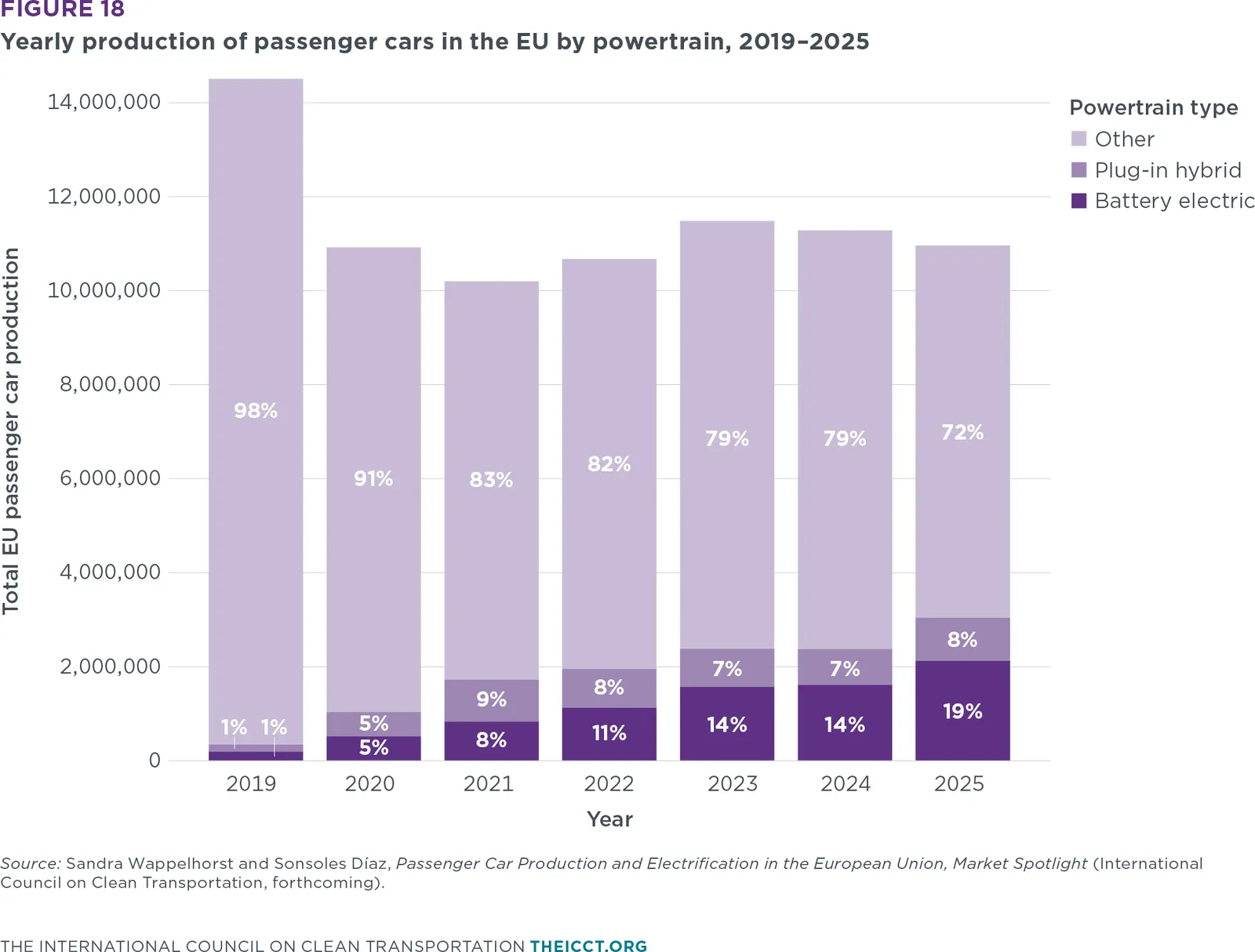
We have observed that vehicle prices have not dropped as quickly as battery costs; this suggests that electric cars could become even cheaper in the coming years. This is a critical moment for automakers around the world. Instead of changing course, European manufacturers must maintain and increase their investments in electrification. Competition in this market will intensify,” says Peter Mock, director of ICCT Europe.
Electric trucks in Germany cheaper than diesel trucks
The figures for trucks are also impressive: electric trucks and diesel trucks could achieve cost parity in long-haul transport within the EU by 2030. Germany has already reached this point thanks to toll exemptions for electric trucks. As a result, the costs of purchasing and operating an electric truck in long-haul transport in Germany are currently 11 percent lower than those of a diesel truck.
The ICCT’s “EV Transition Check” considers not only the costs of electric vehicles but also the environmental aspects of their market growth: over their entire lifecycle, electric cars emit 73 percent less greenhouse gases than gasoline vehicles — a significantly better figure than that in the controversial whitepaper by TU Munich. For battery-electric long-haul trucks, the CO2 reduction is even estimated to be 86 percent compared to diesel trucks. In contrast, plugin hybrids (PHEVs) show a rapidly widening gap between actual emissions and the values approved at the time of type approval (on average about 4.6 times higher) — this is referred to as the “Utility Factor.”