
Electric Car Satisfaction Study 2026: Major Differences Among Brands
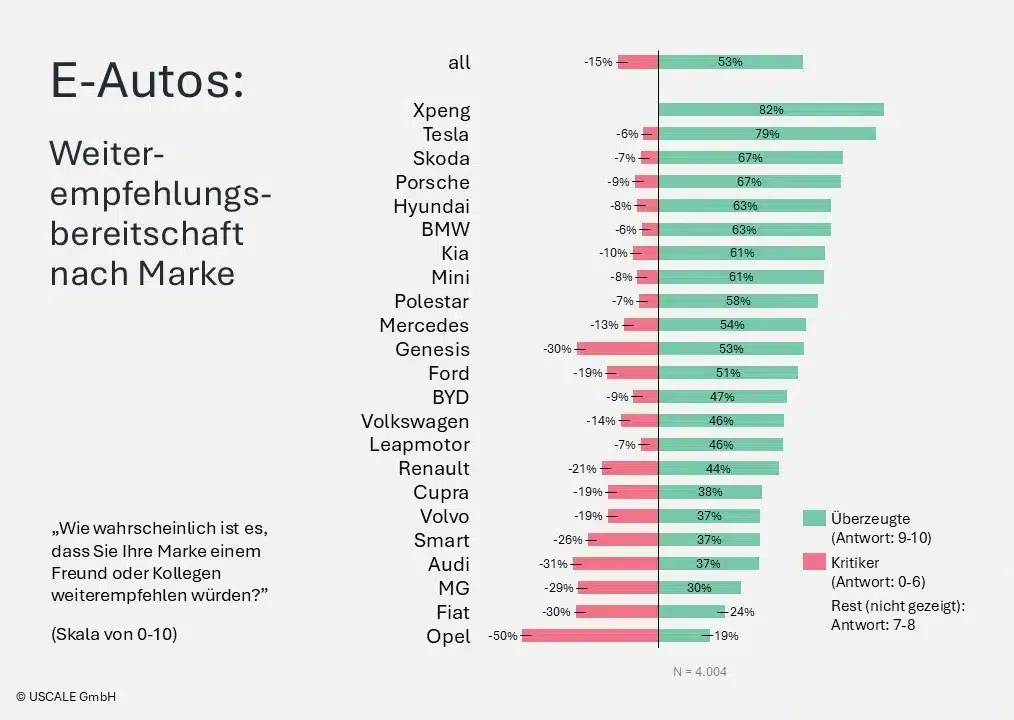
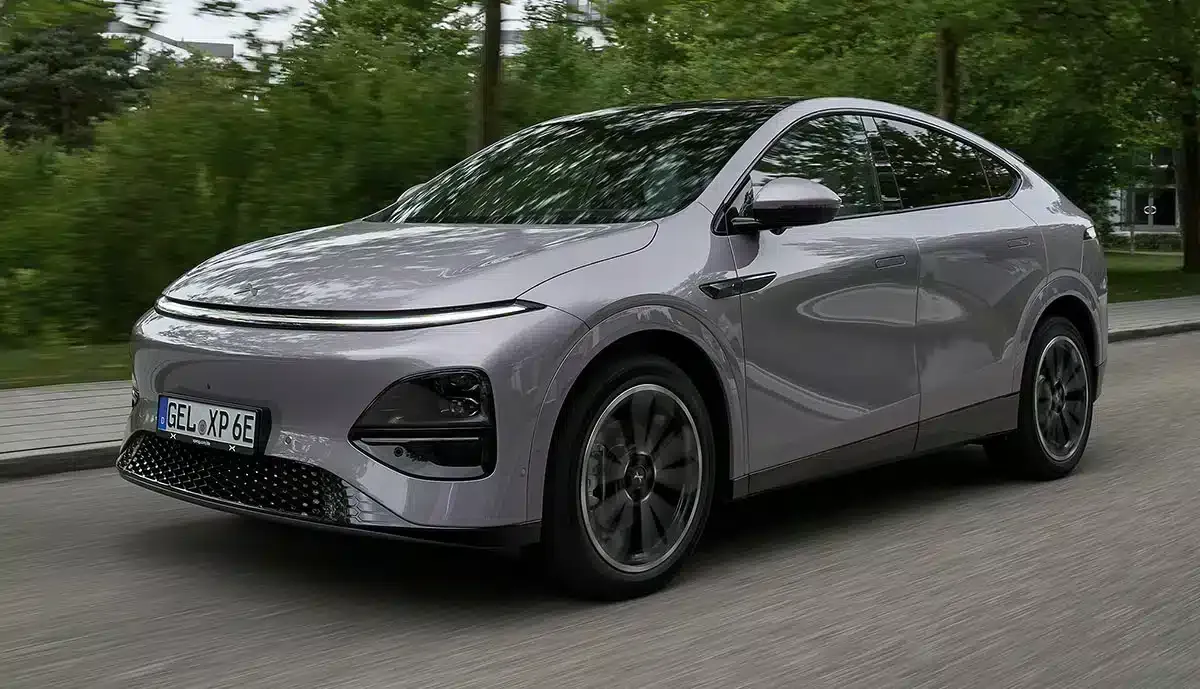
Image: XPeng
According to a survey by market researcher UScale, drivers’ satisfaction with all-electric models is rising for the third consecutive year. The so-called Net Promoter Score (NPS), a metric indicating willingness to recommend, increased from 33 to 38 points in this year’s “UScale EV Satisfaction Study 2026” compared to the previous year. This represents the highest value since the start of the tracking period.
Across all brands, 53 percent of respondents would actively recommend their vehicle, 15 percent would advise against it, while the remaining 32 percent are neutral.
Manufacturers continue to make progress in range and charging speed. 59 percent of vehicle owners now report an actual summer range of over 400 kilometers (2025: 50 percent). 77 percent of electric cars have a DC charging capacity of 150 kW or more (2025: 75 percent). At the same time, expectations are rising.
Only 75 percent now consider a 400-kilometer summer range to be good or very good (2025: 79 percent), with only 15 percent still viewing it as very good. In 2023, this figure was double. The trend is even more pronounced when it comes to charging: Only 58 percent now consider a 150 kW charging capacity to be good or very good (2025: 65 percent).
Charging remains the biggest challenge
Despite all advances in technology, charging remains the biggest challenge in everyday life. 71 percent of respondents reported problems with charging (2025: 73 %). The most frequently cited issues were difficulties starting the charging process and unexpectedly low charging speeds. Finding charging stations through navigation systems also performed poorly: only 43 percent considered this feature well implemented, while 56 percent felt it needed improvement.
Even with the often-criticized car software, no breakthrough has been achieved yet. 48 percent of electric vehicle owners report issues with their Connect app (2025: 50 percent). The differences between brands are enormous: only 8 percent of Tesla owners report app problems, while 92 percent of Opel owners do. When asked where manufacturers should improve, software quality ranks first at 44 percent, ahead of charging speed (42 percent), the Connect app (39 percent), route planning (35 percent), and range (34 percent). While range, fuel consumption, and charging speed have improved compared to the previous year, software quality is criticized even more frequently than in 2025.
A new annoyance are the warning and alert sounds in vehicles. Half of those surveyed feel disturbed by them. The variation across brands shows this is a design choice rather than a technical necessity: only 29 percent of Mini owners feel disturbed, while around 80 percent of Kia and Hyundai owners do. Just the warnings from driver assistance systems disturb 30 percent of all respondents.
Significant differences among brands
The willingness to recommend varies greatly depending on the brand. XPeng maintains its leading position. Tesla returns to second place after finishing sixth last year, followed by Skoda and Porsche. At the bottom of the rankings are once again brands from Stellantis, including Opel and Fiat, as well as MG. Chinese manufacturers show a mixed performance: XPeng leads, while BYD and newcomer Leapmotor rank in the middle tier, and Smart and MG fall short of expectations.
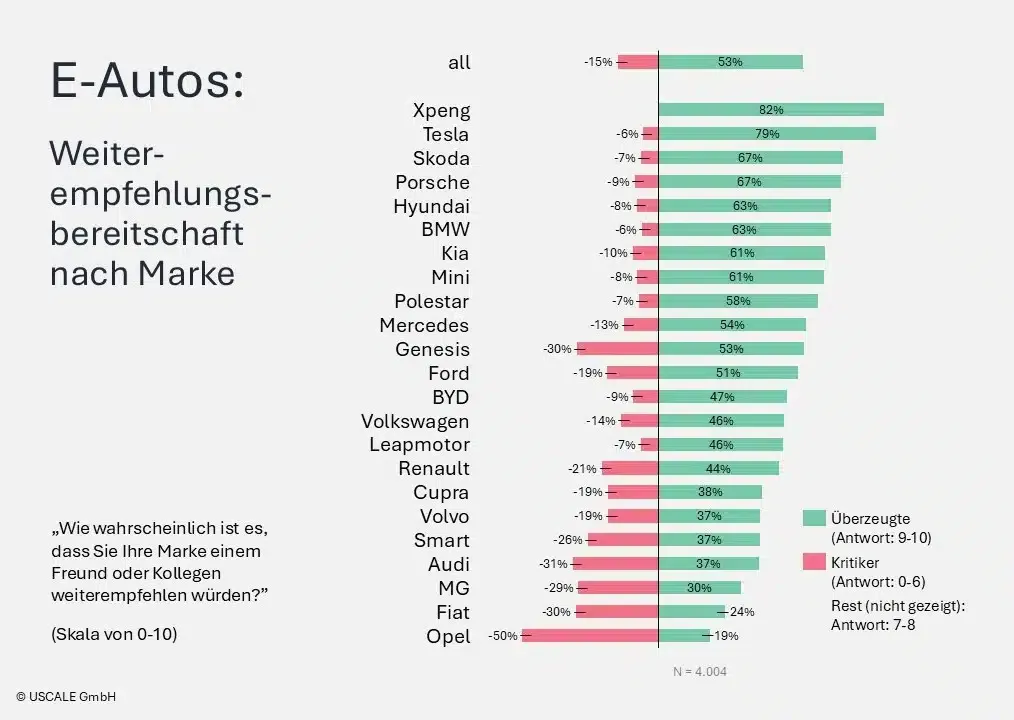
Depending on the brand, respondents identify different strengths and weaknesses:
Xpeng far exceeds the average in almost all categories. Customers are particularly impressed by its charging speed, charging management, and range. The Connect app has improved significantly compared to the previous year. Route planning remains its biggest weakness, and fuel efficiency is criticized more often than in 2025.
Tesla returns to second place, excelling in almost all electric vehicle-related areas, especially software, the Connect app, route planning, and fuel efficiency. Charging speed remains a critical issue, with more than half of Tesla owners expressing dissatisfaction. There are also complaints about sound and build quality, though these have improved. Many other improvement requests relate to driver assistance systems.
Skoda rises to third place. The Elroq outperforms the Enyaq in almost every aspect. Drivers still see room for improvement in route planning and software quality.
Porsche continues to excel with high charging speeds and superior build quality. Software quality and route planning are rated below average.
Hyundai stands out with long range and fast charging speeds, improving in nearly all areas.
BMW scores well in software, the Connect app, route planning, and charging management. The “new class” available since mid-2026 is not included in this study.
Kia excels with good range and significantly improved software quality. Route planning remains a weakness.
Polestar continues to excel with its user interface, route planning, and Connect app. Customers identify issues with fuel consumption, software quality, and noise insulation.
Mercedes makes significant progress with the new MMA platform in models like the CLA and GLB, improving range, fuel efficiency, and charging speed. The Connect app receives above-average ratings. However, software and build quality are more frequently criticized than in previous years, especially in the new models.
Ford benefits from the Explorer, which outperforms the Mustang Mach-E in most aspects. The brand has seen notable improvements in fuel consumption compared to last year. The Connect app remains a major weakness, and charging performance is also criticized.
BYD’s users praise its impressive software, Connect app, and route planning features. While there has been progress in charging speed, drivers still see significant room for improvement in this area as well as in fuel efficiency and usability.
Volkswagen falls below the average overall. The ID.7 outperforms the ID.3, ID.4, and ID.5 with better range, lower fuel consumption, and faster charging speeds. However, software and the Connect app remain major weaknesses for the brand.
Leapmotor makes its debut in the ranking and starts in the middle tier. Customers commend its range and Connect app, but they believe there is much room for improvement in the user interface and route planning.
Renault excels in route planning and software. However, slow charging speeds and issues with the Connect app pose challenges for the brand.
Cupra remains below average. Despite improvements in the Connect app, the brand continues to struggle with issues related to its apps and software, and its charging performance is also criticized.
Volvo stands out with its Google-based route planning. Fuel consumption has improved compared to the previous year, but it remains, along with range and software, the biggest point of criticism.
Smart excels in charging performance, range, and charging management. Drivers see significant room for improvement in fuel consumption, route planning, software, usability, and the app.
Audi has made notable improvements in range and charging performance with the A6/Q6 e-tron. Meanwhile, its software is criticized even more frequently than in the previous year. The Connect app and vehicle quality also fall far short of expectations.
MG excels in range and features but shows significant weaknesses in software and the Connect app.
Fiat continues to stand out for its low fuel consumption. Major issues arise in terms of range, charging management, and the Connect app.
Opel once again finishes at the bottom. 92 percent of Opel drivers report problems with the Connect app, along with serious shortcomings in charging management, software, and usability.
Also interesting
About the author
Thomas Langenbucher is an expert in electric mobility with experience in the automotive and financial industries. Since 2011, he has been covering electric vehicles, sustainable technologies, and mobility solutions for ecomento.de. Learn more.
Reader interactions