Electric vehicle innovation ranking: Geely ahead of Volkswagen and BYD
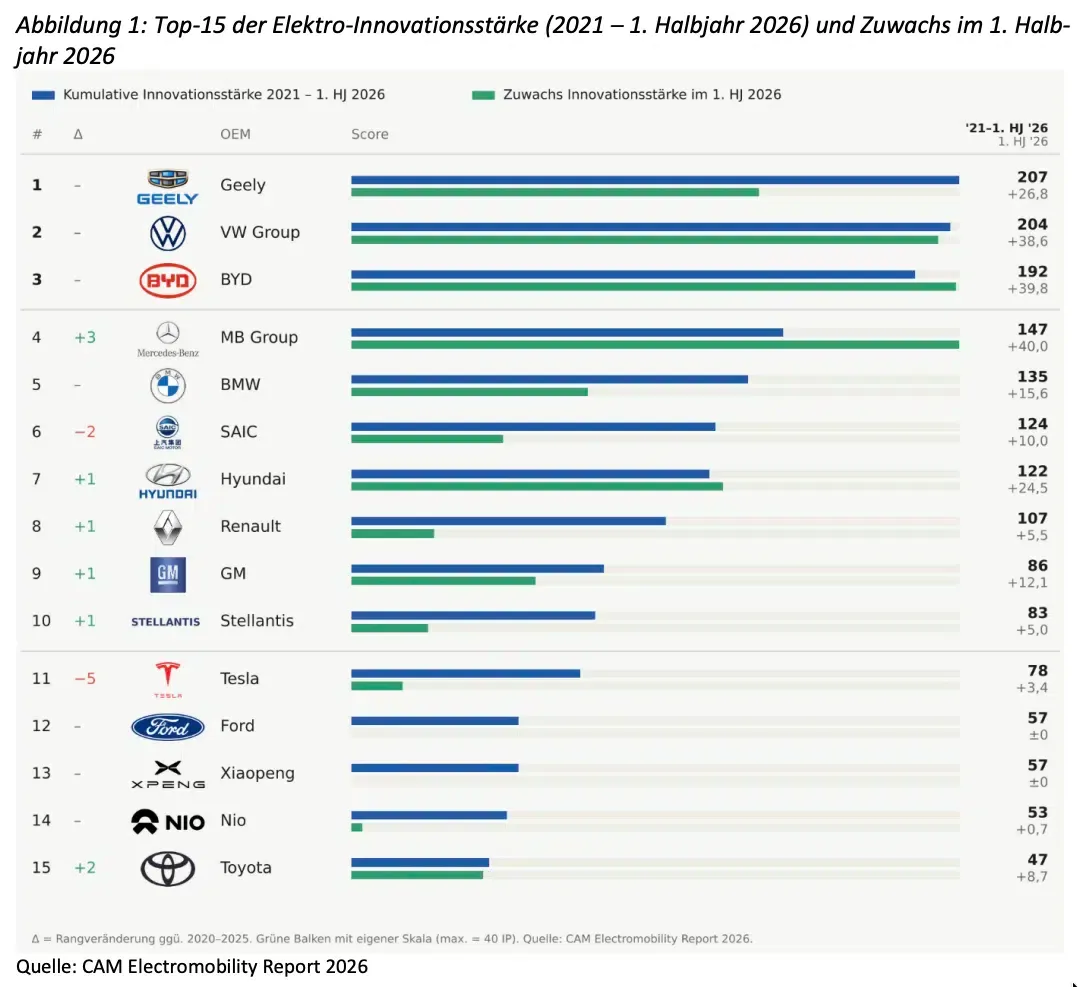
According to the Center of Automotive Management’s (CAM) “Electromobility Report 2026,” the ranking of the most innovative electric vehicle manufacturers remains dominated by Chinese and German companies. In the current research period from 2021 to the first half of 2026, a total of 910 series innovations in the field of electromobility were identified and evaluated by 38 automaker groups.
The leader in innovation within electric mobility is the Chinese Geely Group, with 207 index points (IP), just ahead of the Volkswagen Group (204 IP) and China’s BYD (192 IP). Two other German manufacturers, the Mercedes-Benz Group (147 IP) and BMW (135 IP), also make it into the top 5.
The biggest mover up from the previous ranking is the Mercedes-Benz Group, which improved from 7th to 4th place. SAIC from China declined, falling from 4th to 6th place with 124 IP. Hyundai (122 IP), Renault (107 IP), General Motors (86 IP), and Stellantis (83 IP) complete the top 10 of the most innovative electric vehicle manufacturers, each advancing by one position.
Tesla dropped from 6th to 11th place, marking the first time since the start of the electric vehicle ranking in 2016 (Tesla: 1st place) that it is no longer among the top ten most innovative electric vehicle manufacturers. Japanese automakers also remain weak in the field of electric mobility: Toyota improved to 15th (from 38th) among the manufacturers, while Nissan ranked only 18th and Honda at 22nd.
German automakers will thus continue their technological catch-up with Chinese electric vehicle manufacturers in the field of electrification during the first half of 2026. Mercedes-Benz, Volkswagen, and BMW are among the six most innovative manufacturers in this period.
Based on 120 evaluated series innovations, both the Mercedes-Benz Group and BYD score around 40 index points each. The Volkswagen Group follows closely with 39 IP points, and it launches the most new products by a large margin with 24 series innovations. Mercedes-Benz achieves such high innovation levels despite only having 14 new products, while BYD has only 10. “Both excel through particularly high-quality individual innovations,” explain the CAM analysts. Geely follows with 27 IP points, ahead of Hyundai (24 IP), BMW (16 IP), and General Motors (12 IP).
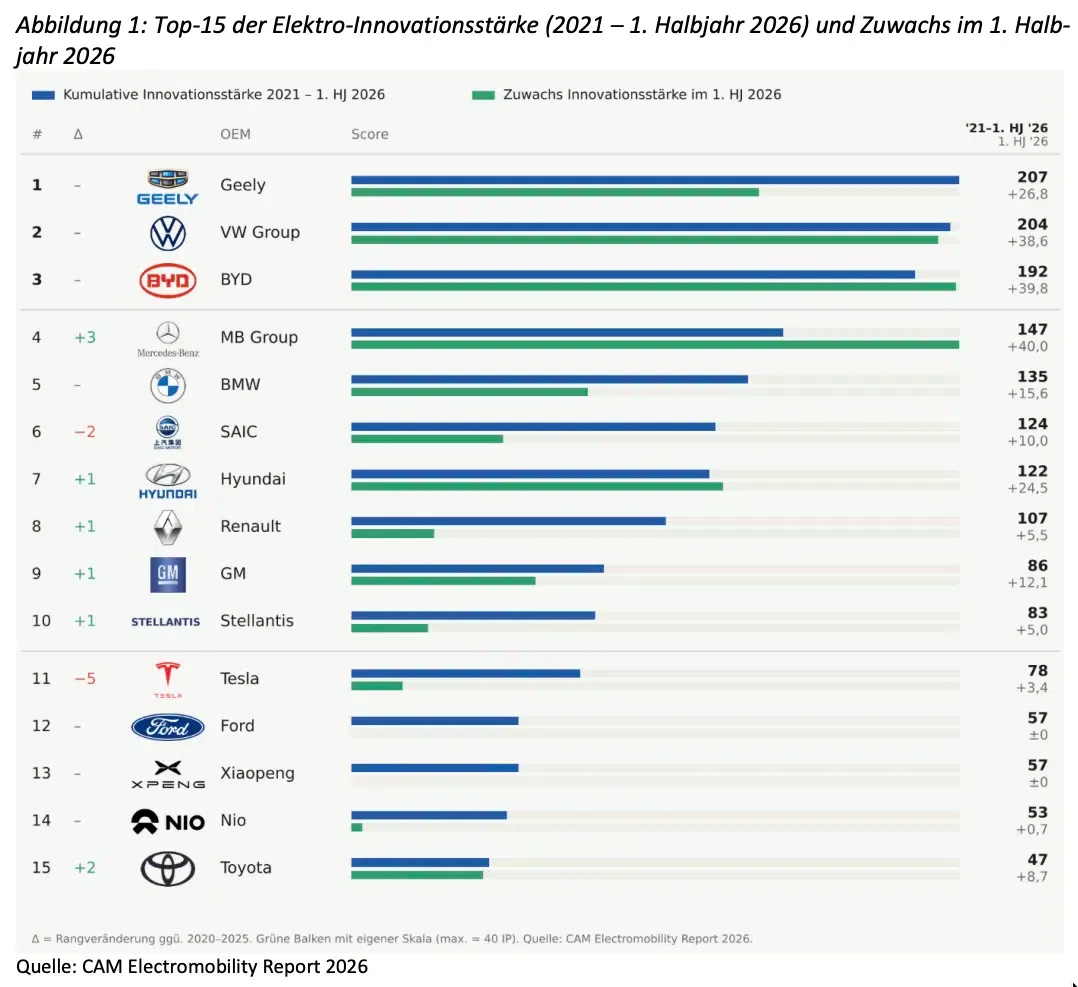
The innovations introduced in the first half of 2026 focus primarily on key customer criteria such as range, charging speed, and fuel efficiency, as well as the electric ecosystem (V2H, V2G). Mercedes stands out with its high range in various model segments (EQS, VLE) and offers bidirectional charging functions (Vehicle-to-Grid/V2G, Vehicle-to-Home/V2H), similar to BMW.
BYD is a leader in fast charging with its “Flash-Charging” technology, achieving a charging power of up to 1500 kW through a single port using the Denza Z9 GT. The European version can charge from 10% to 97% in about nine minutes, even at minus 30 degrees Celsius. Geely’s Lynk & Co 10+ delivers up to two kilometers of range per second thanks to its optimized ultra-fast charging, and it can charge from 10% to 97% in less than nine minutes. On fuel efficiency, the VW ID.3 Neo stands out: a new APP350 electric motor, a more efficient powertrain, and intelligent thermal management increase the range of its 79-kWh battery to an industry-leading 629 kilometers (WLTP), with a fuel consumption of just 14.3 kWh/100 km.
"Innovation leadership in electric mobility will continue to be shaped primarily by Chinese and German manufacturers. Particularly noteworthy is Mercedes-Benz’s catch-up effort, while Geely and BYD have demonstrated strong innovation capabilities over an extended period. In contrast, Tesla is falling significantly behind in the innovation race," says study leader Stefan Bratzel.
"What matters now is no longer just who offers electric cars, but rather who brings the most compelling overall packages to market in terms of range, charging speed, efficiency, and cost. Chinese manufacturers are increasingly showing that they can translate their technological strengths into market share, even in Germany now. A doubling of their new electric car registrations is a clear warning sign for established manufacturers."
Global BEV sales comparison among automakers
A relationship can be observed between electric vehicle innovation capabilities and global sales, though it is not consistent across all cases. Chinese manufacturers BYD, Geely, and SAIC, along with U.S. company Tesla and the Volkswagen Group, are among the world’s top electric vehicle producers.
BYD remains the world’s leading seller of electric vehicles with 867,000 units sold, but it saw a decline of about 15% compared to the previous year. Reasons include the end of government subsidies and intense price competition in China. Tesla is closely behind at 838,000 units (+16%). Chinese companies Geely (571,000) and SAIC (540,000) still account for three of the top five BEV manufacturers globally. The Volkswagen Group completes the top 5 with 438,000 units (−6%).
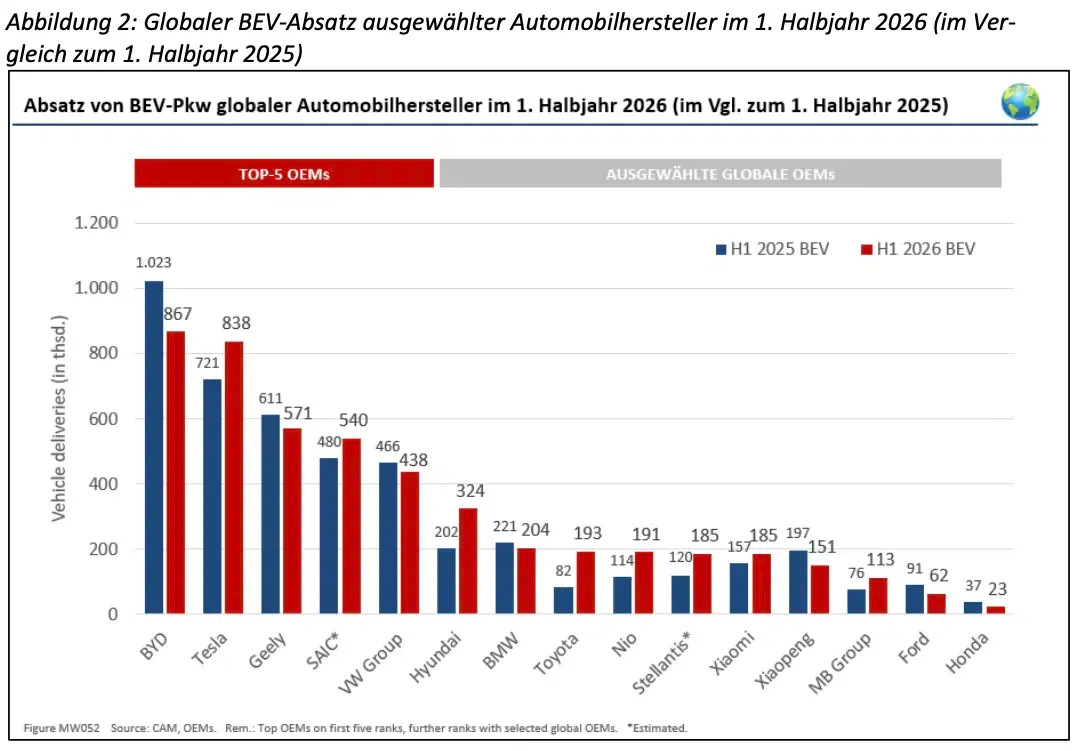
Toyota (+135 %), Nio (+68 %), Hyundai (+60 %), and the Mercedes-Benz Group (+49 %) are the ones showing strong growth. For Mercedes-Benz, the leader in half-year innovation strength, this surge in innovation is accompanied by a significant increase in sales. In contrast, Xiaopeng/XPeng (−23 %), Ford (−32 %), and Honda (−38 %) experienced substantial declines.
Germany: Electric vehicle market grows strongly, with Mercedes and Chinese manufacturers leading the way
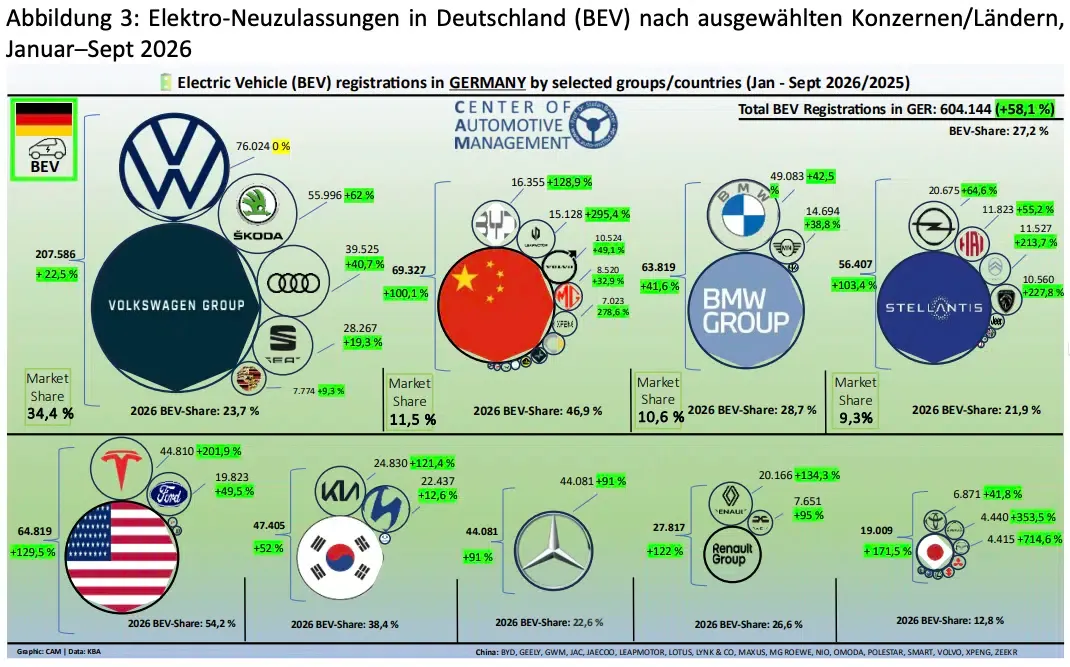
In Germany as well, electric mobility is gaining momentum rapidly. From January to September 2026, 604,144 battery-electric cars were newly registered, representing a 58.1 percent increase compared to the same period last year. The share of BEVs among all new registrations rose from 18.1 percent to 27.2 percent.
The Volkswagen Group remains the clear market leader with 207,586 electric vehicles (+22.5%), but it is growing much slower than the overall market. Its share of Germany’s BEV market declines from around 44% to 34.4%. The core VW brand stagnates at the previous year’s level with 76,024 units, while growth comes mainly from Škoda (+62%) and Audi (+40.7%).
The competitors are developing much more dynamically. Chinese manufacturers double their BEV registrations to 69,327 units (+100.1%) and raise their market share from around 9% to 11.5%. According to CAM, Leapmotor is particularly notable, having sold nearly as many electric vehicles as BYD (16,355 units) with 15,128 units (+295%).
Stellantis (+103% to 56,407 units) and the Mercedes-Benz Group (+91% to 44,081 units) are also growing far above average. Mercedes-Benz, the leader in innovation strength during the first half of the year, increased its share of the BEV market from 6.0% to 7.3%. BMW also saw growth with 63,819 units (+41.6%), but its market share declined slightly (from 11.8% to 10.6%). The U.S. brands recorded the strongest growth with 64,819 units (+129.5%), driven primarily by Tesla (+202%).