
ElectroFleet orders 40 MWh battery storage systems from Fenecon
ElectroFleet is expanding its growing network of charging stations for electric trucks by adding stationary battery storage systems. The company is initially obtaining systems with a total capacity of 40 MWh from Fenecon for use at warehouses and public charging parks. An additional 100 MWh is already in the planning stage.
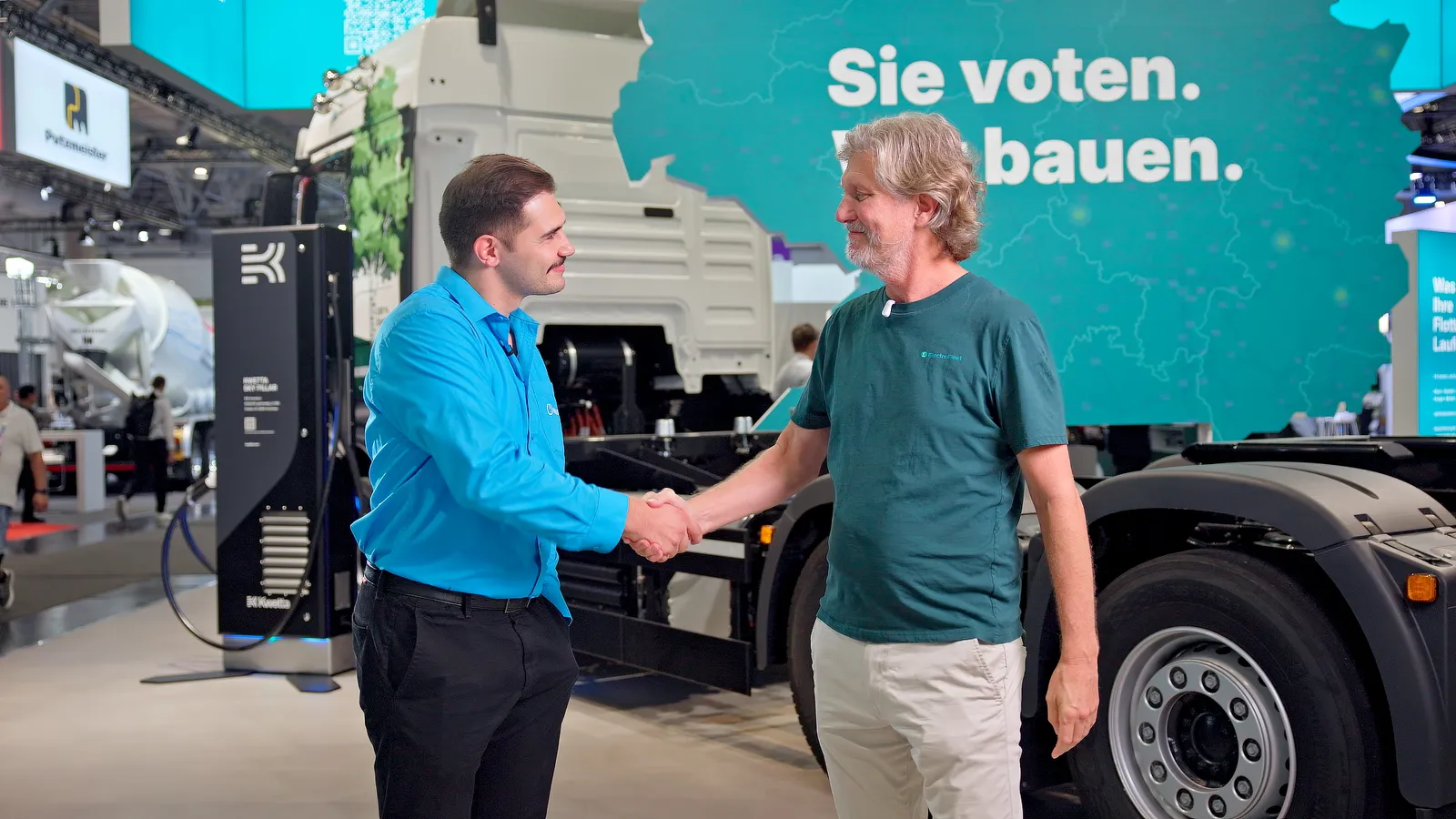
Ludwig Igl from Fenecon (left) and ElectroFleet CEO Mark Hellmann Regouby.
Image: ElectroFleet
The battery storage system used is the Fenecon Industrial XL. According to the companies, a field test at ElectroFleet’s site in Bielefeld preceded this decision. The partners have not disclosed how many storage units or locations will be covered by the agreed 40 MWh capacity, nor when installation is expected to be completed.
A potential application area is customer depots with limited grid connection capacity. There, the storage systems are intended to mitigate peak loads during charging and provide additional charging capacity for electric trucks when a stronger grid connection is not available or has not yet been installed.
In addition, the storage systems are planned to be integrated into ElectroFleet’s public truck charging network. Earlier this September, the company based in Osnabrück presented its concept for so-called on-demand charging parks, which are supposed to be established at locations chosen by fleet operators based on demand. Sharing models among multiple fleets are also envisaged. A charging park equipped with MCS charging points is currently under construction at ElectroFleet’s headquarters in Osnabrück. The battery storage systems are intended to support high charging rates at such locations and reduce peak loads on the grid connection.
Batteries Become Part of Energy Management
The Fenecon systems are intended not only to compensate for limited grid capacity. ElectroFleet plans to integrate these batteries into its energy management system and control them based on power generation, charging demand, and market prices. The company operates as an electricity supplier and claims to run a nationwide virtual power plant that combines generation facilities, batteries, and controllable charging processes.
This allows locally generated solar power to be stored temporarily, shifting electricity usage for charging to cheaper times. ElectroFleet also intends to use this combined flexibility for grid balancing services. Fleet operators are expected to see reduced electricity and grid costs as a result. The company does not provide specific figures for the savings.
Collaboration with Fenecon is thus part of ElectroFleet’s Charging-as-a-Service model. The company finances, builds, and operates charging infrastructure for truck fleets and connects them to energy supply and procurement systems.
The initially agreed 40 MWh is not intended to be the final capacity for storage expansion. ElectroFleet states that it already has additional projects with a total capacity of 100 MWh in development. The timeline for implementing these remains unspecified.
_Source: Information via email_