
BYD’s most powerful hybrid 4x4 SUV is 9,000 euros cheaper than the Defender: we tested the Denza with 544 HP and a range of 835 km
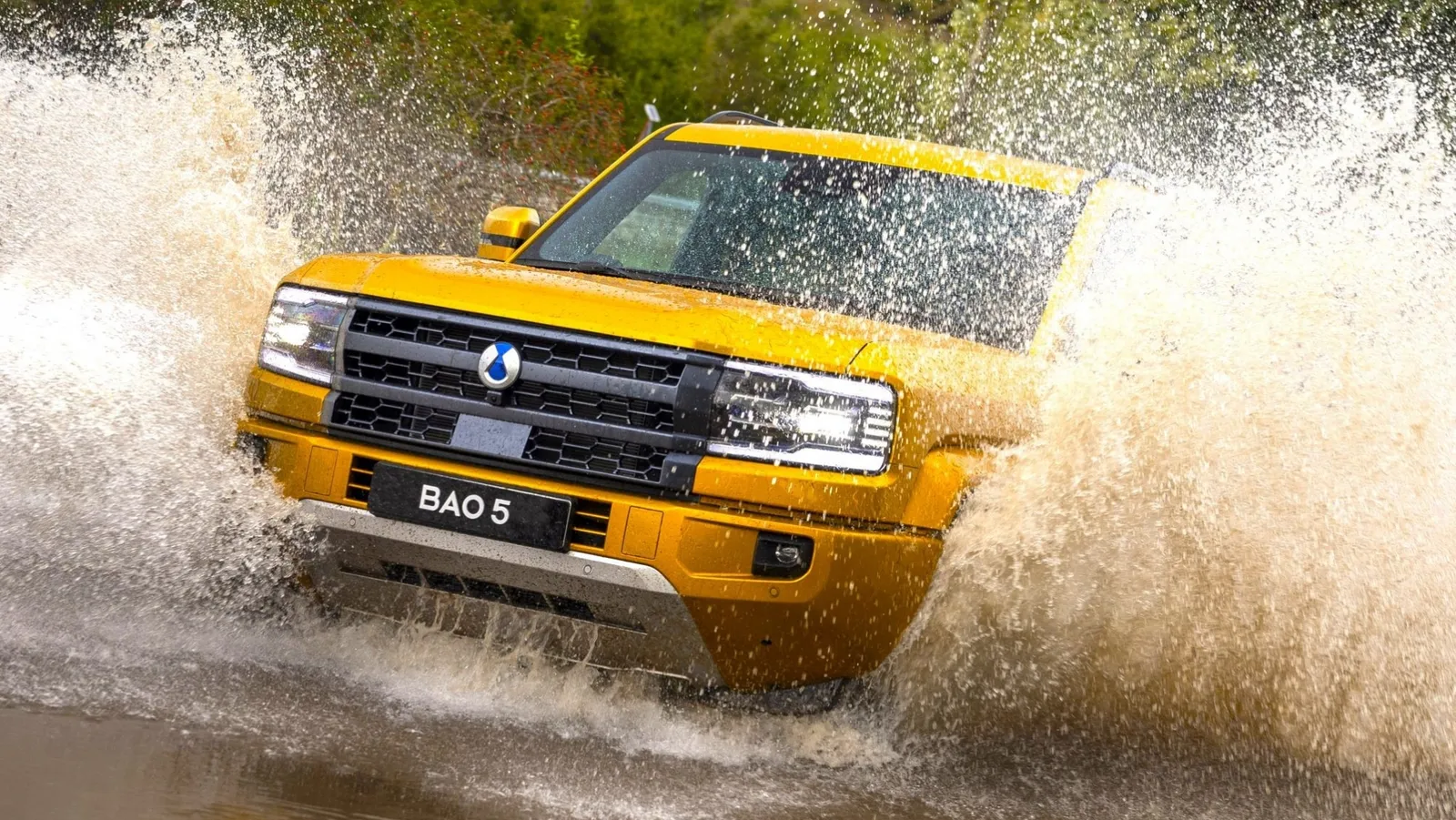
Denza, BYD’s luxury brand, launches its third model in Spain: a powerful plug-in hybrid SUV with 4x4 drive named the BAO 5. BYD unveiled it at last year’s Goodwood Festival, where it impressed with its impressive specs—544 horsepower, three engines, a range of 835 km, and fuel consumption of just 4.1 L/100 km.
Now, we’ve just had the chance to test it... and we can say it’s on par with a Land Rover Defender—indeed, this Chinese SUV is more powerful and offers better performance—but it’s almost 9,000 euros cheaper than the equivalent British 4x4.
544 horsepower and 835 km of range: a highly efficient plug-in hybrid
BYD sells this 4x4 SUV in Europe under its Denza brand, although in China it is marketed under the Fang Cheng Bao logo, its specialized 4x4 brand. After testing it, we understand why it is sold by a specialized brand, and why BYD uses the Denza name on the Old Continent — we have already tested its best car under that brand.
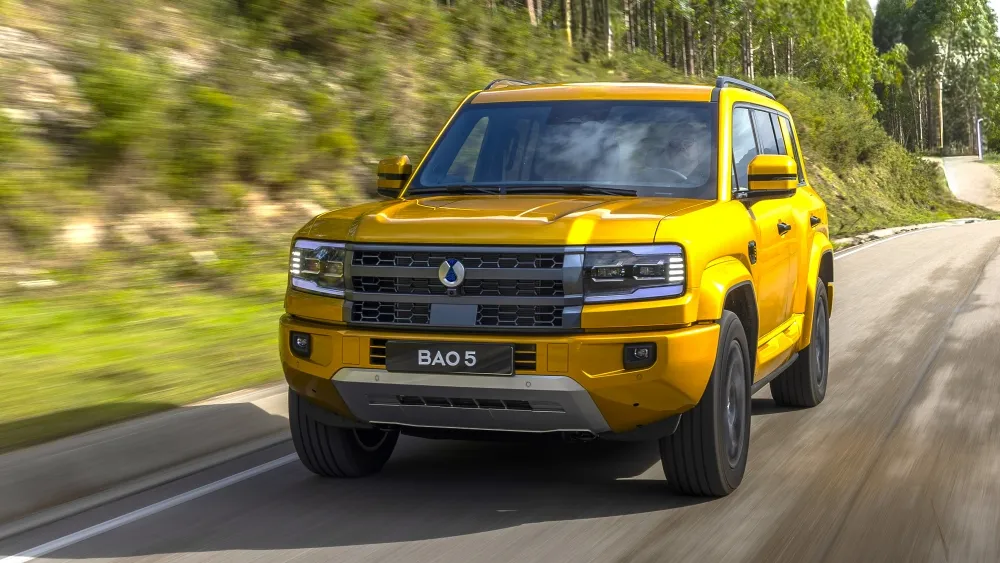
The new BYD / Denza is an SUV that measures up to 4.92 meters in length, 1.97 meters in width, and 1.93 meters in height; it also features a wheelbase of 2.8 meters and a trunk capacity of 475 liters, which can be expanded to 1,069 liters by folding down the rear seats; it reaches 1,736 liters if measured to the roof.
The most notable feature of this SUV is its plug-in hybrid system, which consists of a 1.5 L turbocharged four-cylinder engine producing 110 kW / 150 hp, paired with two electric motors—one per axle—delivering 272 hp and 388 hp respectively. Together, they generate a total power of 544 hp and a torque of 760 Nm, enough to accelerate from 0 to 100 km/h in 4.8 seconds or reach an electronically limited top speed of 180 km/h.
The powertrain is also paired with a 31.8 kWh LFP battery that provides 90 km of pure electric range, bringing the total range of this 4x4 SUV to 835 km. This battery can be charged at up to 100 kW, resulting in a charging time of 16 minutes for 30 to 80% charge. At alternating current, the maximum charging capacity is 11 kW, allowing it to be charged in just over 3 hours.
Lastly, this plug-in hybrid SUV BAO 5 comes standard with V2L technology, which enables connecting and charging electrical devices directly to the vehicle’s charging port.
A robust design and a spacious interior for four
Featuring a design inspired by traditional, rugged 4x4s of the past — including a spare tire hanging from the rear hatch with side access; this SUV offered by Denza exudes a formidable presence... along with a camper-like vibe that extends inside the vehicle.
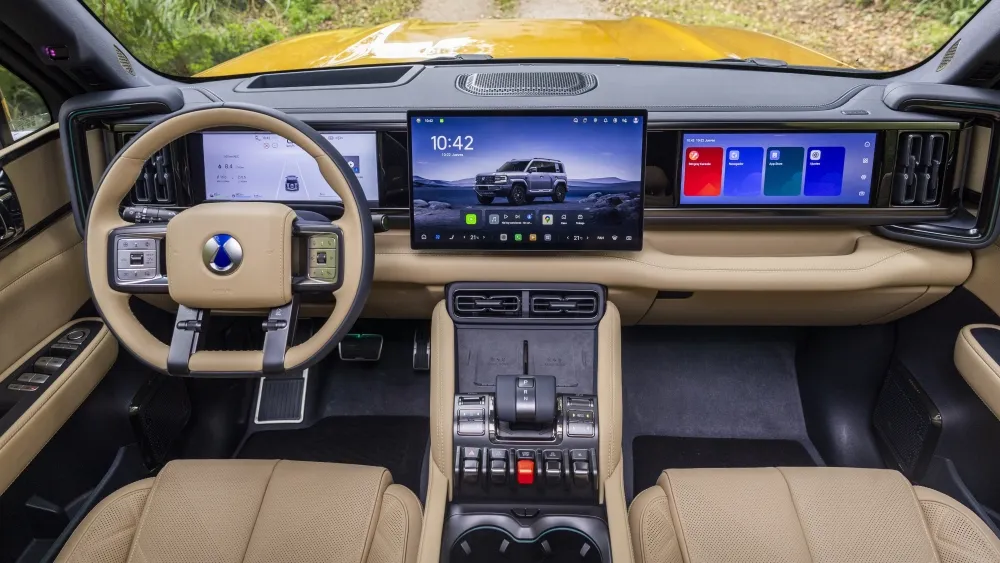
Inside, it boasts an interior crafted from high-quality plastics and well-fitted components, complete with plush trims, comfortable touch controls, and an attractive leather upholstery.
The dashboard, which provides multiple gripping points, stands out with three screens as standard and a HUD system that projects data onto an equivalent 50” display on the front windshield. The driver has access to a 12.3” digital instrument cluster and a 15.6” central multimedia screen, while the passenger is provided with a rectangular 12.3” multimedia screen as well.
The steering wheel is also noteworthy, featuring up to 12 buttons and four rotary selectors, two of which control the driving modes—Eco, Normal, and Sport—as well as programs for navigating various types of terrain.
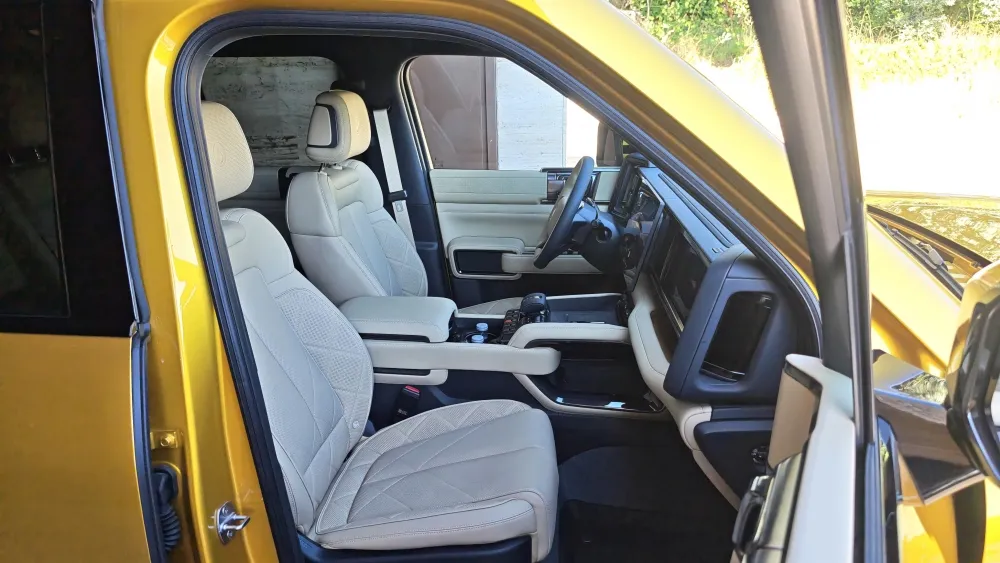
The front seats, which are electrically heated and ventilated as standard, offer comfort along with good lumbar support. Overall, the width is impressive for two tall occupants, as they won’t find their knees hitting the center console due to its raised design, which creates a gap between its lower and upper sections.
In this area, we find up to two 50 W wireless chargers for smartphones and the gear shift lever—which folds inside the console when the car is turned off. Next to it, there’s a set of physical controls that allow adjustment from the air suspension settings to the differential lock, audio system volume, starting and stopping the vehicle, or activating the hazard lights.
While the most innovative feature is the fridge, with a capacity of 4.5 liters, located in the center console beneath the armrest. It functions as a fridge that can cool down to -6ºC, as well as a heater that reaches 50°C.
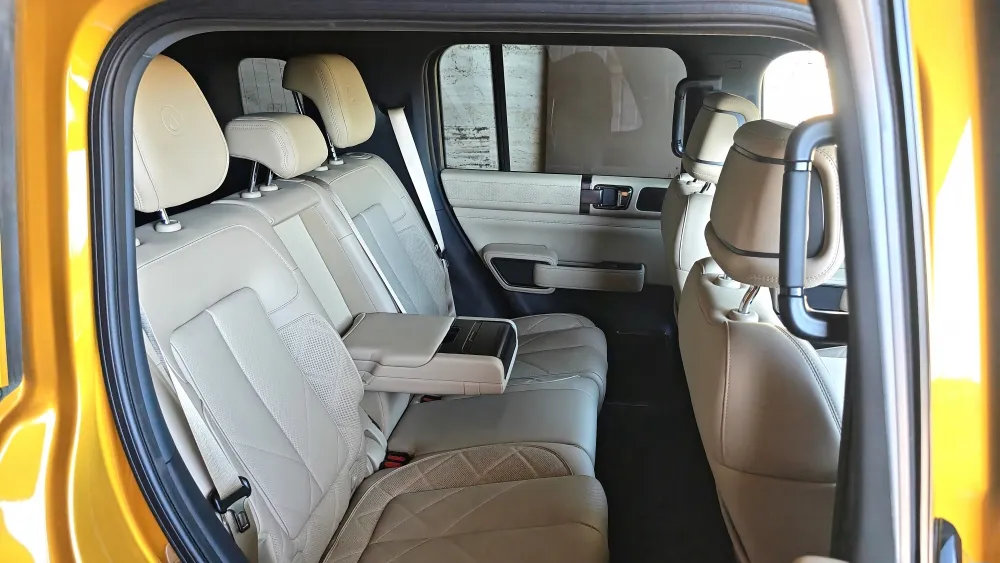
But what really sets the interior of this SUV apart is its headroom, suitable for passengers over 1.95 meters tall, even though the entire range comes standard with a panoramic roof—which always reduces the cabin height by a few centimeters.
That height is also a huge advantage in the rear seats, which offer considerable legroom—four passengers over 1.90 or even 1.95 meters tall can travel very comfortably in this plug-in hybrid SUV—as well as space to put feet under the front seats. The seat backs can be adjusted in inclination for greater comfort during travel.
The nearly flat floor is comfortable, but the central rear seat is a bit narrower and sits slightly higher, making it more suitable for a child or someone of shorter stature.
Two trims, both highly equipped
The luxury brand’s new plug-in hybrid 4x4 SUV from BYD arrives in Spain in seven exterior colors, three interior colors—blue, green, and beige—and two finishes. The first finish is called Elegance and comes standard with 18-inch wheels, leather upholstery, heated front and rear seats, roof rails and rack, power-adjustable, ventilated front seats with massage function; a navigation system compatible with Android Auto and CarPlay, an audio system with 16 speakers, a multimedia screen for the passenger, a wireless phone charger, an NFC digital key, hydraulic suspension, or a semi-enclosed spare tire cover.
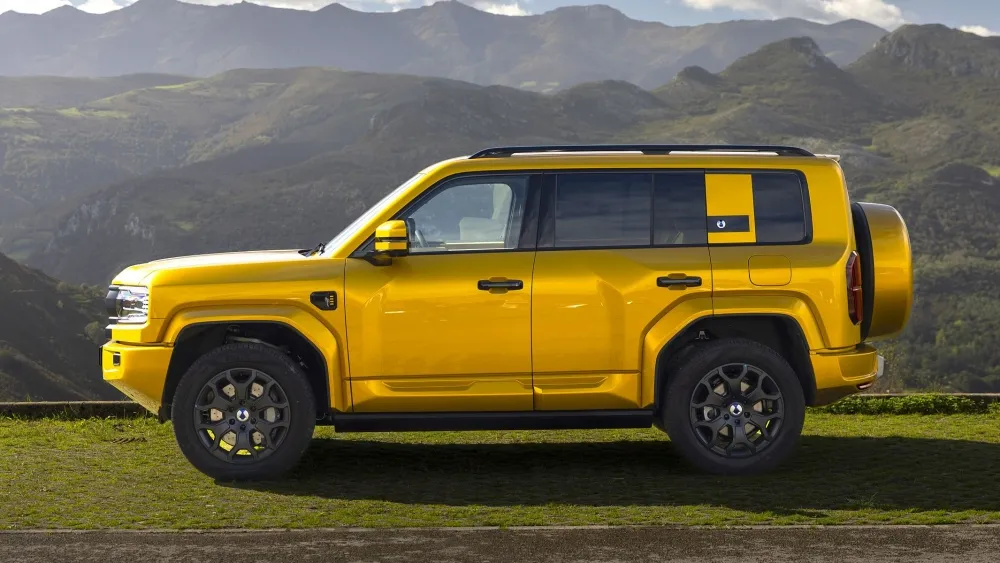
The second trim level, Ultimate, adds to the previous features 20-inch wheels, electric side skirts, Disus-P air suspension, a Devialet audio system with 16 speakers offering excellent sound quality, an interior rearview mirror with a digital camera, ventilated rear seats, Nappa leather upholstery, or a second wireless charger.
How does this 544 HP plug-in hybrid 4x4 SUV perform?
Well —when it comes to its 4x4 performance, which we’ll discuss now—this new SUV from the luxury brand BYD features a ladder-frame chassis with lockable front and rear differentials —there’s also a lockable “virtual” center differential—along with approach angles that can match or even exceed those of a Defender 110 —37.6º approach angle, 27.9º departure angle, and 41.9º recovery angle—.
In the best case scenario, with the hydraulic suspension raised to its maximum height of 310 mm off the ground in Ultra mode—note that it can only travel at a maximum speed of 8 km/h when this mode is active—this SUV offers an approach angle of 39º, a departure angle of 36º, and a breaking angle of 35º. However, with the suspension in normal mode and a ground clearance of 220 mm, this 4x4 SUV has an approach angle of 35º, a departure angle of 19º, and a breaking angle of 32º.
Add to this terrain response control, intelligent descent control, along with the advantages of its electric motors and up to 760 Nm of torque for offroad driving, and the result is one of the most capable 4x4s we’ve seen in recent years—on par with models like the Ford Bronco, Land Rover Defender, or Jeep Wrangler.
Proof of this is that this BYD SUV has effortlessly overcome all obstacles—not just those in a specific 4x4 circuit, but also jumps and uneven surfaces designed specifically for motocross bikes. And it did all of this very easily, with the car itself automatically managing all driving parameters.
In addition, we当然 also got to test it on the road. First of all, its sound insulation is excellent, and since it has very square shapes that aren’t particularly aerodynamic, it’s logical for some aerodynamic noise to appear at speeds over 100 km/h, though it never becomes a nuisance for the passengers.
The tire noise is minimal, even though the Ultimate version we drove came equipped with huge Pirelli Scorpion tires… but they were sufficient for its 544 HP: 275/55 /R20.
Regarding its driving mode, the driver can choose whether to have the SUV operate in pure electric or hybrid mode, plus three driving modes: Eco, Normal, and Sport. In all of these modes, the start of the internal combustion engine is smooth, its noise reaches the cabin quite filtered, and even during strong acceleration, it never becomes annoying.
As for performance, it offers a very quick response to the accelerator, and quite powerful at that—evidenced by 0 to 100 km/h times of just 4.8 seconds for the Elegance trim and 5.0 seconds for the Ultimate trim. This is despite its weight—pun intended—not being light at all: 2,940 kg for the base trim and 3,035 kg for the most equipped version. Still, it is by no means a sports SUV.
This vehicle certainly feels dynamic. That’s thanks to its aforementioned frame of crossmembers and rails. As a result, despite its hydraulic suspension—adjustable manually in up to 4 heights—that handles body movement quite effectively—there is some body roll at the start of slow curves, and in Sport mode, the 544 horsepower cause the front end to lift when accelerating—inertia works against this SUV. And note that despite its power and up to 20-inch tires, it isn’t a dynamic SUV: it is powerful and fast, but also a classic 4x4 that can’t match the dynamics of models with monocoque frames and lower weight.
Still, the dynamics of this SUV made by BYD are not bad. However, there is room for improvement in the braking feel—the initial response of the pedal feels spongy, even though its ventilated disc brakes manage to bring this BAO 5 to a stop within a reasonable distance considering its weight—and the steering could be more direct, as it offers only 3.0 degrees of lock-to-lock movement. Most importantly, once behind the wheel, one becomes aware of the car’s size and weight, which certainly don’t encourage overly sporty driving.
Curiously, it’s not the suspension that’s the issue—though it tends to be more rigid than comfortable. While this BYD may not be very comfortable on poor-quality asphalt, it performs better on highways and well-maintained roads than one might expect. Still, it doesn’t have as refined handling as the aforementioned Defender, as that British 4x4 excels in this regard.
With that weight, aerodynamics, and power… we were a bit worried about fuel consumption. Denza reports an approved fuel consumption for this SUV as a plug-in hybrid of 4.1 L/100 km—this figure applies with the battery fully charged, which provides 90 km of pure electric range. We’re confident it can come close to this figure in urban or suburban driving at moderate speeds, as long as it can keep recharging its battery.
But on a downhill highway at 120 km/h with low battery level, this car’s fuel consumption dropped below 11 L/100 km. This figure is similar to the car’s rated consumption with only the internal combustion engine — 11.1 L/100 km — and, frankly, we don’t find it excessive given the car’s size, capabilities, and performance. It is likely to drop significantly in urban driving conditions, where we weren’t able to test it.
BYD’s most powerful 4x4 SUV prices: 9,000 euros cheaper than a Defender
The prices for Denza’s plug-in hybrid SUV have been revealed. In Spain, its Elegance trim — with all the previously mentioned features — will cost starting at 76,290 euros, without any discounts or subsidies. Meanwhile, the most equipped Ultimate version goes up to 86,420 euros.
It’s not a low price, but the features, along with its 4x4 capability and standard equipment, make it almost 9,000 euros cheaper than the equivalent Defender.
In this case, it’s the long-wheelbase 110 version — 5.02 meters in length — with the base S trim, a 404 HP plug-in hybrid engine that consumes 6.1 L of fuel. This Defender currently costs 85,700 euros, representing nearly that 9,000 euro advantage for the SUV made by BYD.