
BYD’s rival to the Volkswagen ID. Polo will be able to charge in 9 minutes: here’s what the new Great Seagull looks like

Little by little, new details about the updated BYD Seagull are coming to light—a model sold in Europe as the Dolphin Surf. Recent reports suggest that this most affordable electric vehicle in the range will be equipped with second-generation Blade batteries, which offer higher energy density, better cold resistance... and much faster charging.
While the current Seagull is only 3780 mm long (the European Dolphin Surf is slightly longer due to larger bumpers, reaching 3990 mm), the new model will measure 4205 mm, putting it on par with models like the Renault Mégane E-Tech. For this reason, it is speculated that it will be named the Great Seagull.
Therefore, in practice it will not aim to replace the current Seagull but to coexist with it, with both likely to continue being sold simultaneously. If it enters the European market (something we consider almost certain), it may fall under the Dolphin family, which currently consists of three models: the already mentioned Dolphin Surf, the newly launched Dolphin G DM-i (the only plug-in hybrid in this subcategory), and the original Dolphin.
Before its official launch, the Great Seagull was spotted during a photoshoot alongside a BYD ultra-fast charging station. This suggests it is likely compatible with the Flash Charging 2.0 system, meaning it can charge from 10% to 70% in 5 minutes and from 10% to 97% in 9 minutes—figures unprecedented for an electric car of its size.

BYD Great Seagull to compete with Geely E2
In China, the Great Seagull will be sold with two batteries, both of the LFP (lithium-iron-phosphate) type: one with 30 kWh capacity (320 km CLTC range) and another with 39.2 kWh capacity (420 km CLTC range). The Flash charging feature is likely reserved for the larger battery pack, meaning the smaller capacity version may still use first-generation Blade batteries.
Initial estimates suggest the peak charging capacity could reach around 300 kW in direct current, though this figure won’t be confirmed until the model is officially unveiled. This would put it far ahead of its main competitor: the Geely Galaxy Xingyuan (sold as the Geely E2 in Europe), the best-selling sedan in the Chinese market in 2025. On the old continent, it will have to compete with the Volkswagen ID. Polo.
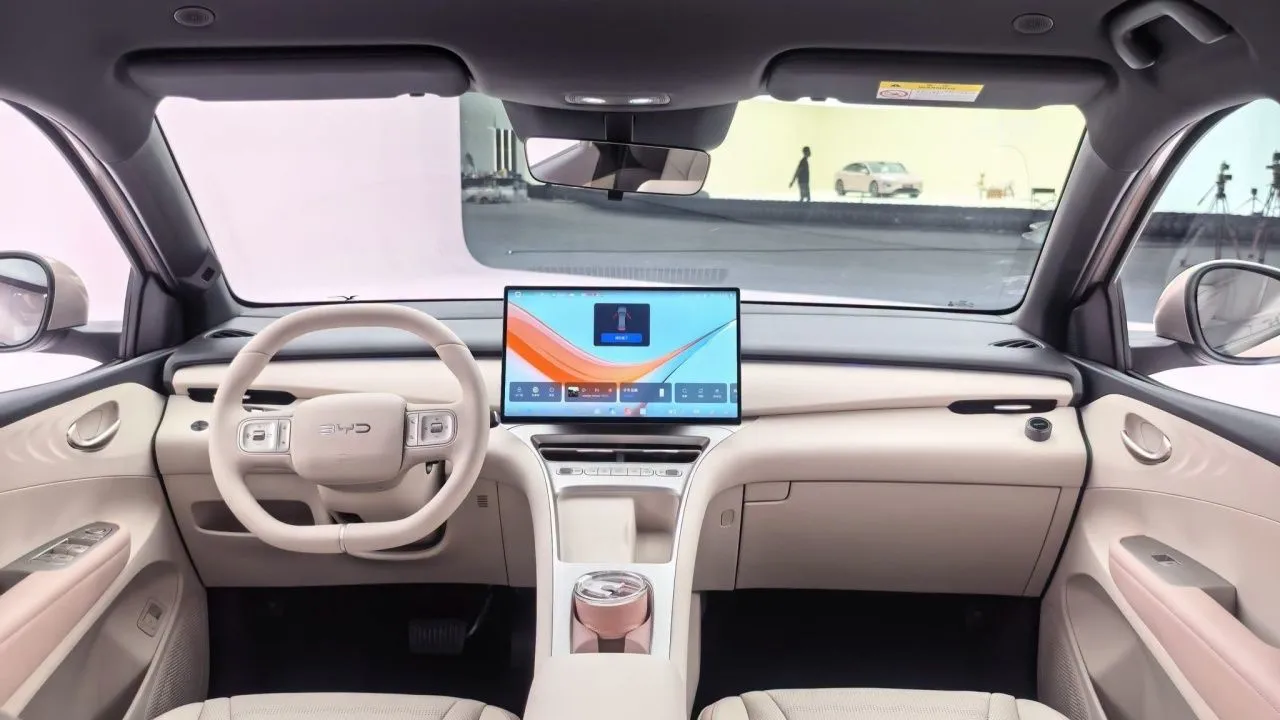
As my colleague Carlos mentioned yesterday, the Great Seagull will also be well-equipped in terms of technology. Among the driving assistance features, it’s worth noting the use of a LiDAR on the roof to support the God's Eye B system. The hypothetical European version is likely to lack this sensor.
Source | CarNewsChina