
Nissan’s new hybrid SUV has 3 beds and takes 225 kilometers to start its engine, but it won’t let you buy it.

Lowering the front seats, connecting them to the rear bench, and creating a bed inside the car. That’s one of the concepts behind the Nissan NX7, Dongfeng Nissan’s new plug-in hybrid SUV — the joint venture between Nissan and China — whose interior has just been revealed in the first official images. It is scheduled to arrive at Chinese dealerships in the fourth quarter of this year and has been described by the brand itself as the “first Porsche Cayenne for young people.”
It is the fourth model in the N series, the electric lineup that the Japanese brand has created for the Chinese market, following the electric sedan Nissan N7, the plug-in hybrid sedan N6, and the SUV Nissan NX8. While the latter focuses on space and comfort, the NX7 targets a younger audience with a more sporty and personalized design, featuring five seats. Nissan’s N series sells well: 33,590 units were sold in the first half of 2026, and since deliveries began in April 2025, a total of 86,359 units have been delivered.
A three-layer dashboard and adjustable seats
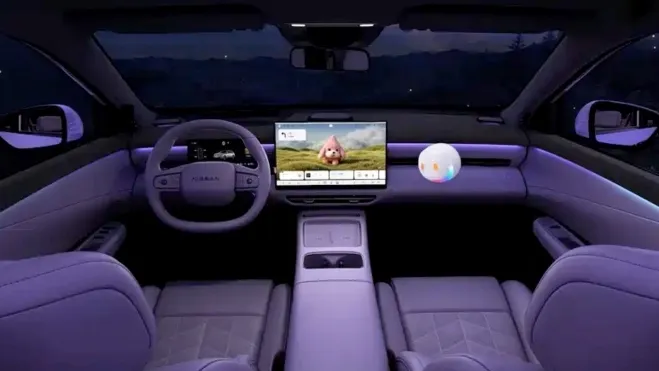
The interior design maintains the simple aesthetic of the rest of the range. The cabin surrounds the occupants, with the dashboard organized in three stacked levels: a two-spoke steering wheel, a separate digital instrument cluster, and a large central screen that appears to float above the console.
The seats are the second version of what the brand calls “zero-pressure” seats, adjusting actively and dynamically to each occupant’s body. Additional features include 256-color ambient lighting, a wireless charging pad for mobile phones, rectangular cup holders, and a central armrest that opens to the side.
A cabin that transforms into a bed
The NX7’s standout feature is the ability to fully recline the front seats so that, together with the rear row, they form a surface resembling a bed. According to the manufacturer, the car offers up to three different bed modes that can be switched between freely, though it hasn’t detailed the differences between each mode. It’s quite useful for those who want to take a quick nap in a service area. This type of configuration is very common in China, as many of these vehicles end up being used as taxis or VTC services.
Shorter and more sporty than the NX8
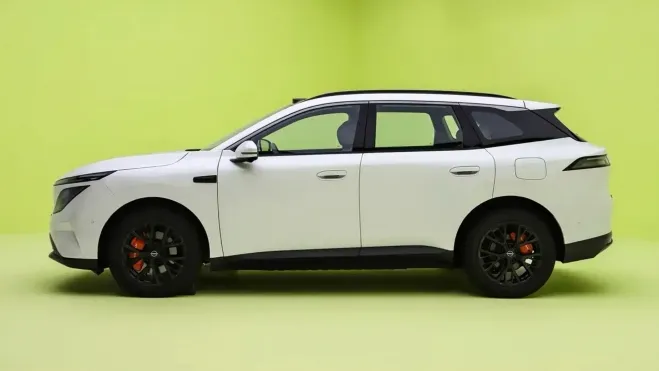
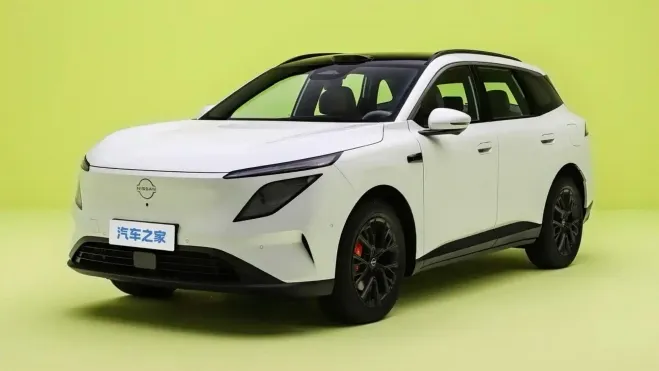
Aesthetically, the NX7 introduces its own unique design language with a more youthful vibe. It retains the split headlights in two levels, but eliminates the light strip running across the entire front end. Instead, it features a hood with pronounced ribs and a bumper equipped with air intakes and side channels to direct airflow. From the side, the semi-hidden door handles and 18- or 19-inch tires—available in three designs—are notable, while the rear end is clearly more compact than that of the NX8.
It measures 4,785 millimeters in length, 1,920 or 1,932 millimeters in width, and 1,660 or 1,665 millimeters in height depending on the version, with a wheelbase of 2,815 millimeters. These are dimensions typical of a D-segment SUV—nearly 9 centimeters shorter and 10 centimeters less long in wheelbase compared to the NX8, which reaches 4,870 millimeters in length and has a 2,917-millimeter wheelbase.
A very generous battery for a plug-in hybrid
We were already familiar with its mechanical specifications from the homologation documents. The NX7 combines a 1.5-liter gasoline engine producing 99 horsepower with an electric motor delivering 231 horsepower, powered by a 40.95 kWh lithium iron phosphate (LFP) battery made by CATL. The cells for this battery are produced by the joint venture between CATL and the FAW group. It achieves an electric range of 225 or 220 kilometers, depending on the version, according to China’s CLTC testing cycle.
The same specifications list a top speed of 180 kilometers per hour and a weight ranging from 1,915 to 2,000 kilograms. With such a battery, most daily trips can be completed without starting the gasoline engine, and the manufacturer claims a week of commuting to work on a single charge. Nissan has not yet announced prices, but it is reasonable to expect the NX7 to be priced lower than the NX8, which costs between 159,900 and 209,900 yuan in China, equivalent to around 20,800 and 27,300 euros.