
The Tesla Cybercab’s engine does not use rare earths, just like the Renault 5’s... but there is a fundamental difference.
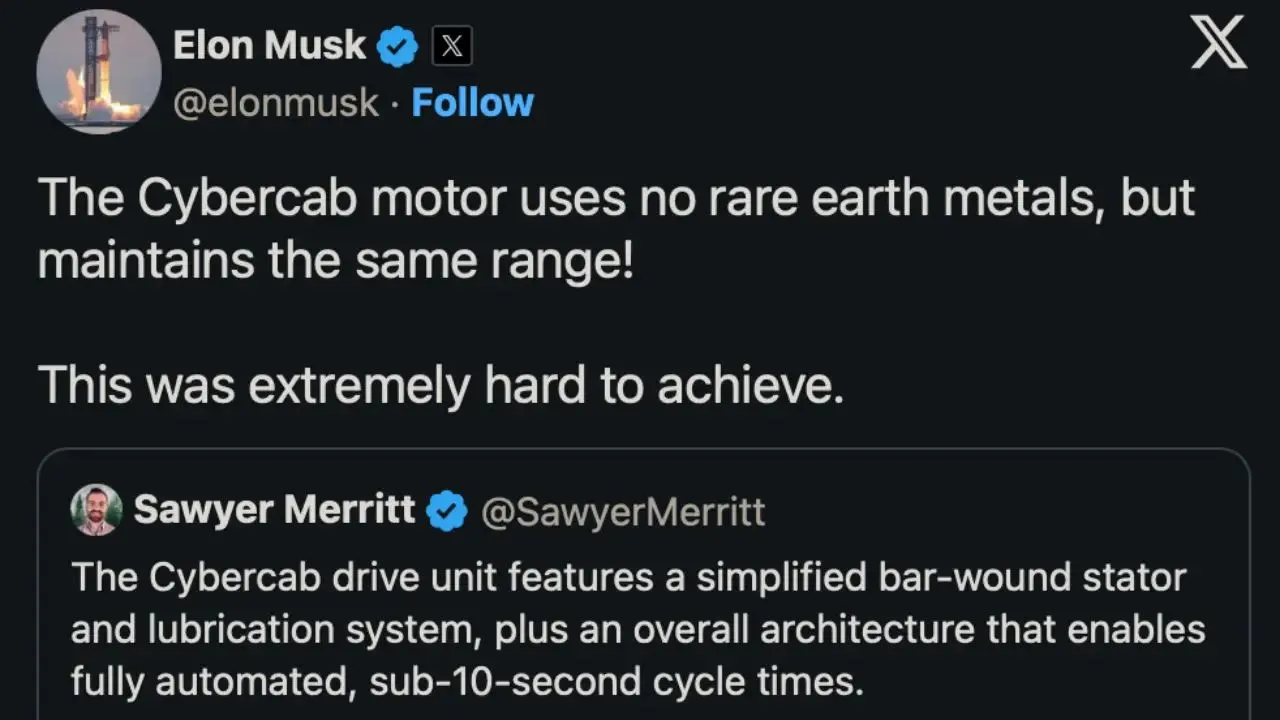
The Tesla Cybercab was one of the major highlights from last week. Tesla’s electric robotaxi, which lacks a steering wheel or pedals, aims to become the vehicle that popularizes fully autonomous driving. To achieve this, the American company has adopted a radically different approach compared to competitors like Waymo, focusing on designing a vehicle that is inexpensive from the start.
This is evident in choices such as the cable-braking system (which uses electric actuators on the brake calipers), the absence of paint on the body (the golden color is mixed with the material used in the panels, eliminating the need for painting), or the use of a battery with limited capacity—something compensated for by excellent aerodynamics (a coefficient below 0.20) and a highly efficient propulsion system.
This same approach has guided the development of the FSD (Full Self-Driving) system for years, relying on cameras and eliminating other sensors such as LiDAR and radar that are used in the autonomous vehicles of most competing companies. Additionally, FSD does not depend on high-definition maps to function.
While this approach clearly offers advantages in terms of scalability and cost efficiency, many experts argue that the lack of redundancy could pose a safety issue; in fact, Tesla is involved in several lawsuits in the United States due to defects in its driving assistance systems over the years.
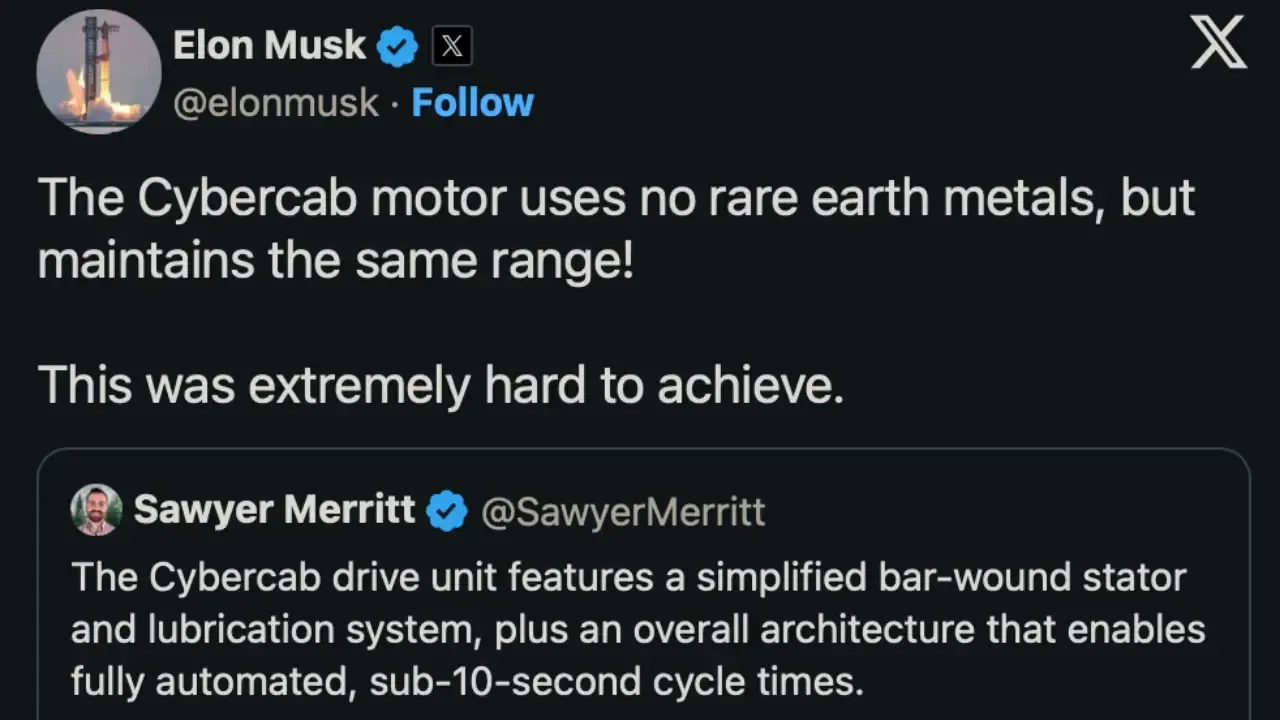
The Tesla Cybercab uses a permanent magnet motor without rare earth elements
Another area where Tesla has saved costs is in the Cybercab’s motor, as reported by the company’s CEO, Elon Musk, it does not contain rare earth elements. Typically, these materials are used in permanent magnet motors; however, for years brands like BMW and Renault have opted for rotor-wound motors free of rare earths.
The major breakthrough is that Tesla appears to have developed a permanent magnet motor without rare earth elements. According to the company, this motor is 18% smaller and 25% lighter and more efficient than other high-performance electric motors. The main advantage of permanent magnet motors is that they are more efficient than those with wound rotors; in fact, Renault has opted for a motor of this type for its compact Twingo, which is the most fuel-efficient electric vehicle in its lineup.
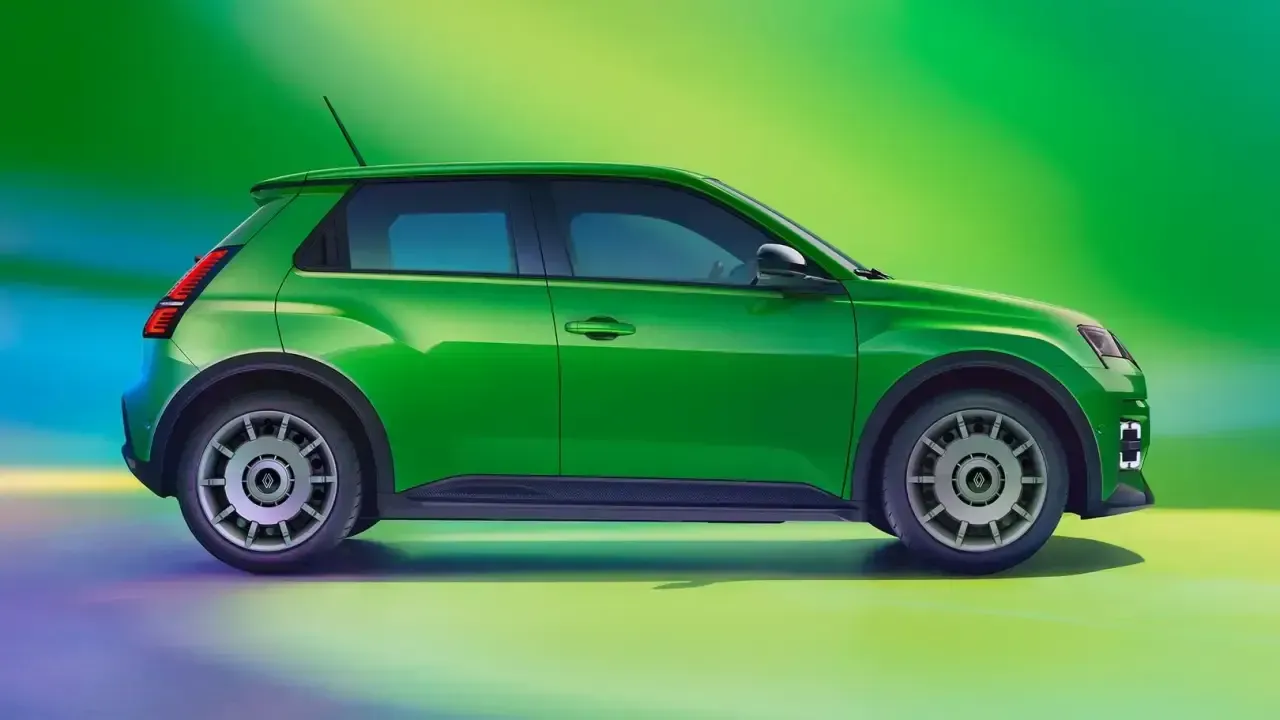
That said, the firm is working on two significant advancements for its wound-rotor motors: one is the 400-volt Gen 2 Evo models, which will arrive next year, and the other is the 800-volt Gen 3 models, scheduled for 2028. Both motor families aim to improve performance and reduce consumption compared to the current Gen 2 motors found in the R5, R4, Mégane, and Scénic.
The entry-level Five version of the R5 was the first to feature a Gen 2 Evo engine: despite being more powerful (109 HP instead of 95 HP), it has lower consumption. It boasts a WLTP range of 305 km with a 36.5 kWh battery, which is practically equal to the 310 km WLTP range of the previous version with a 40 kWh battery. The improvement is evident.
Returning to Tesla, given that China is the world’s largest exporter of rare earths and considering the current state of U.S. diplomatic relations with this Asian country, it is not surprising that they have decided to opt for a motor without these materials for the Cybercab. So far, the company has not explained the details of its rare earth-free permanent magnet technology.
Source | Electrek