
China’s market is crashing hard, and Europe has become the solution for its manufacturers
China has accustomed us to a pace of innovation that is hard to keep up with. We’ve discussed this several times here, and even CATL’s CEO warned about the risk of rapid innovation and updates that may lead to skipping certain verification and control steps. But behind this situation lies a far less optimistic reality: there are too many factories, too many brands, and not enough buyers to support them all.
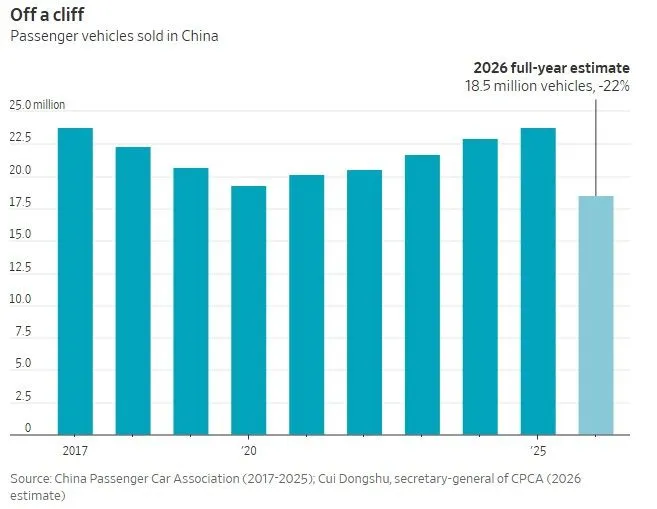
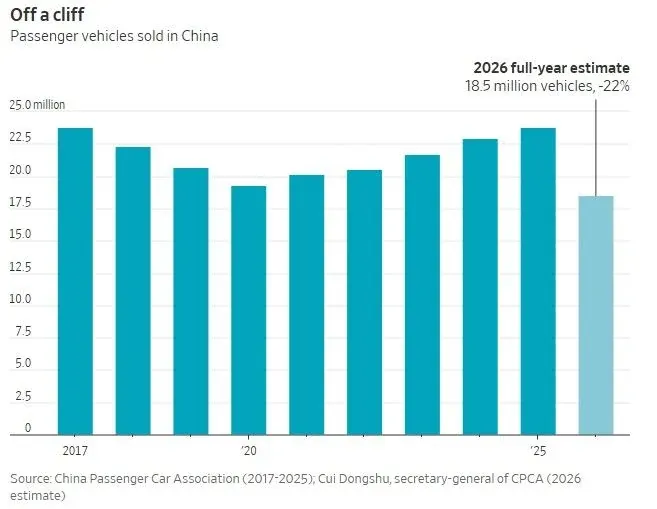
A report by The Wall Street Journal provides figures for this imbalance. Sales of passenger cars in the Chinese market have dropped by about 22% as of September. Additionally, Cui Dongshu, secretary-general of the China Passenger Car Association (CPCA), predicts that sales will end 2026 at around 18.5 million units, down from 23.7 million the previous year.
The Skyworth case illustrates how far expectations have diverged from reality. In 2021, the company claimed to have a factory capable of producing 100,000 cars per year. Yet its sales in China during the first nine months of this year amounted to only 660 units. While this figure doesn’t allow for calculating the factory’s utilization rate due to the lack of export data and other possible markets, it reflects its weak commercial presence in its home market.
And yet, the company continues to operate. The report describes empty dealerships, stores that had already closed, and a website still showing new models and job offers, along with details such as non-existent Twitter or YouTube accounts. A local government in Nanjing is involved in the manufacturer of its electric vehicles. Here lies one of the key issues: closing a brand also means admitting that an industrial venture backed by public funds has failed.
Too many brands and factories that are hard to shut down
For years, numerous Chinese cities have aspired to become major hubs for electric vehicles. To attract manufacturers, they offered investment incentives, facilities, financing, and other benefits. The result was an industrial ecosystem capable of advancing at great speed, but it also led to a proliferation of projects that relied on continued demand growth. According to AlixPartners, by the end of 2025, there were 143 Chinese electric vehicle brands with at least one product on the market.
NIO’s rescue by Hefei in 2020 became a benchmark for this model. A city could help a struggling company and, in return, attract factories, suppliers, and skilled jobs. The problem arises when many governments try to replicate this strategy, all believing their local manufacturer will be one of the survivors. Not all projects can turn into the next major automotive group.
According to data from Mobility Global cited by The Wall Street Journal, China has the capacity this year to produce around 63 million light vehicles. This is far higher than the expected domestic demand, although this capacity includes production for export and is not limited to electric cars.
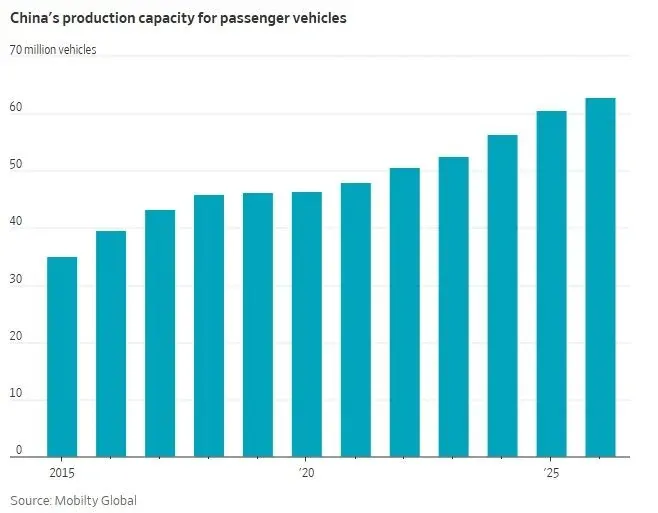
In addition, part of the excess capacity exists in facilities dedicated to internal combustion engines. The shift toward electric and plug-in hybrid vehicles reduces demand for older production lines as new ones are built. Although these two types of plug-in vehicles accounted for about two-thirds of September’s sales, according to the report, this does not prevent overall market contraction. Gaining market share in a declining market also does not guarantee an increase in sales for individual manufacturers.
For local authorities, allowing a closure comes with immediate costs: jobs, tax revenue, and supplier activity. Keeping the company operating can delay this impact, though it also prolongs competition among manufacturers who need to sell at any price. This is why regulating the industry is difficult: what makes sense for the entire country becomes much more complicated when the factory that needs to close is in your city.
Pressure from the Chinese market spreads to Europe
Manufacturers have two obvious options to find buyers: lowering prices domestically or selling more overseas. The first approach has been eroding profits for some time. According to AlixPartners, car prices in China have dropped by nearly a fifth since the beginning of 2023. The sector’s profit margin was 3.6% during the first eight months of 2026, per data from the CPCA cited by the newspaper.
The second option explains why Europe holds such importance in their plans. Exports allow them to expand their customer base and make better use of industrial investments, though they require business networks, technical support, and adaptation to each market. For European groups, the pressure comes from two sides: they sell fewer cars in China and face increasing competition in the countries where they traditionally derived much of their profits.

Volkswagen is one of the clearest examples. According to the report, the group and its partners have already closed three factories in China, reducing their production capacity from around five million to about four million cars per year. They now seek to cut another half million. At the same time, they are investing in new electric vehicle developments to regain ground. Withdrawing from China would mean giving up a crucial market; staying requires greater spending while restructuring the existing operations.
Reducing all this competition to low wages or government subsidies, however, overlooks an important part of the story. Investments have also generated industrial knowledge, supply chains, and competitive products. Technological progress is real. What’s in question is how many companies can capitalize on it as they continuously launch new models, prices fall, and demand fails to keep up.
Beijing has called for curbing destructive price competition and speeding up payments to suppliers, but these measures coexist with local interests in keeping factories open. By 2027, Cui Dongshu anticipates only a modest 2% recovery, according to Reuters. A slight rebound that is unlikely to resolve on its own all the accumulated imbalances.
Opinion
The bad news is for European manufacturers, who will find that the current competition from China pales in comparison to what’s to come. Excess production capacity and falling demand will force more brands to reduce their inventories by selling cars in Europe, even at a loss, just to save their local production.
On the other side are consumers, who will see that increased competition leads to better deals and lower prices. But it also makes it more important than ever to know who is behind the car brand, what service network it has, and how it will respond in the years to come. Because creating an attractive model at a competitive price is easy; the real challenge arises when customers need after-sales support and must avoid months of waiting or exorbitant costs.