
Graphene can radically transform LFP batteries.

Graphite has been one of the key materials in electric vehicle batteries for years, but its use poses an obvious problem: it relies on a supply chain for extraction and processing that puts pressure on the raw materials needed to manufacture batteries. That’s why new technologies are emerging aimed at reducing or even eliminating the amount of graphite required. One such technology is eCOphite, a material developed by the American company COnovate that uses graphene monoxide as an alternative for the anode.
The proposal is interesting because it doesn’t necessarily aim to replace all of the graphite in a battery at once. eCOphite can be used as an anode material or as an additive alongside other materials, allowing it to be integrated into existing manufacturing processes. The goal is to reduce dependence on graphite without forcing manufacturers to completely redesign their production lines.
COnovate also claims that the material can be produced using renewable raw materials without relying on graphite extraction. The company has been working to scale up production and plans to use eCOphite in various applications within the lithium battery industry.
But the most striking aspect of this technology isn’t just replacing one raw material with another. eCOphite also aims to solve a specific problem with LFP batteries—a chemistry that has rapidly gained popularity in electric vehicles due to its cost, durability, and lack of nickel and cobalt in the cathode.
A reference to know how much battery remains

LFP batteries have a characteristic that can become an issue for their management systems: their voltage remains relatively stable throughout most of the discharge process. Simply put, the battery’s voltage changes very little as a significant amount of available energy is used up.
This makes it difficult for the battery management system to accurately determine how much energy remains by using voltage alone as one of its references. The problem is not directly related to the battery’s capacity or range, but rather to the difficulty in accurately estimating its charge level.
This is where eCOphite comes in. According to COnovate, this material can introduce an easily identifiable voltage reference into battery behavior. This additional signal would allow the management system to have a clearer reference point for calculating the charge level while the battery is in use.
The difference may seem small, but it is quite significant. A battery management system needs to constantly know its state in order to control charging and discharging, protect the cells, and determine how much energy can be utilized. The more accurate this estimation is, the less the system will need to rely on overly conservative safety margins.
In an LFP battery, where the voltage curve is particularly flat, having an additional reference could simplify this task. eCOphite is not intended to increase the car’s range on its own, but rather to provide the system with a signal that helps it better determine where the battery lies within its operational range.
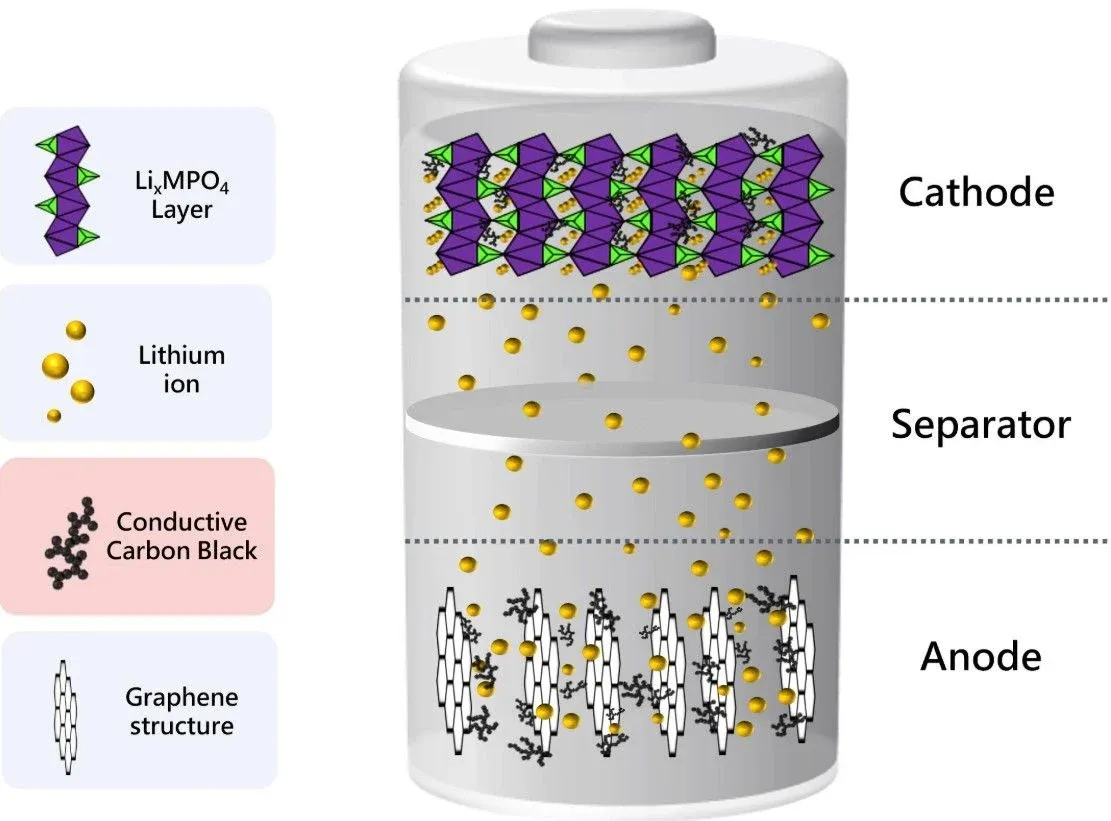
This feature can also have implications for long-term use. A more accurate estimate of the charge level allows for better management of available energy and a more precise understanding of battery behavior. COnovate aims to achieve benefits in areas such as maintenance, warranty management, and planning for the replacement or expansion of storage systems.
The technology is based on what is known as graphene monoxide, a material that COnovate has developed specifically for use in batteries. The company holds patents related to its composition and its application in electrodes, and it has been working for several years to turn it into a material that can be manufactured on a scale sufficient for commercial use.
COnovate suggests that eCOphite can be used in conjunction with current anode manufacturing techniques. This offers a different approach compared to technologies that require completely replacing the materials and processes currently used by manufacturers.
In addition, the company has explored its use to partially reduce the amount of graphite. This strategy could be particularly interesting for the industry, as a gradual substitution is much easier to implement than a complete technological shift.
Source | Conovateinc