
Diesel prices soar to 1.9 euros per liter in the United States, prompting consideration of cutting exports to Europe
The global diesel market is entering a particularly delicate situation. Russia is cutting back its exports following attacks on several of its major refineries, while the United States is facing prices that have already reached record highs and is beginning to consider whether it should reserve a larger portion of its production for its own market. The problem is that Europe enters this scenario still relying heavily on imported diesel.
The situation in the United States serves as one of the best indicators of how far the problem can go. The average price of diesel in the country has exceeded $6 per gallon for the first time, at 6.28 dollars per gallon during the week of September 14 according to the U.S. Energy Information Administration. That is roughly $1.66 per liter. In California, where prices often act as a particularly sensitive indicator of market tensions, the average has reached $8.21 per gallon, equivalent to about $2.17 per liter.
To put that figure in perspective, U.S. diesel was priced at $3.52 per gallon in September 2024 and at $4.633 per gallon during the same week in September 2023. In other words, the current national price is approximately 78% higher than it was two years ago and 36% higher than it was three years ago. In California, the difference is even more striking: the current price of $8.21 is about 59% above the average price from a year ago.
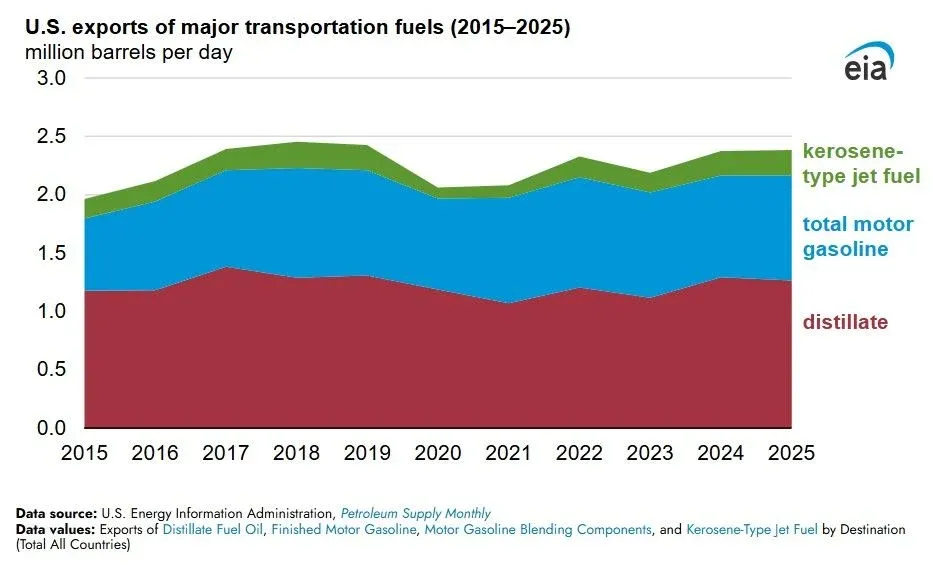
And here lies one of the problems that could eventually affect Europe. The United States is not only a major consumer of diesel but also a huge exporter of refined products. In 2025, its exports of distillates—category that mainly includes diesel—averaged around 1.25 million barrels per day, while in 2024 they had reached approximately 1.30 million. By April 2026, they even climbed to 1.6 million barrels per day, the highest monthly level since 2017.
That is why a possibility that would have seemed extreme just a short time ago has begun to gain importance: the United States temporarily restricting diesel exports in an attempt to ease pressure on its own market. As of now, there is no announced ban, nor can it be said that one will definitely be implemented. Yet this possibility has already entered U.S. political discussions—Senate Republican Leader John Thune has expressed openness to considering a temporary export ban amid the sharp rise in prices.
If such a measure were finally implemented, it would have two effects. The United States might attempt to increase the availability of diesel within its own borders, but at the same time it would remove a significant amount of this product from the international market precisely when other major exporters are facing difficulties. It’s not just a matter of oil: the real bottleneck lies in refining.
Russia is the other key factor in this equation. Attacks on its oil facilities have affected several of its major refineries. According to Reuters, six large plants that account for roughly half of Russia’s diesel production have experienced significant production cuts or disruptions. As a result, Moscow has restricted exports of gasoline, diesel, and aviation fuel to try to ensure domestic supply.
The International Energy Agency has provided figures for this issue. In August, net exports of diesel and gasoline from Russia and Gulf countries were 1.6 million barrels per day less than in February. At that time, these two groups together accounted for nearly 45% of the world’s maritime trade in these products. Losing that volume cannot be compensated overnight simply by increasing oil extraction, because there is a need for available refining capacity to convert that crude into the products the market requires.
Europe is precisely one of the most exposed regions. The continent has greatly reduced its direct dependence on Russian diesel since 2022, but that doesn’t mean it no longer needs imports. The International Energy Agency estimated that the European Union, the United Kingdom, and Norway together imported nearly 850,000 barrels of diesel per day from outside the region during the two years leading up to mid-2025. The Middle East had become the main supplier, while the United States also significantly increased its shipments.

The problem is that several of those suppliers are now facing pressures at the same time. The International Energy Agency itself notes that exports of refined products and liquefied gases remain almost 60% below February levels, while Gulf exports of diesel and heavy fuel oil in August were just a little over a quarter of the pre-war levels. Europe competes with other major global consumers for every additional shipment of diesel.
Europe’s reliance on diesel is also significant. According to the European Environment Agency, diesel accounted for 63.7% of energy used in road transport across Europe in 2023, although this proportion has begun to decline. The fuel remains particularly important in heavy transport, agricultural machinery, construction, and numerous industrial applications.
This prevents a rise in diesel prices from staying limited to gas stations. A truck that pays more per liter ends up passing on part of that increase to freight transportation. Farmers face higher costs for operating tractors and machinery. Construction companies use diesel in excavators, generators, and heavy equipment. And in certain European markets, it still plays an important role in heating and backup power generation.
Spain also has an important characteristic: there are different types of tax-specific diesel, such as diesel B used in certain professional and agricultural applications. Therefore, it is incorrect to directly compare its price with that of automotive diesel without considering taxes and the intended use. The exact price also varies between stations and provinces, and the Ministry maintains a system for continuously updating fuel prices.

The question, therefore, is not merely whether U.S. diesel prices can rise further. What’s truly important is what will happen if the United States stops sending a significant portion of its surplus to the international market, while Russia continues to restrict its exports and Middle Eastern refineries operate under pressure.
There is a fairly clear signal in the markets. The International Energy Agency warns that global diesel supplies could remain tight during winter due to a combination of limited refining capacity, geopolitical issues, and rising seasonal demand. U.S. refineries are operating at very high levels to try to meet demand, but even so, U.S. distillate inventories are below average for recent years.
And this is where things can get complicated for Europe. The United States doesn’t need to completely shut down its exports for the European market to feel the impact. It’s sufficient if a portion of the diesel that would normally leave U.S. refineries stays in the country to meet its own demand. The rest of the market will have to seek that volume from the Middle East, India, Turkey, Africa, or other producers, increasing competition for available shipments.
The market is already reflecting some of that tension. European diesel prices even surpassed those of aviation fuel at certain points in 2026, while European imports of diesel have declined since the beginning of the year. Reuters reported in August that imports dropped from 1.97 million barrels per day in January to 1.56 million in July.
Therefore, rather than talking about an inevitable rise in diesel prices in Europe, it is more appropriate to discuss an increasing risk of new price tensions. There are too many unresolved variables to determine how far the market will go: a recovery in Russian refineries, improved traffic through the Strait of Hormuz, increased production by other refineries, or eased export restrictions could quickly change the landscape.
But the opposite can also happen. If Russian exports remain restricted, Middle Eastern refineries continue to face problems, and the United States decides to reserve more product for its domestic market, Europe would have to pay more to obtain the same diesel. And in an economy still so dependent on this fuel, that increase wouldn’t stay at the gas pump: it would eventually affect transportation, agriculture, industry, and ultimately the prices of many goods.
The difference from two or three years ago is that Europe now has less room to turn to the supplier that had been its natural source of diesel for decades. Russia has largely disappeared from that role, and the United States has become one of the suppliers helping to fill the gap. If Washington starts needing that same fuel for its own market, the problem is no longer solely American.
And that is probably the most important aspect of this crisis: oil can continue to flow, but that does not guarantee there is enough refining capacity to turn it into diesel where it is needed. In such an interconnected market, a decision made in the United States can end up affecting the prices at a gas station in Spain thousands of kilometers away.