
Electric cars are gaining momentum in Europe, but Spain remains far behind its neighbors.
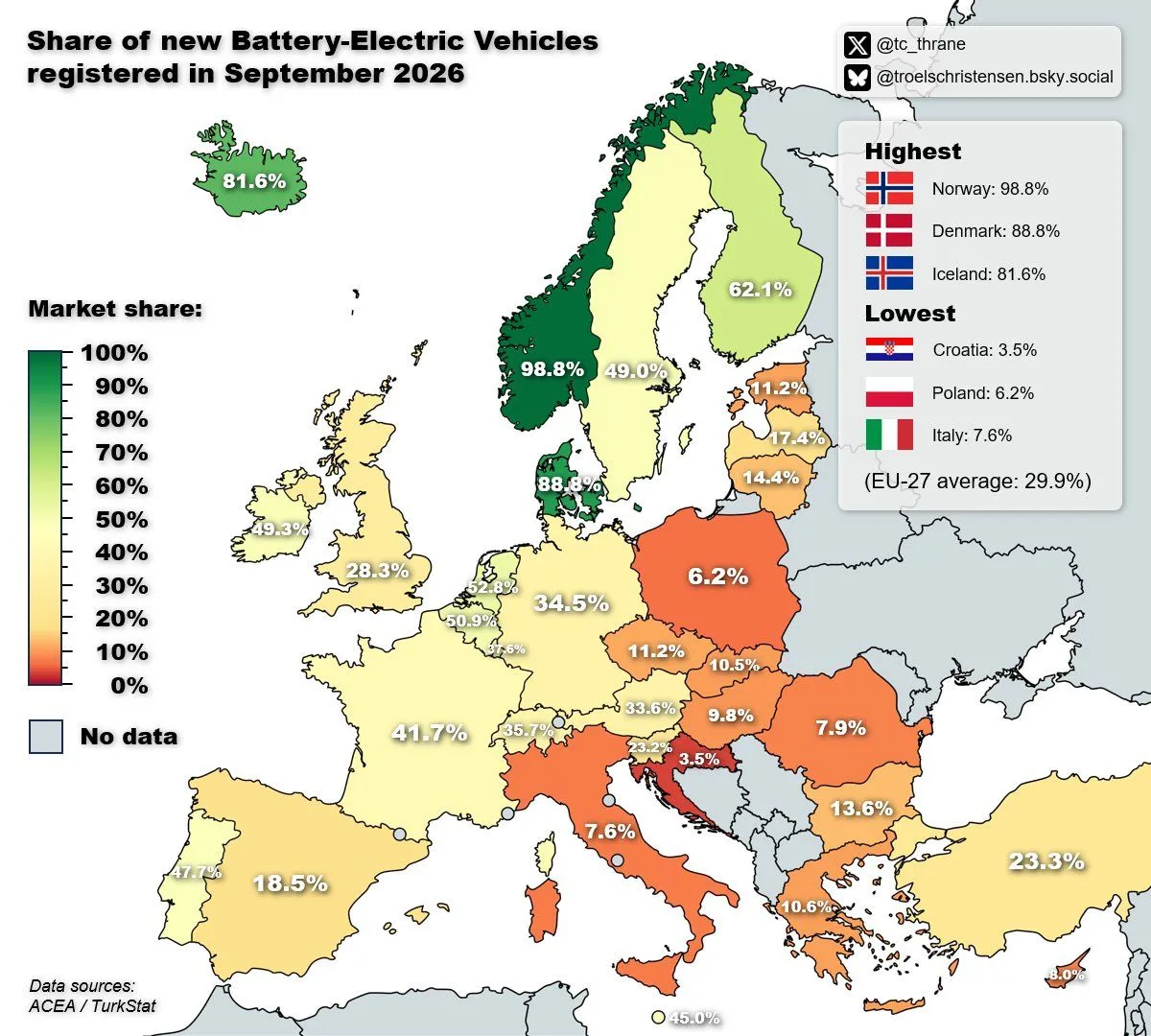
Spain is still far behind Europe’s pace of adopting electric cars. Data from September 2026 shows its share at 18.5% of new passenger car registrations, while the EU average reaches 29.9%. The gap is 11.4 percentage points: here we still haven’t reached one in every five new cars, whereas the entire union is approaching three in every ten.
There’s no need to look to Norway for examples of this lag. A glance across our borders suffices. Portugal has a share of 47.7%, and France reaches 41.7%. In both countries, electric cars account for more than twice the proportion of registrations as in Spain.
It is important to clarify what we are comparing. These figures refer exclusively to battery electric vehicles registered in September. They do not include plug-in hybrids or non-plug-in hybrids, nor do they represent the percentage of electric cars on the roads. They provide a snapshot of purchasing decisions that month, showing a significant gap between Spain and much of its surrounding region.
This contrast occurs at a time of strong growth in Europe. Electric vehicle registrations increased by 72.9% year-on-year in the EU during September, while gasoline vehicle registrations fell by 23.4% and diesel registrations dropped by 29.6%. These variations correspond to the gasoline and diesel categories in the statistics, with hybrids counted separately.
Portugal and France Show Spain’s Gap
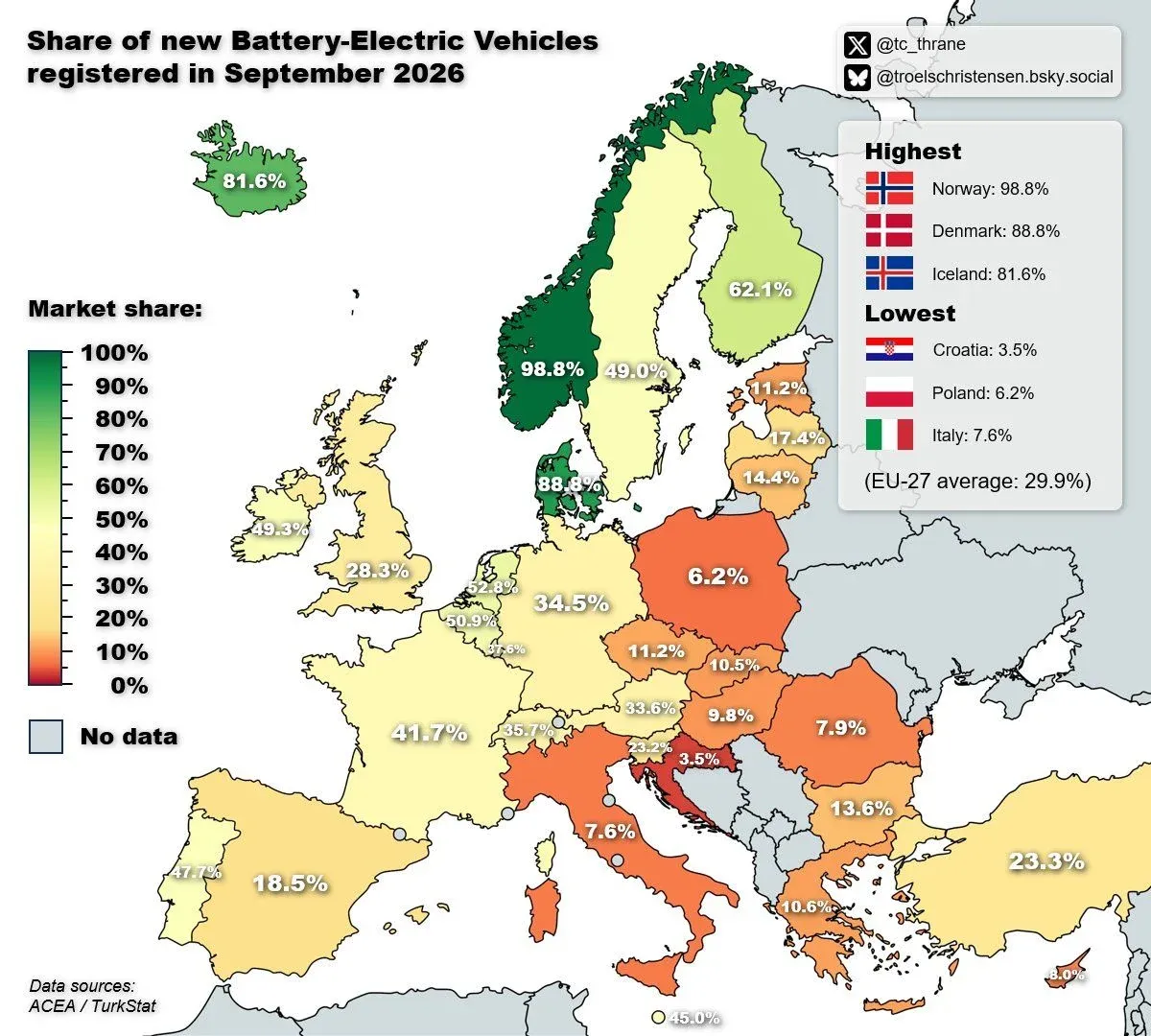
The comparison with Portugal is particularly revealing due to their proximity. Portugal’s electric vehicle share exceeds Spain’s by 29.2 percentage points and is roughly 2.6 times higher. This doesn’t mean more units are sold, as we’re talking about markets of different sizes, but it does indicate that electric cars make up a much larger proportion among those purchasing new passenger vehicles.
The Portuguese results also force us to look beyond the usual comparison between Northern and Southern Europe. We’re not just talking about Scandinavian countries, which have very specific economic and fiscal conditions. On the Iberian Peninsula itself, there are two markets where the significance of electric cars differs dramatically.
France provides another nearby reference point. With 41.7%, it outperforms Spain by 23.2 percentage points. Germany, on the other hand, reaches 34.5%, while the United Kingdom sits at 28.3%. Although the latter is slightly below the EU average, it still holds a clear advantage over the Spanish market.
Netherlands comes first with 52.8%, followed by Belgium at 50.9%. In both cases, electric cars already account for more than half of the monthly registrations. Ireland reaches 49.3%, Sweden 49%, and Finland 62.1%, indicating a scenario where this technology holds a much greater share than in Spain.
The extremes remain in the north. Norway reaches 98.8%, Denmark 88.8%, and Iceland 81.6%. These figures should be interpreted within the context of each market, but to assess Spain’s lag, there’s even no need to use these benchmarks—the EU average is already quite far behind.
If we expand the analysis to the European Union, EFTA countries, and the United Kingdom, the combined share is 30.5%. In the EFTA bloc, which includes markets such as Norway and Switzerland, it reaches 65.1%. These are different geographical areas that should not be confused, although all of them highlight the contrast with Spain.
It would also be incorrect to present our country as the worst in Europe. Italy has a rate of 7.6%, Poland at 6.2%, and Croatia at 3.5%. Spain is clearly ahead of these markets, but finding countries with worse results does not change the fact that we remain below the community average and our two closest neighbors.
To put the gap into perspective, with the same total number of registrations, Spain would need approximately 62% more electric cars to move from its current share to the EU average as of September. This is a calculation based on market distribution, not a sales forecast, but it helps illustrate that the gap cannot be closed with minor progress.
The chart alone does not allow us to attribute this delay to a specific cause. It does not clarify the impact of purchase price, charging convenience, taxation, subsidies, or corporate registrations. However, it does highlight the question we should ask: what conditions are facilitating adoption in neighboring countries, and what is missing so that more Spanish buyers can make the switch.
It is also advisable to separate the monthly figure from the cumulative total. According to ACEA, in the first nine months of 2026, electric cars accounted for 22.7% of the EU market. September alone accounted for 29.9%. A single month can be influenced by concentrated deliveries or marketing campaigns, so it will be necessary to monitor trends to see how this gap narrows.
Spain’s performance remains very poor. Reaching a share close to 20% is not enough to speak of convergence when our neighbors are above 40%. Portugal shows that there is no need to move to Northern Europe to find a market where almost one in two new cars are already electric.