
The world’s tallest wind turbine has been completed: it stands 365 meters tall and can charge 1,200 electric cars per day
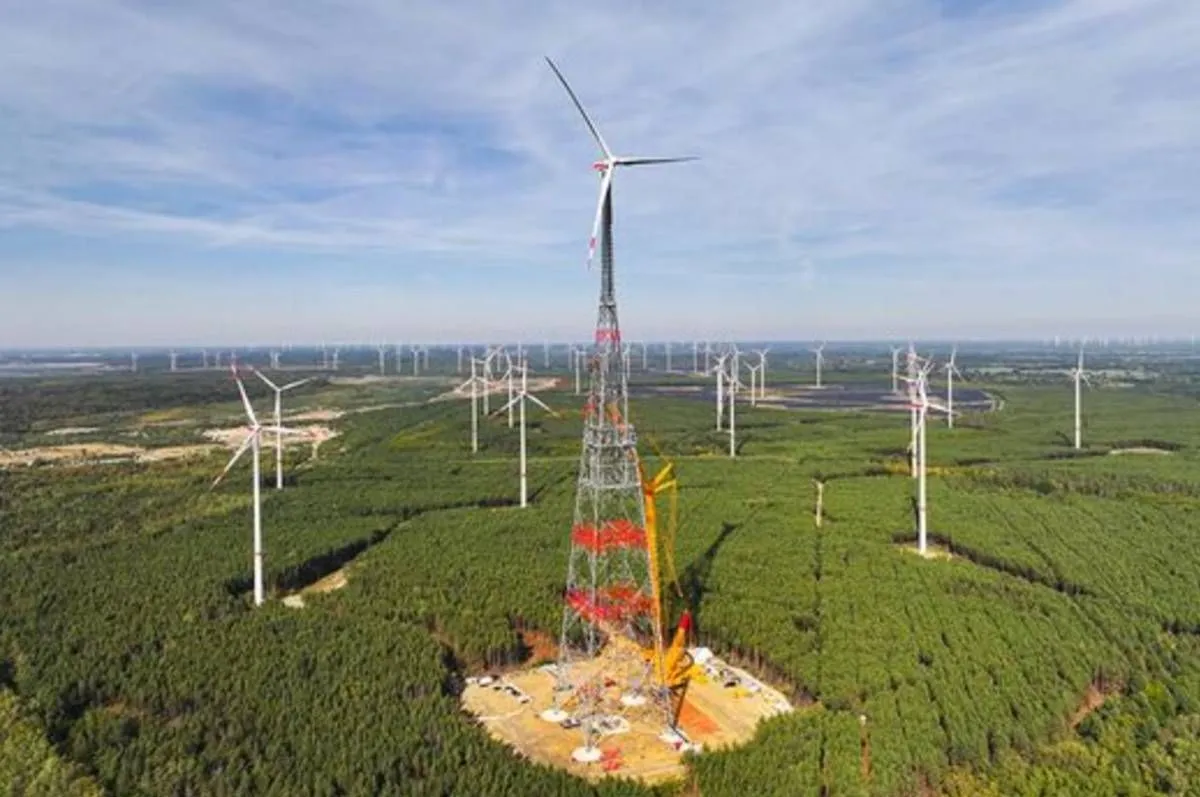
The world’s tallest wind turbine has now reached its final height in Germany. The massive structure erected in Schipkau, in the Lusatia region, stands at 365 meters tall, a figure that brings it just a few meters short of Berlin’s television tower. But beyond its height record, what’s truly interesting about this project is what happens 300 meters above the ground.
GICON’s idea is to take advantage of wind conditions that have so far been practically beyond the reach of conventional onshore wind turbines. At that height, the wind is stronger and, more importantly, more consistent, which can enable the generation of more electricity using a rotor of similar size to those in much lower installations.
The project has just overcome one of its final major obstacles. The telescopic system, part of the structure, allowed the inner section to be raised to its final position, bringing the total height of the installation to 365 meters. Operation is scheduled for November, after completing the final works.
A wind turbine capable of generating electricity for over 1,200 cars per day

The construction of Schipkau doesn’t resemble much the traditional image of a wind turbine. Rather than using a huge conventional tower, GICON has developed a steel lattice structure with a telescopic system that allows the turbine to be installed at a much greater height.
The installation reaches a hub height of 300 meters and uses a rotor with a diameter of about 126 meters. At the top is a 3.8 MW VENSYS turbine, equivalent to around 5,167 horsepower. This power output may seem modest compared to some of today’s large wind turbines on paper, but it takes on a different dimension here due to the high altitude at which it operates.
In fact, one of the project’s goals is to demonstrate that significantly increasing the turbine height can improve a facility’s performance without having to increase the rotor size by the same proportion. GICON claims that, with the same rotor diameter, its technology can generate approximately twice as much electricity as a conventional wind turbine located at a lower height, though the final outcome depends on the specific conditions of each location.
Here is one of the most interesting figures to understand the scale of this project. GICON estimates that the 3.8 MW turbine installed in this prototype can produce at least 18 million kWh per year, or about 18 GWh. The company itself calculates that this amount would be sufficient to meet the annual energy needs of around 6,000 households.
In the context of electric vehicles, this figure is also striking. If all that electricity could be used exclusively to charge cars with a 40 kWh battery, the 18 GWh per year would allow for about 450,000 full charges annually. That amounts to roughly 1,233 cars per day, each receiving 40 kWh.
Naturally, this is an energy equivalence and not the actual capacity of a charging infrastructure. Transport, conversion, and charging losses must be taken into account, plus the fact that the generated electricity is not necessarily stored for later use by cars. Nevertheless, it helps put into perspective the output of a single facility.
There is another figure that can cause confusion. In recent months, GICON has mentioned 30-33 GWh per year serving around 7,500 households, but that projection relates to future wind turbines of at least 8 MW installed using this tall-tower technology. It is not the output expected for the Schipkau prototype with its 3.8 MW turbine.
If those 30-33 GWh could be achieved with a facility of this type in the future, the equivalent number of full charges per year for electric cars with 40 kWh batteries would be around 750,000-825,000, or approximately 2,055 to 2,260 cars per day. These are theoretical figures, but they illustrate why GICON believes this technology could go beyond this initial prototype.
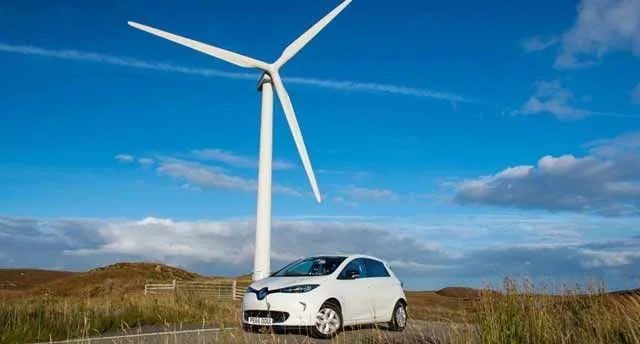
Another important aspect is the ability to make better use of land areas where conventional wind turbines do not achieve particularly high efficiency. At 300 meters altitude, the wind usually has different conditions compared to those near the ground and can be more consistent. The company even proposes integrating these wind turbines into existing wind farms by using a second height level to increase output without the need to occupy large additional areas.
The structure was not designed with only this first unit in mind. GICON explains that commercially available components and a construction approach were used so that the concept could later be scaled up for mass production. The project uses over 2,000 tons of steel and consists of approximately 22,000 parts, giving an idea of the complexity involved in raising a turbine at such a height.
The record is therefore almost the least interesting aspect of the project. While it is remarkable for a wind turbine to reach 365 meters, the real goal is to demonstrate that the wind available at those heights can become an additional source of renewable electricity with output high enough to justify the complexity of the structure.
The Schipkau installation still needs to prove its performance in operation. The planned commissioning in November will be the opportunity to verify on site to what extent wind conditions at 300 meters allow for meeting the expectations. If the results are favorable, the next step will be much more significant than this record: scaling up the technology to facilities with higher capacity and output.
And that’s where the comparison with electric cars comes in. The 18 GWh per year projected for this first wind turbine is equivalent, in theory, to fully charging about 1,233 cars with 40 kWh batteries every day for an entire year. A future installation of 30-33 GWh would raise that figure to over 2,000 cars per day. Energy doesn’t appear out of nowhere, but being able to produce more electricity with the same available area can become one of the keys to continuing to increase renewable energy generation.