
Einride acquires 500 Tesla Semis
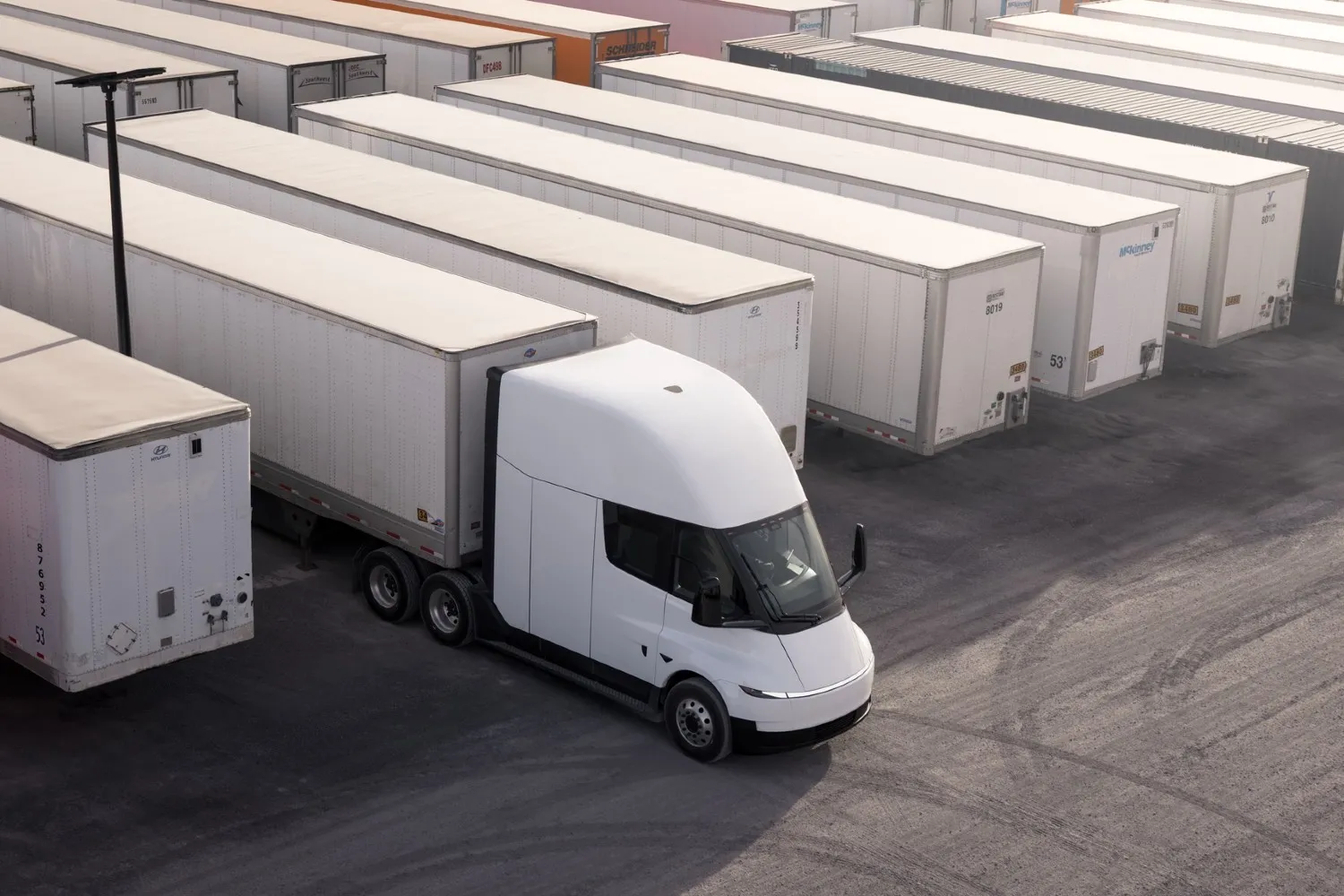
Einride, a provider specialized in electric and autonomous freight transportation, plans to expand its electric fleet in the U.S. by adding 500 Tesla Semi trucks. These battery-powered trucks are set to be used, among other things, in Amazon’s logistics operations.
Einride announces a partnership with Tesla and plans to facilitate the “world’s largest deployment of Tesla Semi.” As is well known, this model refers to Tesla’s electric truck, which is set to be introduced in the U.S. this year. The production of this series has been taking place at the Nevada Gigafactory since this spring. Einride specifically states that it will “deploy 500 Tesla Semi vehicles on its Saga-AI platform for Amazon and other customers, thereby converting existing contracts into revenue-generating shipping capacity.”
Einride does not specify on what basis the vehicles will be added to its fleet. The Swedish company listed on U.S. stock exchanges mentions a newly agreed partnership with Tesla. It is not stated whether the vehicles will be purchased, leased, or acquired through some other arrangement to join the logistics specialist’s fleet. What is clear, however, is the scale of this acquisition: The 500 units of the Semi will increase Einride’s electric truck fleet in the U.S. to 750 battery-powered trucks. Thus, these new vehicles will account for two-thirds of the company’s future electric vehicle fleet.
Regarding the deployment of its future semi-truck fleet, Einride only specifies that the electric trucks will operate across North America for customers. Amazon is the only company named. Specifically, new electric freight corridors are planned in California, Texas, New Jersey, Illinois, and Georgia. According to an accompanying statement, procurement of the 500 units is set to begin in September 2026 and be completed within two years. The financing is said to be fully covered by third-party funding solutions, though Einride does not go into further detail on this point.
To provide context: Einride was founded in 2016 and is headquartered in Stockholm. The Swedish company pursued the use of driverless commercial vehicles early on and has already developed a corresponding concept vehicle named T-Pod. However, for several years now, the company’s core product has been the Saga AI software platform, which serves as an intelligent operating system for electric (and eventually autonomous) vehicle fleets as well as charging and connectivity networks. This enables companies to transport goods more sustainably and cost-effectively from point A to point B.
"Since electric trucks bring operational variables such as charging times and energy costs that change depending on the situation, they require a sophisticated logistical approach for deployment," Einride explains in its latest statement. Against this backdrop, Saga AI transforms a fleet of individual electric trucks into a coordinated network. Saga AI has already enabled over 19 million miles of electric driving and 42,000 optimization sessions worldwide.
"This procurement is further proof that we can operate at the scale required by our customers," says Roozbeh Charli, Chief Executive Officer of Einride. "The close collaboration with Tesla to bring next-generation semis into active service quickly and on a large scale demonstrates the strength of this partnership and how rapidly this technology is evolving from concept to everyday use."
"Einride is a leader in sustainable freight transportation, and we are very pleased to deepen our partnership with the company through this order for 500 tractor-trailers," says Dan Priestley, Director of Semi at Tesla. "Electric heavy-duty trucks offer lower costs per mile compared to diesel trucks due to fuel savings, reduced maintenance needs, and higher availability. These savings increase further through operational efficiency when electric trucks are used on a large scale, and we are glad that Einride recognizes this, looking forward to supporting their deployments."
The partners emphasize that customers can get “early access” to the Tesla Semi through Einride. The electric truck is being built in a specially constructed, separate factory next to the Gigafactory Nevada. As Electrek reported on the start of production in April, the facility is designed for an annual capacity of 50,000 trucks, with production ramping up gradually. Thus, such annual output cannot be expected right away. Nevertheless, the start of mass production represents a crucial moment for Tesla. The scale benefits from mass manufacturing are intended to allow the Semi to be offered at prices of $290,000 for the long-range version and $260,000 for the standard version. According to industry experts, these announced prices will make it the cheapest Class 8 BEV tractor-trailer on the U.S. market. At the same time, the Semi stands out in terms of its technical specifications.
outperform its somewhat outdated competitors.Sporadically, a few Semis can already be seen on the roads in the U.S. These were the first units, primarily built manually on a pilot line. Most of these pre-production vehicles are believed to be in Tesla’s own fleet, with 36 units confirmed in PepsiCo’s California fleet. Tesla began producing the first pre-production models of the Semi in October 2022. Over the following three years, Tesla focused on “refining the design, reducing the truck’s weight by about 1,000 pounds, and building its own factory next to the Gigafactory Nevada in Sparks,” according to Electrek. In February, the automaker released the final production specifications and confirmed two trim levels: a Standard Range with a range of 325 miles (about 523 km) and a maximum gross weight of 82,000 pounds.
A short range version weighing around 37.2 tons and a long range variant with a range of 500 miles (around 800 km).Both trim levels feature a powertrain with three integrated electric motors delivering up to 800 kW of power, along with batteries sized at 548 or 822 kWh. You can read more about the additional specifications here. Importantly, the semi is designed to support megawatt-level charging at 1.2 MW, and such charging infrastructure is being developed in parts of the United States.
As charging hardware, Tesla is installing the 1.2-MW charging solution announced last spring for the Semi, based on its own V4 technology. The manufacturer also uses this technology to make its car chargers more efficient. It is a decentralized system consisting of compact satellite chargers and a separate equipment cabinet known as the Powerunit. At high scale, this technology can reach up to 1.2 MW, which is said to enable the Semi to “restore most of its 800-kilometer range” in half an hour.