
EDF subsidizes Chinese electric cars from BYD, which irritates the French government.
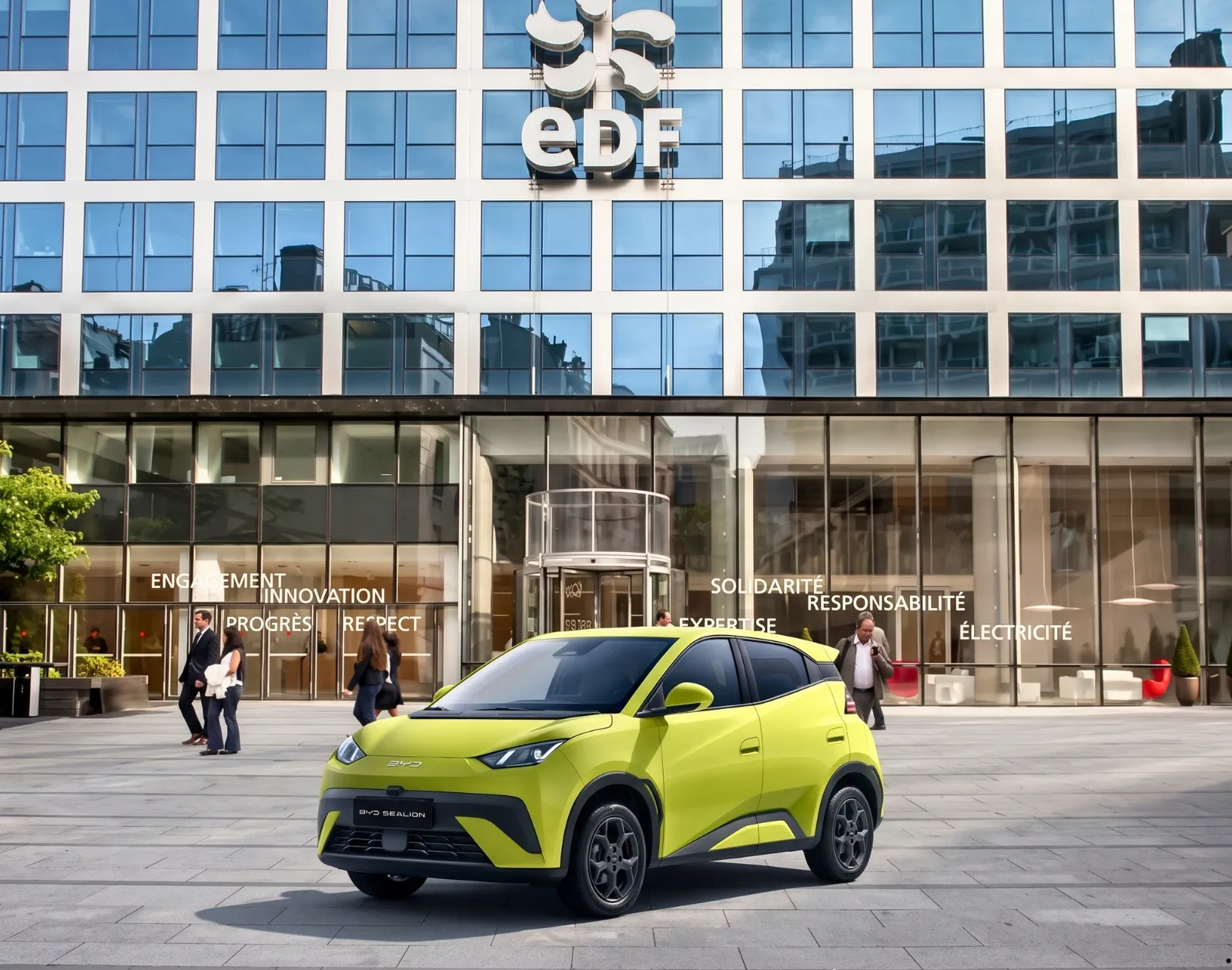
Thanks to the UNEC subsidy, individuals and businesses receive a discount when purchasing a new electric vehicle. To make these vehicles more accessible to their customers, some automakers partner with energy suppliers. These suppliers pay a few hundred euros per sale, thereby reducing the cost. In France, EDF has just entered into a new partnership with the Chinese automotive giant BYD. This move has caused dissatisfaction even at the highest levels of government.
Since the end of the environmental bonus, the main support provided for purchasing or leasing an electric vehicle over the long term comes through the energy savings certificate (CEE) mechanism. In short, this mechanism requires energy suppliers to subsidize actions that lead to energy savings proportional to their operations.
Thus, CEEs can reduce the purchase price or first lease payment for a new electric vehicle by several hundred to several thousand euros, depending on the buyer’s profile and the vehicle’s eco-score. The subsidy is granted without any conditions related to the vehicle brand. The buyer must submit their application before signing the order, to an energy supplier or a company specialized in CEEs.
Also read
10 to 80% in 6 minutes: Does BYD’s ultra-fast charging damage batteries?
Most car brands partnered with energy suppliers
To simplify the process and apply the EU rebate directly to their customers, most car manufacturers are affiliated with these suppliers and organizations. In France, for example, EDF has formed a partnership with the Volkswagen Group. As a company wholly owned by the French state, this national electricity provider has no agreements with French automakers, and this situation has not caused any reactions so far.
The controversy arose in early September when EDF decided to partner with the Chinese giant BYD for its back-to-school product launch. A €365 subsidy was offered to individuals who purchased or leased certain 100% electric models: the Dolphin Surf, Atto 2, Atto 3 Evo, and Sealion 7. For professionals, the subsidy amounted to €555.
Also read
BYD Dolphin G DM-i review: a rechargeable super hybrid city car, but what’s the point?
The EDF/BYD partnership heavily criticized by both left and right
Noted by Les Échos, this partnership has triggered reactions from several politicians. On the social media platform X, deputy Place Publique Sacha Houlié expressed outrage: “At what point does a company 100% owned by the French state favor a foreign industrialist (and not just any one!) over its own manufacturers! What are the ministers in charge for?! What a scandal!” On the right, it also angered LR senator Marie-Claire Carrère-Gée, who called it “Scandalous and irresponsible” on X.
According to the economic newspaper, Industry Minister Sébastien Martin reportedly asked EDF to end its partnership with BYD by the end of the year, reminding them that “European taxpayers’ money must first support our industrial base and jobs.”
Also read
BYD reaches a critical milestone: its future now hinges outside of China
Other French energy companies are already partnered with foreign manufacturers.
In fact, the CEE subsidy does not rely on public funds; it is private assistance governed by public rules. Its cost is estimated at 8 billion euros per year starting in 2026, primarily funded by energy consumers’ bills. In other words, all of us. It finances not only the purchase of electric cars but also energy efficiency upgrades (insulation, boiler replacement, etc.).
Furthermore, other French energy providers and organizations are already partnering with foreign automakers without causing any outrage. Outside the European Union, Korean company Kia stands out for relying on French energy giant Engie (in which the state holds a 23% stake). Hyundai utilizes funds from a La Poste subsidiary owned by the state at 34%. Below is an incomplete table summarizing the main partnerships:
Automaker
EEA Partner
Renault, Dacia, Alpine, Mobilize
CertiNergy (Engie)
Peugeot, Citroën, DS, Fiat, Opel, Jeep, Alfa Romeo, Lancia
CertiNergy (Engie)
Nissan
CertiNergy (Engie)
Kia
Engie
Volkswagen, Audi, Skoda, Cupra
EDF
BYD
EDF
Toyota, Lexus
Siplec (E.Leclerc)
Ford
Siplec (E.Leclerc)
Hyundai
Energy Savings (La Poste)
Volvo
Energy Savings (La Poste)
A debate that goes beyond the issue of CEE subsidies
Beyond the few hundred euros in CEE subsidies offered by EDF for purchasing a new BYD electric car, the controversy reflects the competition exerted by Chinese manufacturers on their French and European counterparts. With its low-priced, high-equipped models, BYD directly threatens the sales of domestic automakers.
Only the “boost subsidy,” an additional bonus to the CEE subsidy granted only to vehicles primarily manufactured in Europe, can currently keep price differences in check. This safeguard may fail once BYD launches its first models produced on the Old Continent.