
EDENenergy builds batteries from old e-scooter batteries
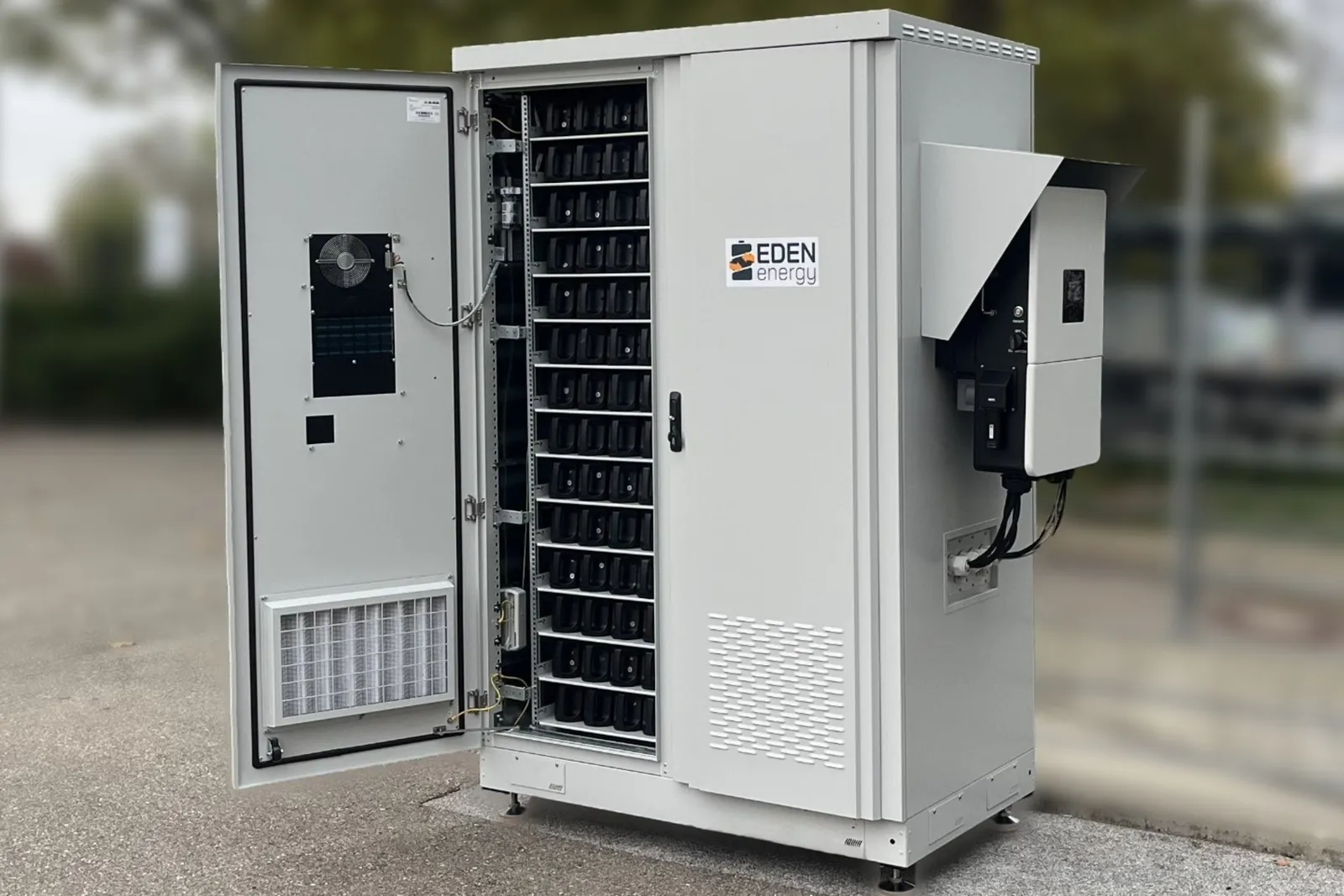
The Freiburg startup EDENenergy is developing stationary commercial batteries using used e-scooter and e-bike batteries. The first battery with a 70 kWh capacity has already been delivered. In the future, different battery types are also set to be combined.
The first tested used batteries still retained more than 90 percent of their original capacity in some cases.
Image: EDENenergy
EDENenergy, a startup founded by the Fraunhofer Institute for Solar Energy Systems ISE, aims to give second life to used batteries from micromobility devices. To achieve this, the company based in Freiburg develops modular energy storage solutions for commercial and industrial clients. In mid-October, the first storage unit with a capacity of 70 kWh was delivered to a customer.
The system connects 112 used e-scooter batteries together. Before use, these batteries are tested for their technical condition. According to the company, the initial results were better than expected: among the approximately 350 batteries tested, the remaining capacity in some cases was well above 90 percent. EDENenergy had originally estimated a so-called health status of 80 percent.
The technical foundation is power electronics developed at Fraunhofer ISE. It is designed to enable the combination of batteries of different shapes and with various battery management systems in a stationary storage system, without the need to disassemble individual batteries. So far, EDENenergy relies primarily on larger suppliers such as operators of e-scooter and e-bike fleets to obtain sufficient batteries of the same type.
EDENenergy plans storage systems with up to 300 kWh
A advantage of the modular concept is the interchangeability of batteries. EDENenergy monitors each module remotely and can replace them if needed even during operation. This is intended to maintain a constant storage capacity over the long term. The company promises that it will still be able to provide the original 70 kWh capacity even after ten years. Batteries that are completely worn out are then sent for recycling.
Initially, the product is aimed at medium-sized companies with their own photovoltaic systems that wish to increase their self-consumption or reduce peak loads. EDENenergy also sees potential applications for utility companies and the electricity trading sector. In the long run, the startup plans to expand its storage capacity to up to 300 kWh.
A challenge remains the variety of available batteries. For each new battery type, connections, battery management, and communication systems must be adapted, among other things. In the long term, EDENenergy believes unified communication standards and clear legal frameworks for the stationary reuse of mobile batteries are necessary.
Other companies are also working on recycling used batteries from micromobility. For example, e-scooter rental service Lime and U.S.-based battery recycler Redwood Materials agreed in 2025 to collaborate on battery recycling in Germany, the Netherlands, and the U.S. While this aims to recover valuable raw materials for new batteries, EDENenergy focuses first on reusing functional batteries in stationary storage systems. Only afterward are they intended to be sent for recycling.
To further develop its initiatives, the company is seeking additional pilot customers from local businesses. According to the company, relevant projects can receive 50 percent funding through Baden-Württemberg’s support program “Mittelstand trifft Start-ups.” EDENenergy also receives support from the Sustainability Performance Center and the BW Pre-Seed program. The first investor is Ulrich Prediger, founder of JobRad.