
Echion wins ETS as partner for niobium anode material
The British battery materials startup Echion will now be working with the South Korean battery equipment manufacturer Energy Tech Solution (ETS). At the core is XNO, Echion’s niobium-based anode material, which is said to enable extremely fast charging and very high cycle life.
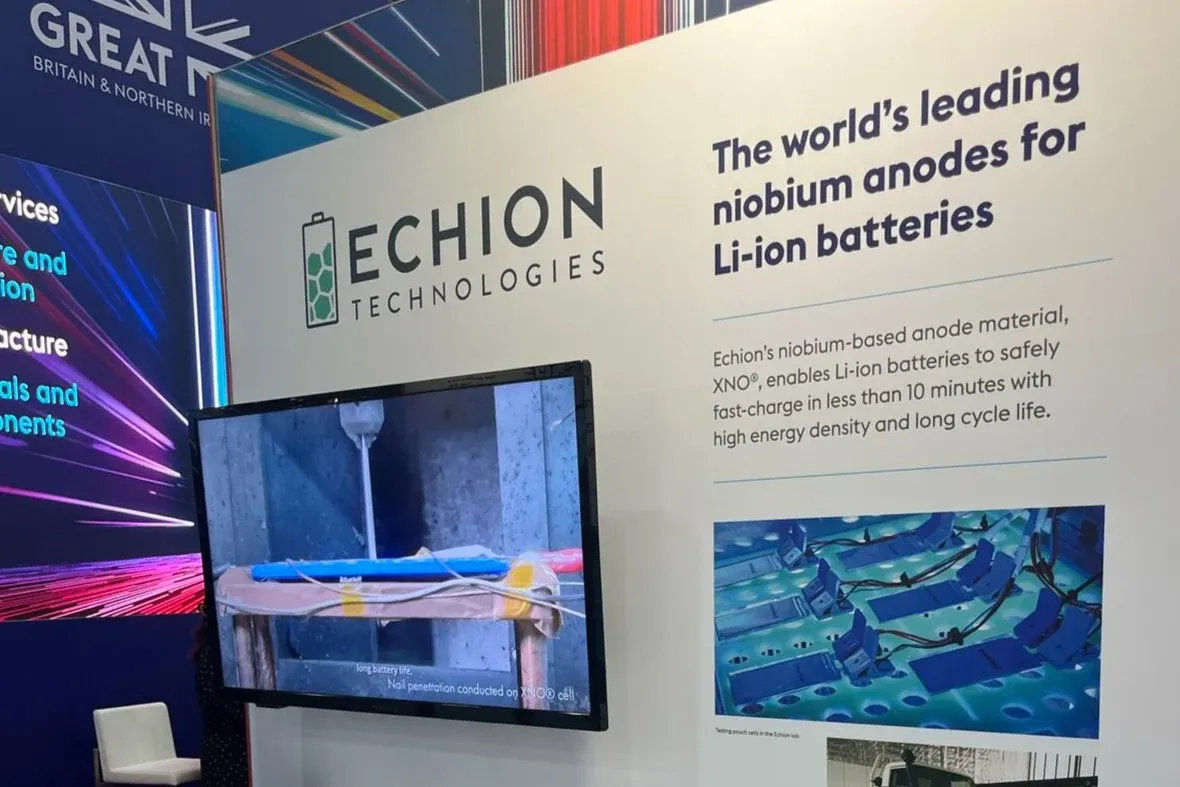
Echion’s booth at the Battery Show
Image: Echion
Specifically, Echion Technologies has signed a Memorandum of Understanding (MoU) with Energy Tech Solution (ETS) to jointly develop battery cells using Echion’s XNO anode material. ETS is expected to provide not only manufacturing technology but also handle cell design and act as a contract manufacturer for demonstration cells.
For Echion, ETS represents the first so-called “Total Battery Solution Provider” in its own partner network. The company, headquartered in Seoul with another facility in South Korea’s Chungju, develops production facilities for battery startups and gigafactories and also manufactures cells on contract. Under the agreement, ETS plans to establish capacity in Chungju for XNO cells in cylindrical, prismatic, and pouch formats.
"Echion has demonstrated impressive performance in our specially developed cells," says Y.H. Kim, CEO of ETS. "As battery technology increasingly penetrates all sectors of the global energy system, this long-lasting high-performance chemistry will find its place among the most demanding applications."
Echion has developed the "Drop-in" anode material XNO
But what lies behind XNO? Simply put, Echion does not start with the entire lithium-ion battery but rather with one of its two electrodes: the anode. In today’s lithium-ion cells, this is usually made of graphite. XNO replaces graphite with a material developed by Echion that is based on nickel oxides. The cathode—made of materials such as NMC or LFP—can remain unchanged according to Echion. That’s why the company refers to XNO as a “drop-in” anode material that can be processed using conventional electrode coating facilities.
The advantages lie primarily in fast charging and longer battery life. Echion claims a continuous charging rate of up to 10C for XNO cells — theoretically allowing a full charge in about six minutes. Under optimal conditions, the company states more than 50,000 charging cycles, while in real-world industrial use with fewer cycles, it reports over 15,000 cycles. For comparison, LFP cells are typically charged at much lower C-rates. Thus, XNO is positioned less as an alternative for maximum range and more for applications where batteries need to be charged and discharged frequently and quickly.
Niobium anodes, especially for demanding applications
Echion is primarily targeting industrial applications such as mining vehicles, rail vehicles, ships, forklifts, as well as stationary storage systems and uninterruptible power supplies for data centers. Another comparison point is lithium titanate (LTO): this technology is also known for very fast charging and many charge cycles, but it has a relatively low energy density. Echion claims that XNO has roughly twice the energy density of LTO, which should enable smaller and lighter batteries with similar cycle life performance.
The technology is no longer solely in the laboratory stage. According to Echion, it has been producing XNO on an industrial scale since 2025. Together with niobium producer CBMM, the company operates a facility in Araxá, Brazil, with an annual capacity of 2,000 tons of XNO — enough to produce roughly 1 GWh of battery cells. With ETS, a new partner has joined to handle the next stage of value creation: the development and manufacturing of actual battery cells.
Goal: 10C charging and 50,000 cycles
As part of this collaboration, Echion and ETS aim to first demonstrate XNO cells with high cycle durability and fast charging speeds. ETS sets a target of up to 50,000 cycles and charging rates of up to 10C. Whether these values can be achieved in cells suitable for mass production under actual operating conditions will have to be shown by further development.
"Energy Tech Solution offers a comprehensive range of services related to battery solutions as well as manufacturing expertise, and has proven that the company excels at bridging process engineering with scientific research and development," says Jean de La Verpilliere, CEO of Echion. "We are convinced that XNO batteries, manufactured by ETS’ experts using proven facilities, provide exactly the charging performance and cycle life that customers need for their operations if they wish to produce their own XNO batteries."