
Electric Mobility in Germany: Market and Sales Trends in the First 9 Months of 2026
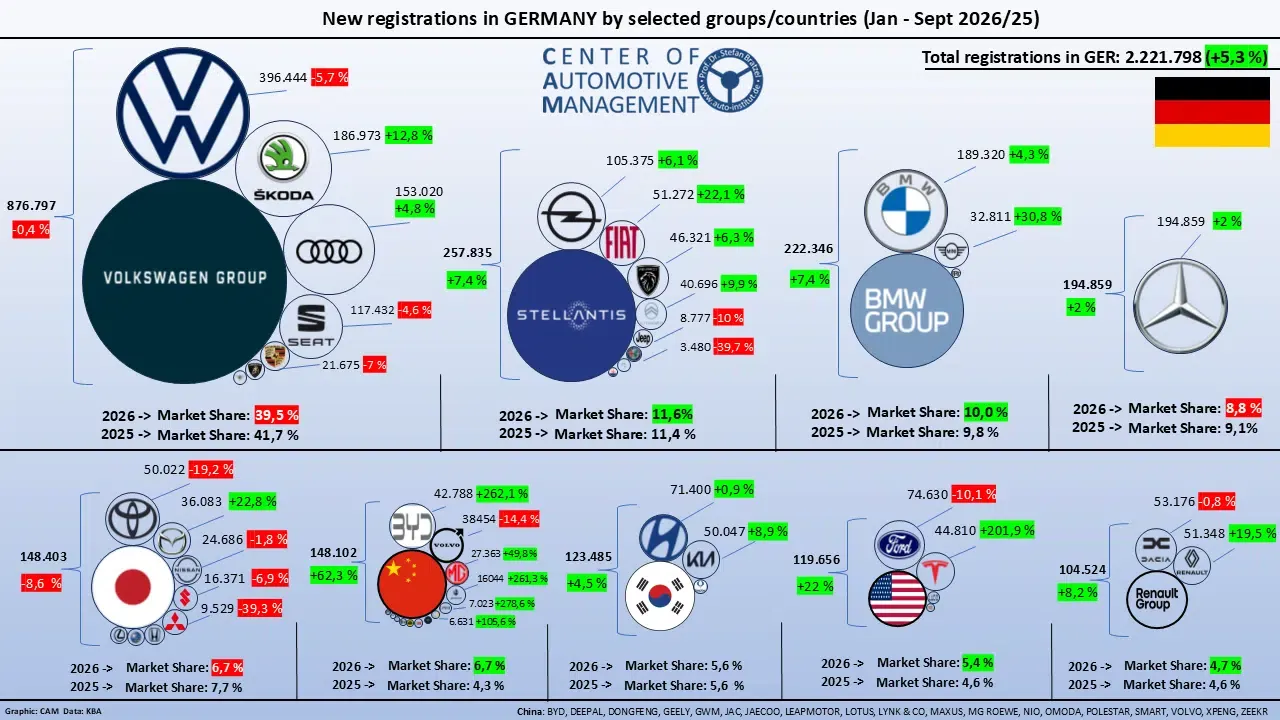
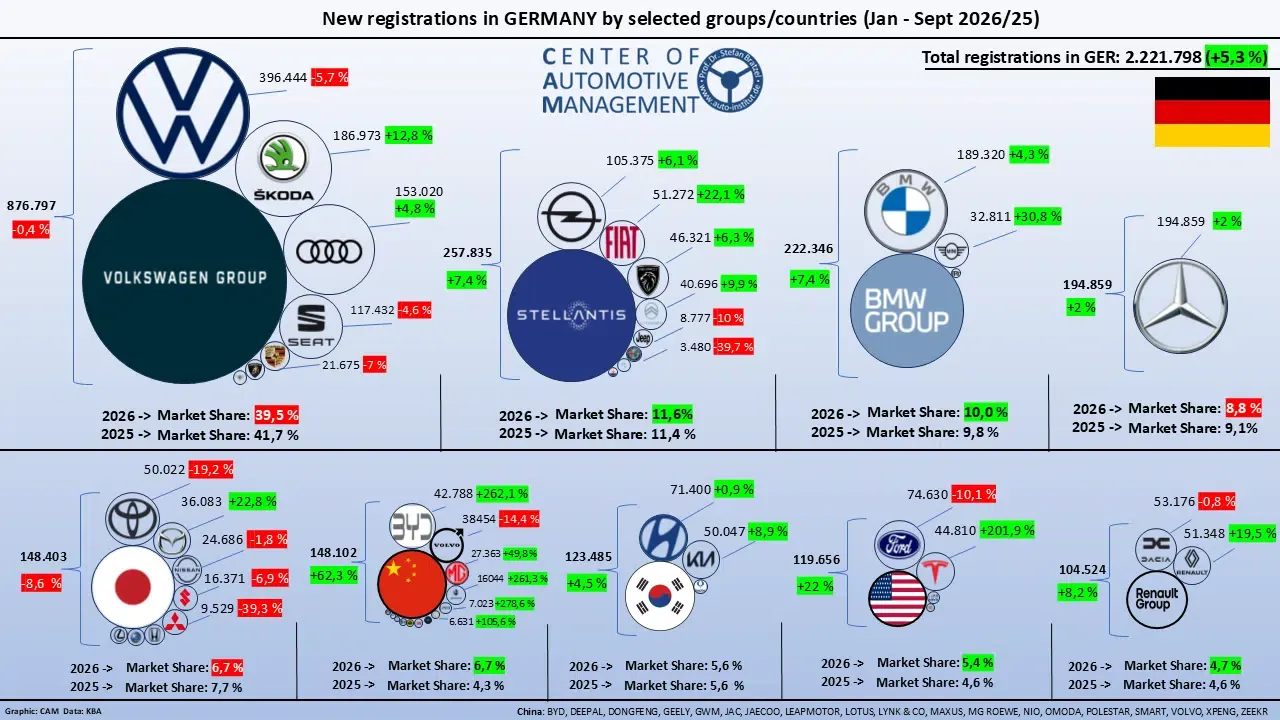
In Germany, as electric mobility shifts from a niche market to a mass market, the power dynamics among automakers are increasingly changing. From January to September 2026, Chinese manufacturers and Tesla were able to gain significant market share, while many established automakers from Germany or Japan lost ground in the expanding overall market. A total of 2,221,798 new passenger cars were registered in the first nine months, representing a 5.3 percent increase compared to the previous year’s period.
This is evident from the CAM Electromobility Report. The Volkswagen Group remains by a large margin the market leader. However, both its market share (from 41.7% to 39.5%) and sales volume (-0.4%) are declining. The core VW brand suffers a significant drop of -5.7%, while its subsidiary Skoda manages to see growth of +12.8%. In contrast, Chinese manufacturers are gaining strongly, with their combined market share rising by 2.4 percentage points to 6.7% after three quarters of 2026. With 148,102 new registrations, they are now almost on par with the group of Japanese manufacturers (148,403).
Among the top performers from China is BYD, which has already surpassed Volvo with 42,788 cars sold (+262%), compared to Volvo’s 38,454 new registrations (-14.4%). MG, Leapmotor, and XPeng also saw significant growth. Tesla, the U.S.-based electric vehicle pioneer, remains ahead of BYD overall with 44,810 cars sold (+202%).
Stellantis, as the second-largest automaker, was able to slightly increase its market share in Germany to 11.6% (+0.2 percentage points), thanks largely to Opel, the best-selling brand with a 6.1% increase, and Fiat with a 22.1% rise. BMW also saw a slight increase in market share, rising by 0.2 percentage points to 10.0%, while Mercedes lost a small amount of market share despite a 2% increase in sales (8.8%; -0.3 percentage points).
Japanese manufacturers are suffering significant losses: their market share drops from 7.7% to 6.7%, while sales volume falls by 8.6%. This decline affects almost all brands. Toyota, as the largest seller, experiences a 19.2% decline. Mazda is the only positive exception among Japanese brands with a 22.8% increase.
Korean manufacturers Hyundai and Kia manage to stabilize their market share at 5.6%. The Renault Group sees a slight increase in its market share to 4.7% (+0.1 percentage points), driven by its core brand Renault (+19.5%). In contrast, Ford loses 10.1% in sales volume after nine months in Germany’s growing market.
The market for purely battery-powered passenger cars (BEVs) is developing particularly dynamically. From January to September 2026, 604,144 BEVs were newly registered, 58 percent more than in the same period last year and already exceeding the total for entire year 2025 (545,142). Their share of new registrations rose from 18.1 percent to 27.2 percent. Throughout the year, the monthly BEV share increased from 22.0 percent in January to a record high of 34.5 percent in September. With 88,599 units (+94.7%), September was also the second-best month for BEVs overall. Only December 2022 saw more registrations (104,325), when buyers rushed to register vehicles before the reduction of government subsidies for electric cars known as the “Umweltbonus.”
In contrast, the market share of plug-in hybrids (PHEV) remains around 11 percent (January–September: 11.1%). In September, 27,861 PHEVs were newly registered, accounting for a market share of 10.8 percent. Together, BEVs and PHEVs account for 45.4 percent of new car registrations.
Traditional internal combustion engines are losing significant importance. New gasoline vehicle registrations dropped by 29.2 percent to 44,632 units in September, while diesel registrations fell by 20.1 percent to 23,058 units compared to the same month last year. Together, gasoline and diesel vehicles now only account for 26.4 percent of the market share, far less than BEVs alone.
"Electric cars have reached the mass market in Germany."
"Electric cars have entered the mass market in Germany: In September, more than one-third of all new cars were pure electric vehicles, and after nine months, more BEVs have been registered than in the entire year 2025. This rapid growth is driven primarily by a significantly wider range of attractive electric models, as well as government incentives and high fuel prices. At the same time, the balance of power is shifting permanently: Tesla and Chinese manufacturers are gaining market share thanks to their strong value for money, while many established manufacturers are losing ground," said study leader Stefan Bratzel.
"The electric vehicle market is growing — but not automatically in favor of German manufacturers. They must now turn this growth into their own market share and cost advantages by offering competitive prices and affordable models. Those who cannot keep up will eventually be among the losers. Policy makers should ensure a stable market environment, especially regarding charging infrastructure and charging prices. For the whole year, we expect 825,000 to 850,000 new electric cars — with the upper end of this range becoming increasingly likely."
