
An electric truck study demonstrates the advantages of shared charging infrastructure
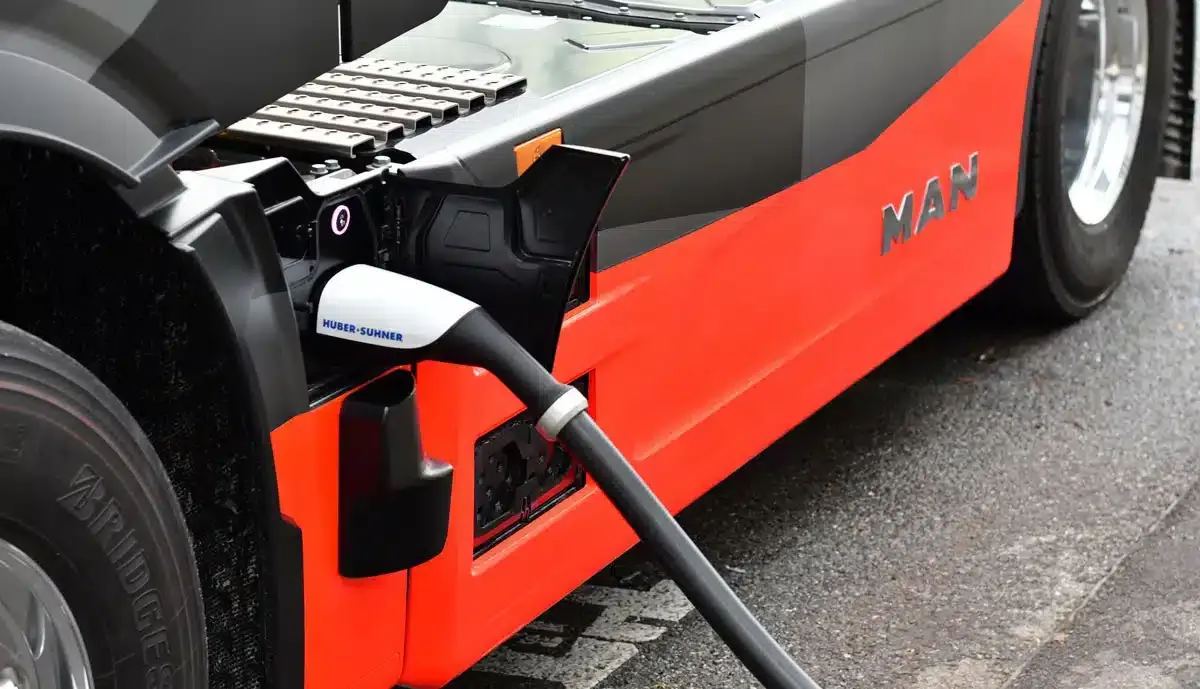
Image: MAN Truck & Bus SE (illustrative)
In addition to independence from continuously rising fuel costs, a good charging infrastructure is crucial for the widespread use of electric trucks. A new study by NRW.Energy4Climate shows the potential that shared charging infrastructure can offer for this purpose. Consolidating charging needs and jointly planning locations make battery-electric heavy transport even more cost-effective.
The study “Charging Infrastructure for Electric Trucks in Commercial and Industrial Areas” examines various charging scenarios, operator models, as well as the technical and economic requirements for a viable charging infrastructure. Battery electric trucks are already technically available for many applications and increasingly cost-effective to use, which makes their integration into existing logistics, energy, and infrastructure systems a key focus. Since a large portion of the required energy is charged in depots and locations near them, these play a central role in the electrification of heavy freight transport.
According to the study, key challenges include limited grid capacity, long lead times for grid connections, and location-specific restrictions. At the same time, demand for electrical power is rising in other areas such as data centers, industry, and energy storage, making grid capacity an increasingly scarce resource.
The analysts conclude that what is needed is not primarily additional grid connection capacity, but rather more efficient use of existing capacity. Standalone storage solutions reach economic limits, especially under high power demands, due to high investment costs, power-dependent electricity prices, and limited utilization rates.
Community charging clusters reduce costs and ease strain on power grids
According to the analysis, particularly large potential exists for jointly used charging clusters in commercial and industrial areas where availability of space, energy demand, and infrastructure decisions overlap geographically. By aggregating the charging needs of multiple companies, grid connections can be utilized more efficiently, investments reduced, and energy costs lowered. Combined with photovoltaic systems, battery storage, and intelligent load management, integrated charging solutions can be created that enable technical and economic scaling.
Various models exist for building and operating charging infrastructure, going beyond traditional public charging stations and individual company-owned depots. Companies can open their existing charging points to selected additional users, thereby increasing utilization, reducing fixed costs, and generating extra revenue, while they themselves can also use charging facilities at other depots.
Alternatively, multiple companies can jointly build and operate the infrastructure or supplement or use public charging services as an alternative. The operational models range from in-house management to collaboration with service providers, as well as joint solutions through partnerships, operating companies, or cooperatives.
However, high-performance, community-shared, and energy-integrated charging clusters have not yet been widely implemented. Therefore, in addition to highlighting the economic potential, the study also presents specific implementation approaches, decision-making structures, and action recommendations, with site operators playing a crucial role through early infrastructure planning, securing grid capacity, and fostering corporate collaborations.
According to the study authors, North Rhine-Westphalia offers particularly favorable conditions for taking a leading role in developing such charging infrastructure due to its high density of logistics companies, strong industrial base, and efficient energy providers. “Implementing the first large-scale charging clusters requires coordinated efforts from all relevant stakeholders — from logistics companies and site operators to energy providers and the public sector,” it states.
Also interesting
About the author
Thomas Langenbucher is an expert in electromobility with professional experience in the automotive and financial industries. Since 2011, he has been covering electric vehicles, sustainable technologies, and mobility solutions for ecomento.de. Learn more.
Reader interactions