
DUH-Dienstwagen-Check 2026: Top politicians once again favor internal combustion engines more heavily
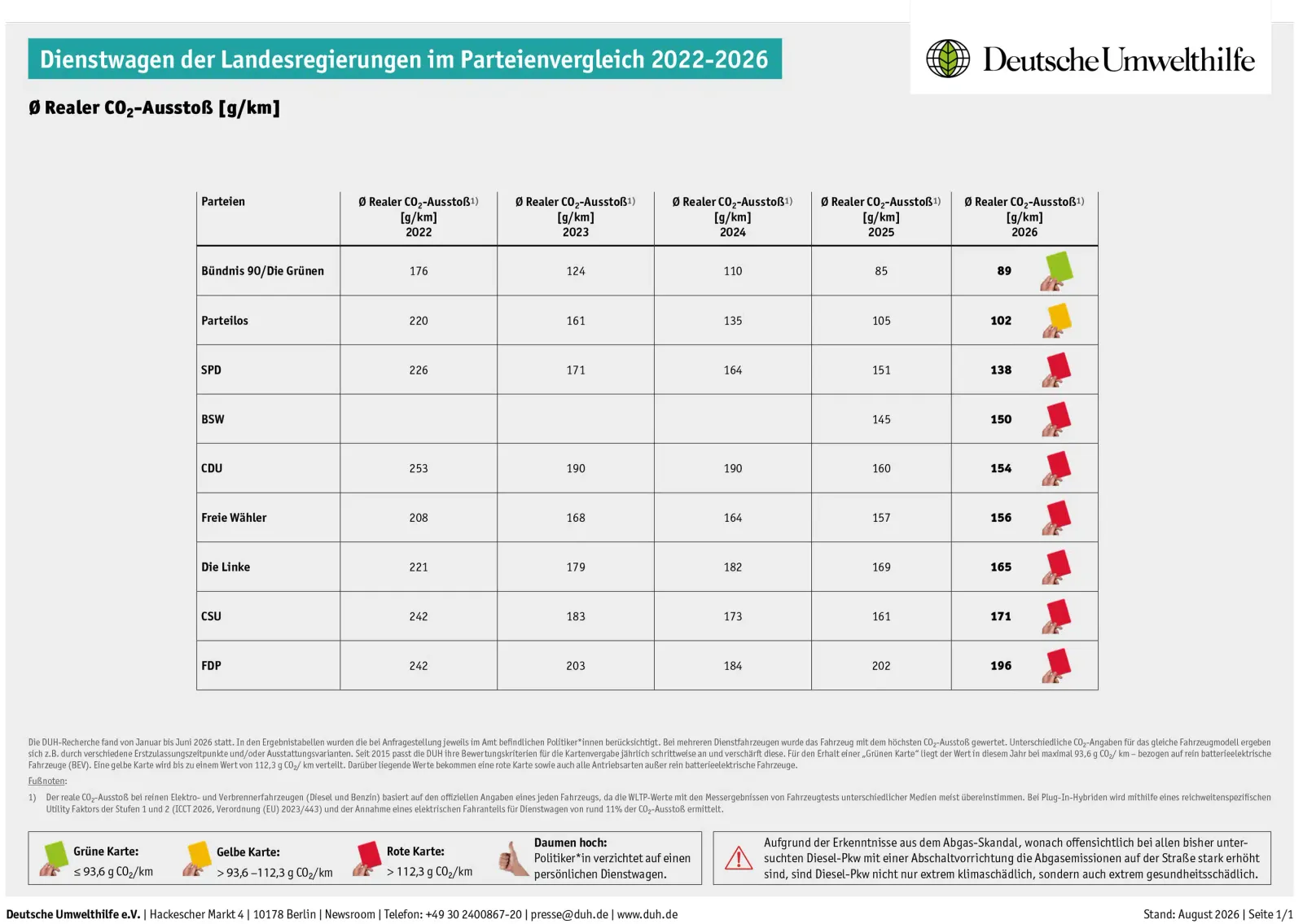
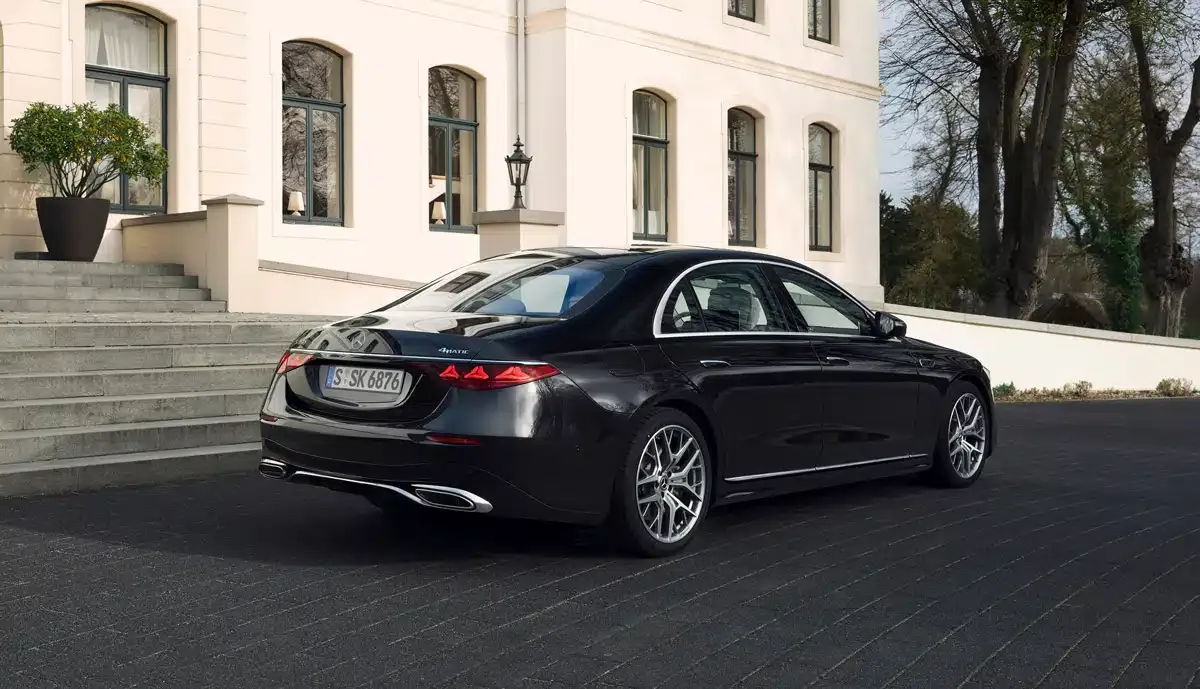
Image: Mercedes-Benz (illustrative)
German top politicians are increasingly turning to vehicles equipped with internal combustion engines again. This is shown by the 20th Vehicle Check conducted by Deutsche Umwelthilfe (DUH). According to this, 160 out of 249 official vehicles exceed the EU fleet emission limit in terms of actual CO2 emissions and receive a “red card.”
The DUH is particularly critical of the rise in climate-damaging plug-in hybrids. Vehicles equipped with large internal combustion engines and small electric motors account for 42 percent of all business cars. At the bottom of the list are Federal Government Justice Minister Stefanie Hubig and Education and Family Minister Karin Prien, each emitting 196 grams of CO2 per kilometer, while state leaders Hendrik Wüst, Manuela Schwesig, and Kai Wegner each emit 262 grams of CO2 per kilometer driven.
The proportion of fully electric vehicles declined compared to last year at both the federal and state levels, accounting for 36 percent overall with 90 vehicles. The differences in actual CO2 emissions are significant: fully electric business cars emit an average of 62 grams of CO2 per kilometer. Plug-in hybrids produce 179 grams, emitting almost three times as much CO2. “All models far exceed the EU fleet limit, as they only use electricity for 11 percent of their trips and rely entirely on the highly fuel-intensive internal combustion engine for 89 percent,” says DUH. Conventional internal combustion engines would emit even more, at an average of 193 grams of CO2 per kilometer.
The regression is particularly evident in several newly acquired official vehicles: State ministers from the Foreign Office, Serap Güler, Gunther Krichbaum, and Florian Hahn, switched from their previous electric vehicles to more climate-damaging plug-in hybrids. Similarly, Hamburg’s Environment Senator Katharina Fegebank and Finance Senator Andreas Dressel, along with Saxony’s State Minister for the Environment, Georg-Ludwig von Breitenbuch, replaced their electric cars with plug-in hybrids. As a result, they now exceed the CO2 fleet limit.
"It is completely absurd that government officials in 2026 still intend to increase the proportion of vehicles powered by internal combustion engines," says Barbara Metz, federal executive director of DUH. "Two out of three vehicles in our survey are equipped with climate-damaging internal combustion engines – this is a challenge to forward-looking transportation policies and a disastrous signal for Germany’s climate policy. The officials in federal and state governments are failing miserably in their role as role models."
Hamburg’s senator for urban development and housing, Karen Pein, shows that it’s possible to do things differently: by switching to an electric car, she reduced the CO2 emissions of her official vehicle from 134 grams to 50 grams per kilometer. Metz said, “We urge the federal government and state governments to consistently switch to efficient electric cars in every new purchase, instead of continuing to artificially make climate-damaging plug-in hybrids attractive.”
The most fuel-efficient official vehicle in the federal government is driven by Development Minister Reem Alabali-Radovan, with 64 grams of CO2 per kilometer. Among the state leaders, Baden-Württemberg’s prime minister, Cem Özdemir, has the lowest emissions at 66 grams of CO2 per kilometer.
Additional Results
Among the state governments, only Berlin, Baden-Württemberg, and Schleswig-Holstein receive a yellow card for their fleets. At the bottom of the list are again Saxony-Anhalt and Mecklenburg-Vorpommern, which will also abstain from using fully battery-electric official vehicles in 2026.
Among the federal ministries, the Federal Environment Ministry (BMUKN), the Federal Interior Ministry (BMI), the Federal Development Ministry (BMZ), and the Federal Labor Ministry (BMAS) receive a green card.
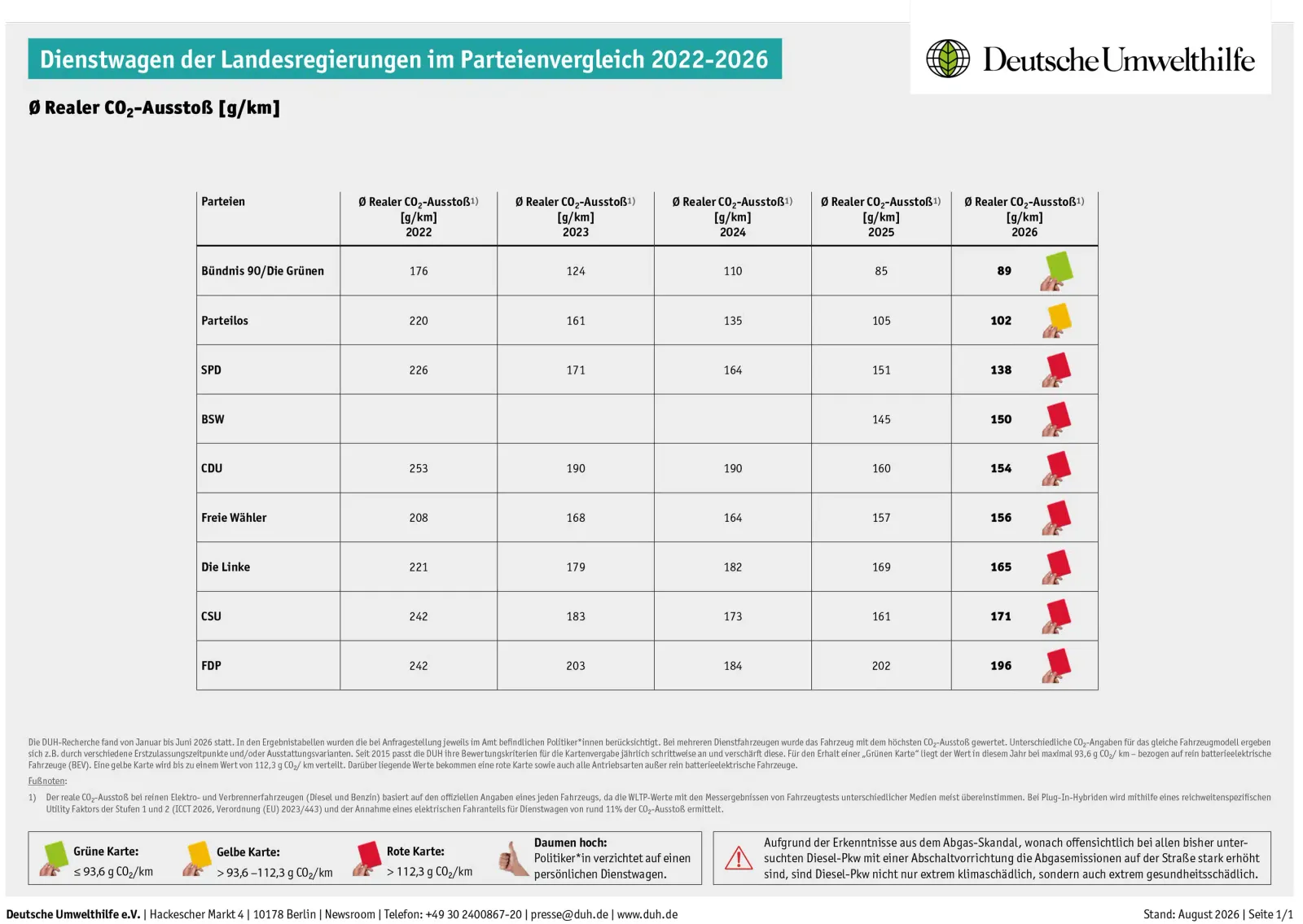
In terms of political parties, only Bündnis 90/Die Grünen receives a green card. Independent officials receive a yellow card. All other parties receive a red card.
In a comparison of environment ministers, Bremen’s senator Henrike Müller sets a good example by using a service bike. The most fuel-efficient vehicle is used by Lower Saxony’s environment minister, Christian Meyer, with 50 grams of CO2 per kilometer. As in the previous year, Saxony-Anhalt’s environment minister Armin Willingmann is at the bottom of the list, his official car emitting 192 grams of CO2 per kilometer.
The DUH’s 20th official car survey is based on data collected from January to June 2026. Officials who changed positions or retired after the survey was conducted were not included, nor were those appointed after the survey period ended.
The vehicles of the Chancellor, Vice-Chancellor and Finance Minister, Defense Minister, Interior Minister, and Foreign Minister are not included in the overall ranking. A base model with the same engine power was chosen for calculating other specially protected vehicles.
Also interesting
About the author
Thomas Langenbucher is an expert in electromobility with professional experience in the automotive industry and finance sector. Since 2011, he has been covering electric cars, sustainable technologies, and mobility solutions on ecomento.de. Learn more.
Reader interactions