
Dreame is ending the Starry Sky project after one year. The Rocket Car, which claimed a 0.9-second 0-100 km/h time, was supposed to be a decoy.
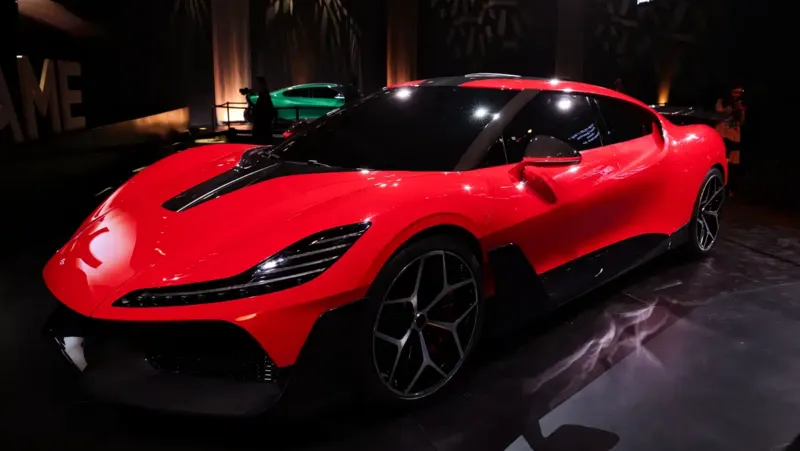
Dreame Technology, a manufacturer of vacuum cleaners and cleaning robots, is ending its automotive operations and shutting down the Starry Sky project. This comes just one year after the company entered the automotive industry, following high-profile displays at CES 2026 and the launch of the Nebula Next 01 Jet Edition on April 27 in San Francisco. For EV readers, this is a sobering wake-up call, as it highlights the gap between a flashy launch and a real automotive roadmap.
Table of Contents
Show
Hide
From a high-profile entry to shutting down in just a few months
Dreame officially entered the automotive sector in August 2025. For a company outside this industry, the pace was aggressive. It quickly established a division that employed nearly 1,000 people at its peak.
At the beginning of 2026, the company created a lot of buzz around itself. In January, it showcased a supercar at CES, and on April 27, 2026, in San Francisco, it unveiled the Nebula Next 01 Jet Edition, marketed as a Rocket Car.
Then came the rapid shutdown. Layoffs began in May 2026 and lasted for months. From nearly a thousand employees, only a few dozen remained, mostly from finance, legal, and HR departments. Their task was no longer to develop the car but to close down the companies, settle obligations with suppliers, and formally end the project.
This pace speaks volumes on its own. Even in China, where new brands emerge quickly, it is an extreme outcome to go from launch to complete liquidation in just one year.
The specifications sounded like science fiction, not a production plan
Paper plans can accommodate anything, and here it accommodated a lot indeed. The Rocket Car was supposed to achieve 0-100 km/h acceleration in 0.9 seconds, feature a solid-state battery based on sulfides with an energy density of over 450 Wh/kg, a range of more than 550 km in CLTC cycles, and an engine system with a maximum thrust of 100 kN.
It sounds spectacular. The problem was that these figures were detached from market realities.
Even today, the most powerful players in China, Korea, or the US do not sell mass-produced cars with semiconductor batteries of such specifications. Battery manufacturers like CATL, BYD, and Geely talk more about pilots and small batches around 2027 rather than a ready-made supercar with road homologation. The figure of 450 Wh/kg itself seemed more like a laboratory claim than a product specification.
This is compounded by CLTC, the Chinese testing cycle known for its optimistic results. Even if such a car existed, 550 km of CLTC testing wouldn’t say much about real-world driving range. Here, it quickly became clear the problem was far more fundamental: it wasn’t a discrepancy between standards and actual roads, but rather between the model and the actual car.
Former employees: the display model didn’t even have a chassis
The most serious accusations come from former employees cited by Chinese business media. According to these accounts, the model shown at CES didn’t even have a chassis and was moved using remote control.
That’s not all. The Rocket Car itself was supposed to be purchased from a model company in Shanghai for several million yuan, after which it would be equipped with elements that looked good on camera, including a chassis and nozzles styled to resemble rocket propulsion.
If this information is true, we’re not talking about an immature prototype. We’re talking about a marketing prop. The difference is fundamental.
In the automotive industry, concept models have existed for decades. A concept without full functionality doesn’t surprise anyone if the manufacturer honestly communicates that it’s a stylistic study or a technology demonstrator. Here, the problem wasn’t the concept model itself, but the scale of the claims and the impression that there’s a real development program behind the spectacle.
Funding first, then R&D. An inverted project logic
According to insiders, at Dream the sequence of actions was unusual even by startup standards. Instead of developing technology and a product first, the team was supposed to find money first, only afterward receiving a budget for research and development.
This is the core of this story. In a healthy car project, marketing sells progress on work. Here, it seemed as though progress on work was supposed to sell marketing.
Employees also claim the company lured specialists from reputable brands with high salaries and fancy job titles. Simply bringing in people from the industry isn’t anything unusual. Xiaomi did similar things, but there they had factories, homologation, deliveries, and a mass-produced product to back the transfers. With Dreame, the most important thing was missing—solid proof that the car was actually being built.
Poor.
Regulators urged an end to the project
The reputational issues were compounded by regulatory oversight. Reports emerged that local regulators became interested in how investment funds were being used, restricting the company’s ability to freely spend public subsidies.
In a project that requires such substantial capital, this is a blow from which it’s difficult to recover. If a company loses investors’ trust and authorities start scrutinizing its use of public funds, the margin for error disappears very quickly.
We still don’t have a full picture of the legal proceedings, court outcome, or official technical report. But just the involvement of regulators has been enough to turn the project from an ambitious startup into a costly problem to resolve.
Dreame returns to vacuums, lawn mowers, and robots
President Yu Hao has stepped back from the automotive venture and scaled back most of the company’s incubators. Dreame will now focus on four main business areas:
vacuums,
lawn mowing robots,
two-wheeled electric vehicles,
Magic Atom robots.
That sounds reasonable indeed. The company still wants to go public, so streamlining its business and dropping the riskiest project might be an attempt to save credibility among investors.
For the EV market, this is also a lesson that entering automotive isn’t a natural extension of success in consumer electronics. Xiaomi is an exception today, not a simple blueprint for every home appliance or smart device manufacturer. A car isn’t just another gadget with an app. It requires certifications, suppliers, safety measures, legal responsibility, and enormous capital that must be invested over years.
Dreame’s story also shows something else. Impressive things are still happening in China’s electric vehicle sector, but alongside real breakthroughs, there are also projects that only look good in renders, on stage, or at trade shows. That’s why when claims like 0.9 seconds to 100 km/h and 450 Wh/kg are made, it’s better to look for a factory, tests, and cell suppliers first before getting excited.
The most interesting part of this story isn’t that Dreame failed, but how quickly the market exposed marketing without a real product. Do you think there are more such projects with flashy prototypes and no actual backing in China today than people realize?