
After incentives, turbocharged electric vans account for 7% of the market in August
Pure electric commercial vehicles more than doubled their market share in one year, rising from 2.9% to 7% in August. This increase came after the launch of the MIMIT incentives, whose funds were exhausted in less than an hour. The data confirms that even in commercial transportation, demand for zero-emission vehicles can respond rapidly when supportive measures are actually available.
August sees market growth resume
Italy’s light commercial vehicle market closed August with 8,390 registrations, up 4.6% from 8,025 in the same month of 2025. This marks a reversal from the -10% decline recorded in July, when deliveries dropped to 15,921 units.
The balance for the first eight months of the year remains negative: 119,152 light commercial vehicles were registered, 4.5% fewer than the 124,742 units recorded in the same period of 2025.
August was driven mainly by vehicles already available for immediate delivery, purchased through the new incentive program aimed at vehicles in categories N1 and N2 weighing up to 7.2 tons.
Funds exhausted in less than an hour
The Invitalia platform for booking 2026 incentives opened on July 29, but the available funds were quickly depleted: the resources ran out in less than an hour.
The program provides a total of 180 million euros by 2030, with 40 million per year until 2029 and 20 million in 2030. 40% of the annual funds are allocated to zero-emission vehicles, namely BEVs and FCEVs.
This mechanism has had a noticeable impact on the figures: in July, before the measure took effect, BEVs accounted for 4.9% of the market, compared to 5.2% the previous year. By August, that share rose to 7%, up from 2.9% in August 2025.
There is demand, but incentives are not enough
For Roberto Pietantonio, president of UNRAE, the results for the summer bimester clearly show the impact of the incentive framework. Following the wait period in July, the launch of the platform led to a rapid depletion of resources and subsequent registrations for available vehicles.
This figure is particularly significant because it highlights potential demand for zero-emission commercial vehicles, which does not necessarily translate into purchases without financial support.
Cardinali (UNRAE): Italian electric cars moving backward. An alarm is needed.
UNRAE therefore calls for greater continuity in incentives and financial support that better meets the needs of renewing the vehicle fleet. This is particularly important in Italy, where the commercial vehicle fleet remains very old: of the approximately 4.7 million vehicles in use, 34.6% are still Euro 4 or earlier, meaning they are at least 21 years old.
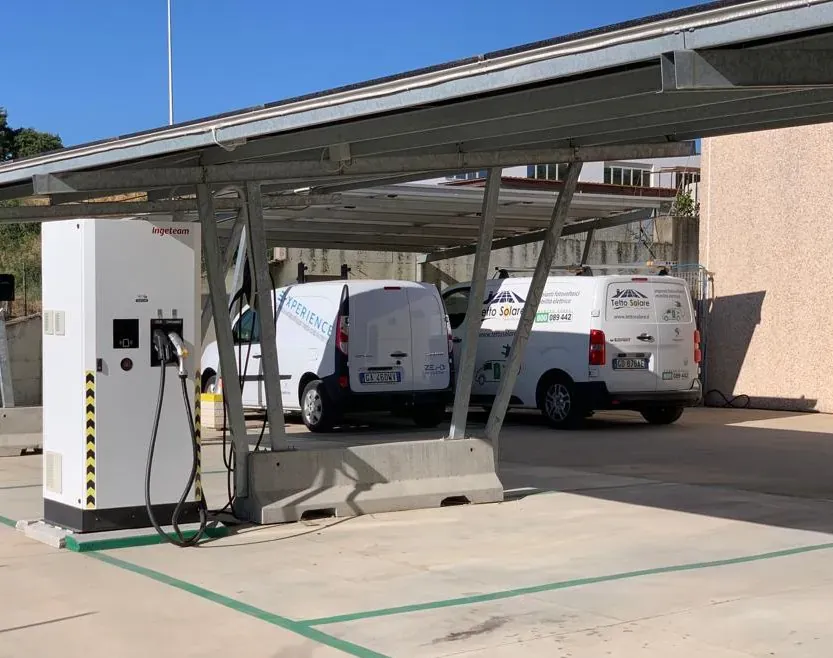
Electric vans also require a charging network
Replacing older vehicles with electric models depends not only on the purchase price. For those who use vans professionally, charging times and methods directly affect the efficiency of their operations.
UNRAE therefore lists specific planning for charging infrastructure for light commercial vehicles as one of its priorities, along with measures to reduce the cost of energy used for charging.
The association also proposes a 50% tax credit for private investments in high-power fast charging stations, over 70 kW, during the 2027-2029 triennium.
BEVs still at 3.7% in cumulative figures
The 7% figure for August should not be mistaken as an already completed market transformation. In fact, in the first eight months of 2026, pure electric commercial vehicles accounted for only 3.7% of the market share, down from 4.4% in the same period of 2025.
The automotive sector remains dominated by diesel, which holds 78% of the total market share despite losing 2.3 percentage points in a year. Hybrids, on the other hand, account for 10.5%, while plug-in vehicles make up 2.2%.
The weighted average CO2 emissions of commercial vehicles registered in the first eight months dropped by 0.5%, from 185.3 to 184.3 g/km.
The August data thus provides a clear indication: when incentives become truly accessible, the electric van market responds. The challenge now is to determine whether more sustained measures and an adequate charging network can turn this summer surge into structural growth.
READ ALSO: “Electric Plaza, fighting rising B2B charging costs with multi-year fixed prices” and watch the VIDEO