
Diesel cars remain the most common in nearly half of the counties.
The sales of new electric cars are rising as expected, but in the total car fleet, diesel vehicles still make up the majority in seven out of the country’s fifteen counties. Now OFV plans to raise the emission standards.
27.10.2026 16:32 | Updated 16:39
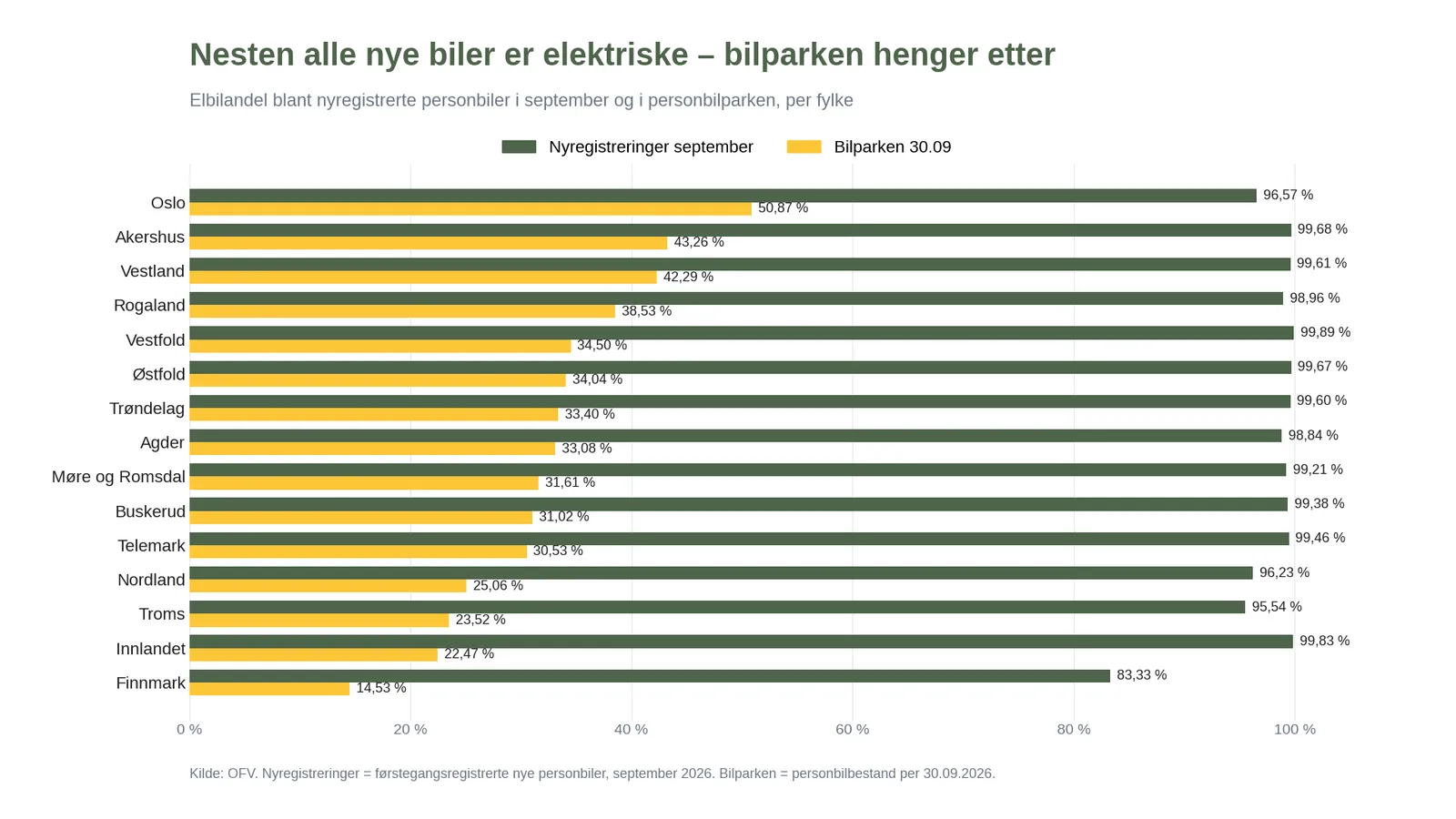
A record 98.81 percent of the new passenger cars registered last month were electric vehicles.
However, when looking at the overall car fleet in Norway, that is, all passenger cars on Norwegian roads, fossil fuel-powered models still predominate.
As of the end of September this year, there were 2,954,957 passenger cars registered in Norway – of which 1,048,702 were electric vehicles.
– The transition is slower than new car sales would suggest
Electric vehicles now account for 35.5 percent of the car fleet and are thus the most common type of vehicle nationwide.
At the same time, there is still an overrepresentation of diesel cars in seven of Norway’s fifteen counties:
In Finnmark, Troms, Nordland, Innlandet, Trøndelag, Møre og Romsdal, and Telemark, diesel remains the most common, according to the Road Traffic Information Council (OFV).
The diesel proportion is highest in Finnmark, where 48.61 percent of cars run on diesel and 14.53 percent are electric.
Followed by Troms with 43.97 percent diesel cars, Nordland with 41.37 percent, and Innlandet with 41.16 percent.
Diesel is also still the most common in Trøndelag, Møre og Romsdal, and Telemark.
Desire for a higher depreciation allowance
To accelerate the transition to electric vehicles, OFV now wants authorities to raise the depreciation allowance from 3,000 to 10,000 kroner.
- The total number of cars on the roads determines emissions levels and traffic safety, and the transition to a zero-emission fleet is progressing much more slowly than car sales would suggest, says OFV director Geir Inge Stokke.
- The policy has worked, and now it needs to focus on renewing the entire fleet. We can’t rely on the situation to resolve itself, he continues.
The average age of scrapped cars varies greatly
Scrapped cars are getting older. According to SSB, the average age of scrapped passenger cars was 18.8 years in 2024.
In Oslo, the average age was 15 years, while in Finnmark it was 23.6 years.
The scrap fee has remained at 3,000 kroner since 2013. At the same time, far fewer cars are being scrapped than before.
Data from OFV shows that ten years ago, around 120,000 cars were scrapped annually, compared to only about 79,000 in 2025.
- The scrap fee has remained unchanged for 13 years. 3,000 kroner is too low to encourage people to surrender old cars they can still use. Stokke believes the fee should be raised to 10,000 kroner, offering a clear recommendation to the government and parties negotiating next year’s state budget.
- Newer cars offer better protection in accidents, and so far this year, more people have died in traffic accidents than during the same period in the past decade. Therefore, renewing the vehicle fleet is also a matter of traffic safety.

More like this?
Sign up for our newsletter
– get electric vehicle news delivered straight to your inbox!
Also read
The post Diesel cars still most common in nearly half of the counties appeared first on Norsk elbilforening.