
“GermanyNetz for Trucks”: A closer look at the tender for managed locations
The Autobahn GmbH outlines the key details of the planned truck charging network at managed rest areas in a newly printed project overview. The main point: the bidding process, organized through lots, is set to begin in November. This will complement the existing network at unmanaged locations.
Image: Chargecloud
The Germany network for electric trucks and buses currently includes 350 locations on a map of the Federal Republic. Each represents a truck charging station. While construction equipment is expected to arrive at some of these sites soon, contracts for most have not yet been awarded. This is due to the federal government’s two-tier bidding process: the Autobahn GmbH distinguishes between managed and unmanaged rest areas.
As is known, the initiators first pushed for the rollout of the initial electric truck charging network at 124 unmanaged rest areas in Germany. Bids were distributed recently, and the successful bidders are:
- Bid 1 (25 rest areas): eliso Voltix Charging GmbH
- Bid 2 (24 rest areas): autostrom.plus GmbH
The bidding process for the 227 managed rest areas has been delayed. One reason was a multi-year legal dispute between the Autobahn GmbH and Fastned over the practices for installing and operating charging stations at these rest areas. Fastned won the case a few months ago, making it clear that the installation and operation of charging stations at rest areas must now be bid on separately — as they are not covered by existing gas station concession contracts.
Government to seek further feedback through a survey
In this situation, the Autobahn GmbH is now preparing the tender process to complement the “Germany Truck Network” in collaboration with the Federal Ministry of Transport and the National Charging Infrastructure Control Center. The bidding process is set to begin in November. An project overview allows “interested market participants” to learn in advance about the details of the tender. Additionally, the Autobahn GmbH is asking knowledgeable stakeholders to contribute their experiences and insights through an online survey (see link below) to shape the final plan.
At this point, we focus primarily on the twelve-page project overview: it highlights the clear message from Autobahn GmbH—namely, that the upcoming bidding round differs little from the previously completed tender for charging stations at unstaffed rest areas. The next round will also issue bundled contracts for the planning, construction, and operation of truck charging sites. The awards will be made in five overlapping lots.
Grid connections are already in preparation
The size of the truck charging parks at the 230 managed rest areas along Germany’s federal highways is intended to vary. The federal government has already applied for the necessary power connections and calculated the estimated required capacity for truck power connections at each location by 2035. The following table shows the top ten managed rest areas that are set to receive the highest power connection capacities and thus will likely house the largest truck charging parks:
| | Rest Area | Highway | Power Connection Capacity for 2023 |
| --- | --- | --- | --- |
| 1. | Garbsen Nord | A2 | 24,640 kVA |
| 2. | Börde Nord | A2 | 23,760 kVA |
| 3. | Michendorf Nord | A10 | 22,880 kVA |
| 4. | Vaterstetten Ost | A99 | 22,000 kVA |
| 5. | Dresdner Tor Nord | A4 | 20,680 kVA |
| 6. | Lipperland Nord | A2 | 20,680 kVA |
| 7. | Aurach Süd | A3 | 20,680 kVA |
| 8. | Bruchsal Ost | A5 | 20,240 kVA |
| 9. | Dresdner Tor Süd | A4 | 19,800 kVA |
| 10. | Lipperland Süd | A2 | 18,040 kVA |
For context, most rest areas have calculated grid connection capacities for 2035 in the four-digit kVA range. Among unmanaged rest areas, Röhrse Süd on A2 is expected to have the highest grid connection capacity at 22,880 kVA. Important: The federal government naturally reserves the right to make changes to its plans. However, this top-10 list reflects the current state of planning. A detailed list of all other locations is linked below this text.
Each bid includes around 45 rest areas
Regarding the scale, the upcoming tender includes approximately 1,300 MCS and 2,000 CCS charging points for trucks. When unmanaged rest areas are added, the network initiated by the federal government rises to 1,800 MCS and around 2,400 CCS charging points. This highlights the significance of the upcoming tender: the majority of the charging points will be located at managed rest areas, specifically at the 227 sites mentioned, which will be allocated in packages of about 45 sites each across five regionally overlapping lots. The division into lots is intended to “create economically comparable lots and enable bids from multiple contractors, thereby fostering competition and distributing risks associated with the construction and operation of charging infrastructure,” states the Autobahn GmbH in its proposal. Incidentally, opposite rest areas will always be assigned to the same lot.
rdnet, to leverage synergies in development.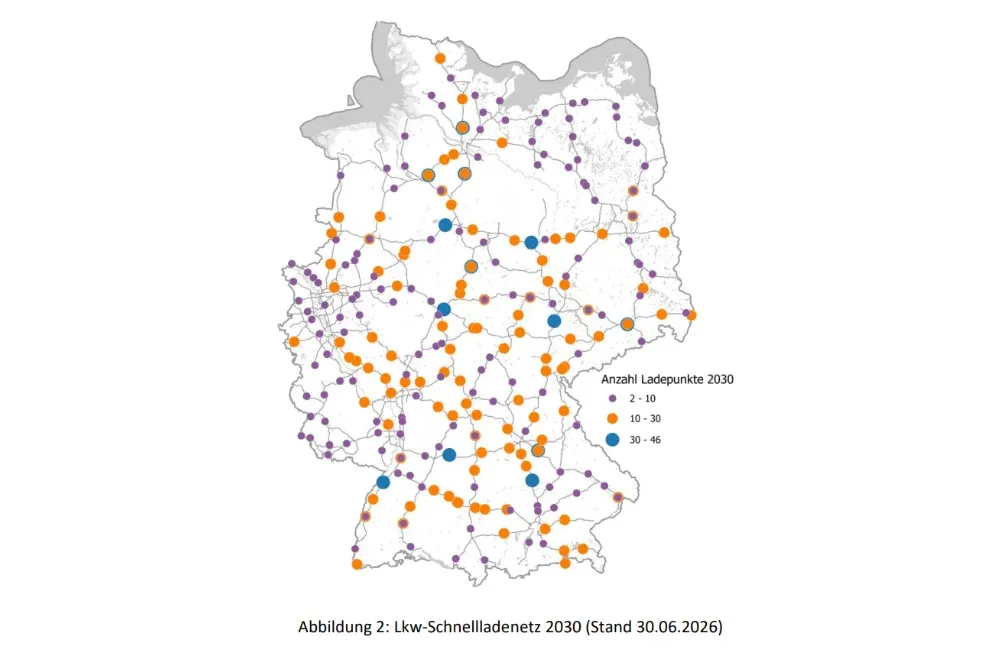
Image: Bundes Autobahn GmbH
- 1/2
- 2/2
Among the bidding criteria: Bidders must commit to building and operating a predetermined number of MCS and CCS charging stations with a rated capacity of at least 400 kW (CCS) or at least 1 MW (MCS). In the case of shared power units, a charging capacity of at least 800 kW must be continuously available at any MCS charging station used simultaneously. CCS charging stations for overnight charging must have a rated charging capacity of at least 150 kW. We are already familiar with all this from the previously concluded bidding process for unmanaged locations.
There is a five-year timeline for implementation
The federal government also stipulates, among other things, an intelligent energy management system as well as physical barriers (such as gates) for future reservation of charging spots at the charging locations. These charging parks are to be established within five years, with the autobahn AG itself stating that “the feasibility of this timeline depends significantly on the timely provision of the necessary power connections.” The relevant procedures have already been initiated. Additionally, the federal government will cover the costs for building or expanding the required power connections.
Important: The subject of the tender should also include potential expansion of the charging infrastructure: “If it becomes apparent during the contract period that the existing charging infrastructure at a location is not sufficient to meet demand on a permanent basis, additional charging stations can be built at that location at the client’s request,” writes the Autobahn GmbH. The intended standard contract duration for operation is eight years. It can be extended by up to four years thereafter.
The transit model remains a tender criterion
To ensure proper operation, the federal government sets various requirements regarding technical reliability, maintenance, and user-friendly payment and billing systems. Most relevant to the industry, however, is that the federal government maintains its stance from the initial bidding process regarding charging options. The initiators still do not want to rely solely on market forces: In addition to ad-hoc payment or activating truck charging stations using roaming cards, truck drivers should also be able to use their shipping company’s electricity supply contract. The key concept here is the transit model.
In essence, the subsidized truck charging at federal-owned highway parking lots is intended to feature a novel competition model with three options:
- Ad-hoc charging directly at the truck charging station
- Contract-based EMF charging (via card or app)
This is made possible by an infrastructure fee, which will be included in the charging price at the same rate for all three charging methods. Why such complexity? “Trucks rely on being able to charge on the highway — fairly and competitively,” explained Johannes Pallasch from the National Charging Infrastructure Control Center in a previous statement. “The old logic that charging on the highway is inherently expensive cannot be the solution here.” In other words, when an electric truck with an empty battery and/or a driver arriving at the end of their shift reaches a parking lot with a suitable charging station, they should not be charged exorbitant prices.
In selecting the winners, the federal government relies on a so-called competition model that “ensures cost-effective expansion of charging infrastructure while providing fair and transparent charging prices for users,” according to the officials. Based on this approach, awards are given in each bid to the offer with the best
price-performance ratio: “The bid price accounts for 70% and the quality of service for 30% in the overall evaluation. Each bidder can apply for all bids but can only receive an award for one bid, unless no other eligible offer exists for a particular bid.”
_Source: Information via email_, nationale-leitstelle.de (locations, PDF), autobahn.de (exposé, PDF), forms.cloud.microsoft (survey)