
Deutschlandnetz: 100th highway charging station opens on A81
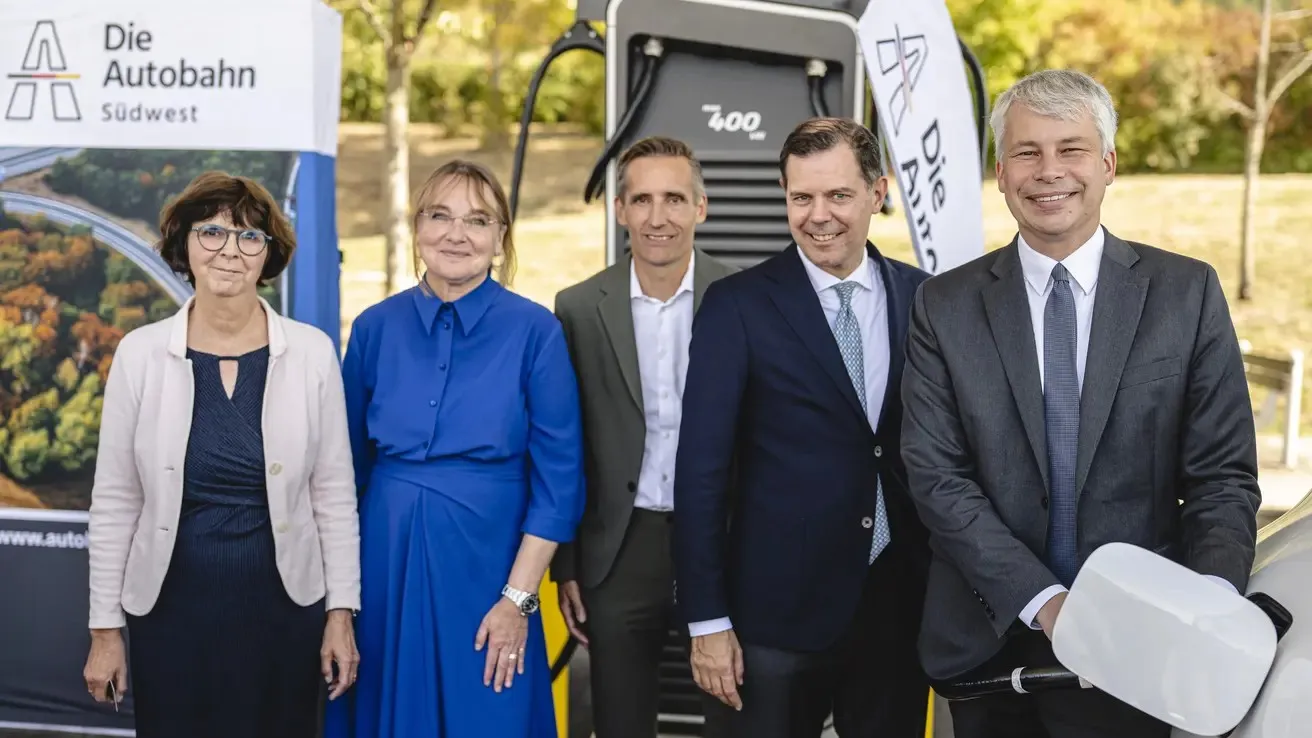
The 100th highway location in the Deutschlandnetz network has been put into operation on the A81 near Räthisgraben. E.ON provides six charging points there with capacities up to 400 kW, and payments can also be made using debit and credit cards.
Advertisement
The Deutschlandnetz network has reached 100 locations on highways. The newest fast-charging park is located on the A81 in Baden-Württemberg, at the parking lot with restroom facility (PWC) Räthisgraben in the direction of Stuttgart. Federal Transport Minister Steffen Bilger opened the location together with Dr. Michael Güntner, CEO of the Autobahn GmbH of the federal government. The facility is operated by E.ON Drive Infrastructure GmbH.
The highway locations in Germany’s network are situated at so-called unmanaged rest areas, that is, parking lots without gas stations or service areas. Until now, there has generally been no possibility to charge electric vehicles there.
Six charging points with up to 400 kW
The Räthisgraben charging park has six charging points. Each of them is designed to provide a charging capacity of up to 400 kW. The press release does not specify the manufacturer of the charging stations or the total number of stations.
According to Autobahn GmbH, a mid-size vehicle can be charged in about ten minutes with enough energy for a range of 300 to 500 kilometers. However, this figure should be considered an ideal value: the actual amount of energy delivered to the vehicle in that time depends mainly on the car’s maximum charging capacity, the battery’s charge level, and temperature. Only a few models can utilize 400 kW at all.
Payment at the charging station is possible using standard charging cards as well as debit and credit cards. This meets the requirements for spontaneous charging without contract obligations, as specified for Germanynetz stations.
Ad
Expansion on highways has increased significantly
The milestone shows how significantly the expansion of highways has accelerated over the past year. As reported by the National Control Center, in September 2025 only 25 highway charging stations across Germany’s network were operational, with another 58 under construction at that time. Regional charging stations were further ahead: the 100th regional station went online in early October 2025 in Bad Neustadt an der Saale.
In total, the Autobahn GmbH plans to install 1,000 fast-charging stations at 200 locations along the highways. With the Räthisgraben site now operational, half of the planned highway charging stations have been put into use.
Southwest: five of twelve facilities online
In the Southwest branch of Autobahn GmbH, Räthisgraben is the fifth of a total of twelve PWC facilities equipped with approved charging points. The remaining seven locations are set to follow by the end of 2026, according to branch director Christine Baur-Fewson — that is, within the next three months.
Germany Network: 9,000 Fast Charging Points at Over 1,000 Locations
The Germany Network is a support program funded by the Federal Ministry of Transport (BMV). Private companies build and operate these locations on behalf of the federal government. Around 9,000 additional fast charging points are planned at more than 1,000 locations. Of these, approximately 900 will be in cities and rural areas, with 200 located directly along highways. The goal is to close gaps in fast charging infrastructure so that the nearest charging station can be reached within minutes anywhere.
The federal government is investing around 2.3 billion euros in this program. The first location began operations at the end of 2023. According to current plans, the network is set to be largely complete by the end of 2026. Implementation is coordinated by the National Charging Infrastructure Center under NOW GmbH, which is responsible for tasks such as demand planning, technical inspections, and data monitoring of the locations.
E.ON, the operator, pointed out during the opening to the growing number of electric vehicles: More than two million battery-electric vehicles are registered in Germany, accounting for over 30 percent of new vehicle registrations. The company itself operates more than 10,000 charging points in eleven European countries, according to its own statements.
The Bundes Autobahn GmbH has been responsible for the planning, construction, operation, and maintenance of federal autobahns since January 2021, managing a network of over 13,000 kilometers through ten regional offices.
Advertisement