
Germany: New Alliance for H2 Truck Mobility Plans a Major Push
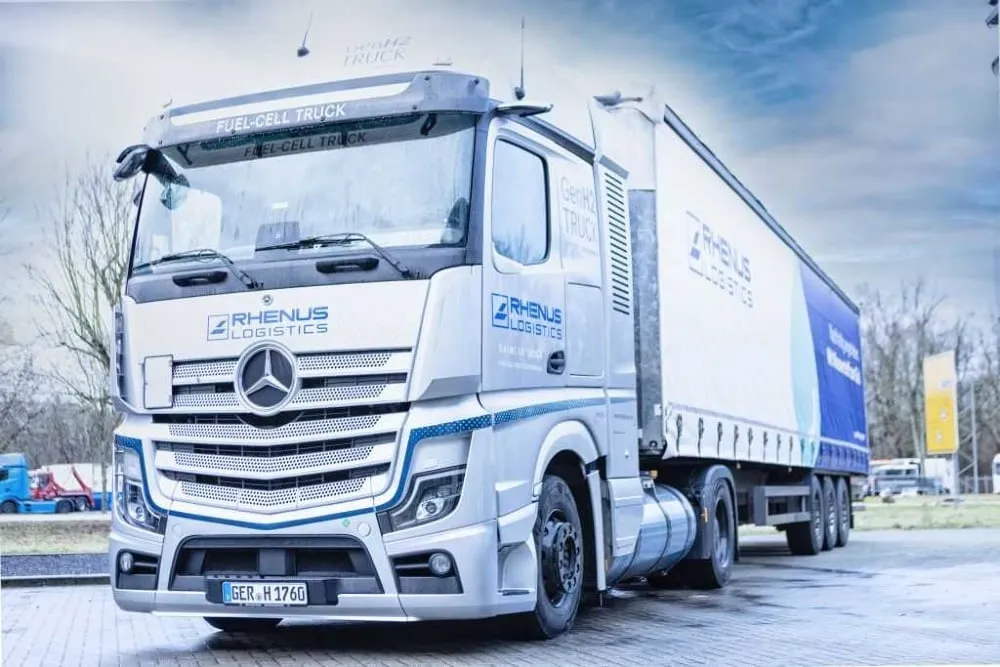
In Germany, an alliance is forming to drive the commercialization of heavy H2 trucks and the infrastructure needed for them. Daimler Truck, the Volvo Group, and Toyota are joining forces, supported by industry leaders such as Bosch, Air Liquide, and TotalEnergies. The message is clear: local players want to establish an H2 ecosystem before others do.
Hydrogen-powered mobility in Germany and Europe is technically feasible — as many pilot projects have already demonstrated. It is clear that fuel cell technology is not cost-effective for passenger cars, but it does have potential in niche applications within heavy transport. However, little progress has been made in this capital-intensive field over the years. There is a lack of confidence that green hydrogen will become affordable. The prevailing view is that battery-electric trucks are more efficient. Additionally, there is a lack of decisive commitment across the board.
The H2 ecosystem for trucks is already developing elsewhere, primarily in China. What works on the roads there eventually makes its way to Europe after a certain delay, as is well known. Behind the scenes, leading figures in the local industry have formed an alliance under these circumstances, with its goals set to be detailed on September 15 at the IAA Transportation in Hannover. Even just the announcement of this date is worth reporting, as Daimler Truck, one of the key players in this new alliance, has already outlined its broad objectives. These indicate a coordinated approach and considerable ambition.
The initiators know each other from Cellcentric
The alliance will initially be formed by manufacturers Daimler Truck, Volvo Group, and Toyota, along with supply chain, logistics, and energy companies Bosch, Air Liquide, TotalEnergies, TEAL Mobility, and MB Energy. The composition of this trio of manufacturers comes as little surprise. Daimler Truck and Volvo Group have been collaborating for years on developing BZ technology, as evidenced by their joint venture Cellcentric. This year, Toyota joined Cellcentric as the third equal partner. Here, the circle closes for the alliance: the three manufacturers aim to advance this future-oriented business, into which they have already invested significant time and money, both operationally and strategically.
So what are the eight alliance members planning? Daimler Truck outlines that they aim to “accelerate the commercialization of hydrogen-powered mobility together and build the necessary ecosystem across the entire value chain” — concurrently with the further rollout of battery-electric trucks. The latter remains unaffected by this initiative. The activities specifically involve establishing hydrogen refueling stations “along key corridors in Europe,” tailored to the expansion of truck fleets. Additionally, the alliance intends to ensure hydrogen is made available “at competitive prices.” For more details, Daimler Truck refers to a press conference on September 15 at the IAA Transportation.
Focus on “competitive hydrogen prices”
Yet the announcement already indicates that discussions have been underway behind the scenes for some time. All parties are “united by the common goal of scaling up hydrogen – with a focus on customer-oriented refueling infrastructure and competitive hydrogen prices,” emphasize the initiators. According to Daimler Truck, previous agreements have now led to Germany “bringing together for the first time in Europe the entire ecosystem required to scale up hydrogen trucks by 2030 – from vehicles and political frameworks to integrated hydrogen supply and infrastructure.” The goal is to enable customers to operate hydrogen-powered vehicles at competitive overall operating costs.
The Stuttgart-based company emphasizes that its business alliance is working together with political decision-makers on the H2 initiative. The exact nature of this cooperation has not yet been clarified by the parties involved. What is clear is that the federal government in Germany is pushing for an initial H2 truck network and has received over 500 applications for the first funding call in this area recently. The grants will be awarded in the second half of the year.
Currently, subsidies amounting to 220 million euros are available to support the development of hydrogen mobility in Germany. These funds aim to create a backbone network for heavy transport, as required by Europe’s AFIR (Alternative Fuels Infrastructure Regulation). Importantly, hydrogen internal combustion engines are also included in this funding program. The technology is largely based on conventional piston engines.
Manufacturers Seek Government Support
Interestingly, according to the Ministry of Transport, among those participating in the funding initiative were also leading manufacturers of heavy commercial vehicles. The electrive editorial team wondered whether manufacturers intended to sell more of their H2 vehicles or possibly invest in infrastructure as well. It now appears that the answer will likely be provided by the press conference on September 15 at the IAA. It is already clear, however, that OEMs will engage in building the H2 ecosystem in a way that goes far beyond merely providing vehicles.
The reason is obvious: Daimler Truck and Volvo Trucks invested early in hydrogen technology alongside their BEV roadmaps, spending years developing it — and anyone wanting to sell series-produced vehicles powered by hydrogen must also provide customers with the necessary infrastructure. Both OEMs underestimated the inertia of the system. The first series-produced vehicles were initially scheduled for 2027, and it was under this assumption that Cellcentric was founded in 2021 to mass-produce the relevant technology components.
In 2024 and 2025, the companies slowed down their progress: While Cellcentric continues to build a large-scale factory in Weilheim an der Teck, Baden-Württemberg, the construction work has been delayed. This is because Daimler Truck’s Next GenH2 Truck will soon enter customer testing (with companies like Dachser), but the manufacturer has already pushed back mass production to the 2030s. As a result, Cellcentric must rethink its plans as well. There has also been no news about Volvo Trucks’ planned BZ trucks for some time now. However, the Swedes have now announced that they will display a prototype at IAA Transportation.