
The Denza N8 has a CLTC range of 1003 km and a battery capacity of 130.15 kWh. BYD focuses on screens and numbers here.
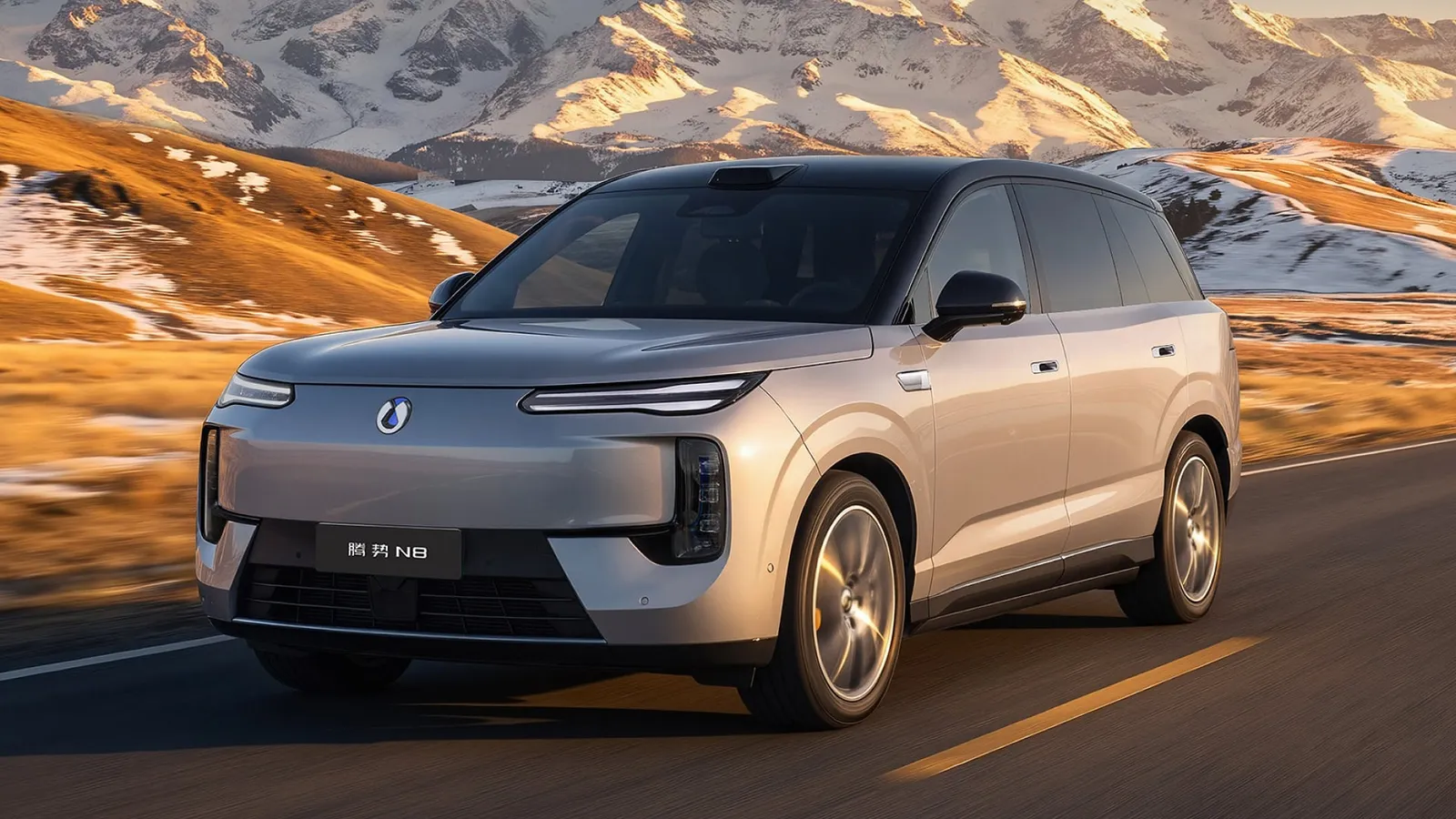
BYD revealed the interior of the new electric Denza N8 and confirmed a CLTC range of 1,003 km for the top version. The car is set to go on sale in China as early as September 2026, equipped with a 130.15 kWh LFP battery and the ability to charge from 10% to 97% in 9 minutes.
Table of Contents
Show
Hide
On paper, this looks like a challenge to China’s leading luxury SUVs. However, two things need to be noted right away: the CLTC testing cycle and the claims regarding ultra-fast charging.
Denza N8 returns as a fully electric model, after a brief PHEV phase
The Denza N8 isn’t a completely new name. The model appeared in China back in 2023 as a mid-to-large premium SUV with plug-in hybrid power. That version offered a total range of 1003 km according to CLTC standards with a fully charged battery and full tank, and it was available in 6- and 7-seater configurations, but it disappeared from the market after less than a year due to poor sales.
Now BYD is making a second attempt. This time as a pure electric vehicle, featuring a new hardware architecture, an updated battery pack, and Flash Charging technology.
The new Denza N8 is set to be a 5-seater car. Interestingly, BYD has also prepared a larger version called the Denza N8L, which will have a 6-seater layout and hit the market around the same time.
1003 km CLTC range and even 890 kW of power
According to the homologation documents from China’s MIIT, the Denza N8 measures 5150 mm in length, 1999 mm in width, and 1820 mm in height, with a wheelbase of 3075 mm. This places it in the realm of large family and business SUVs, closer to the Li Auto L9 or Lynk & Co 900 than to compact cars posing as premium models.
The most impressive figure in the specifications is undoubtedly the range. The top version is said to offer 1003 km of CLTC range thanks to a 130.15 kWh battery. Two LFP battery options are also available, with another option at 105.792 kWh in addition to the larger package. The declared range for the entire lineup is expected to be between 800-1003 km CLTC.
It sounds impressive. But CLTC is not the same as WLTP, let alone real-world highway driving at 140 km/h. Given the car’s size and weight, it can be assumed that the European test results would be significantly lower. Still, this remains a vehicle aimed at achieving very substantial real-world range, not just a catchy headline.
In terms of propulsion, the Denza N8 is expected to come in three configurations:
Rear-wheel drive, 320 kW
Rear-wheel drive, 370 kW
Tri-motor AWD with a system power of 890 kW, or about 1193 horsepower
The AWD version is based on the e3 platform. A 270 kW engine powers the front, while two 310 kW engines are located at the rear. On paper, this represents the level of hypercars and electric performance vehicles, rather than a family SUV. The question is, how much of this power will actually be usable beyond short sprints and marketing claims.
Flash Charging is supposed to be a highlight, but BYD still hasn’t revealed all the details
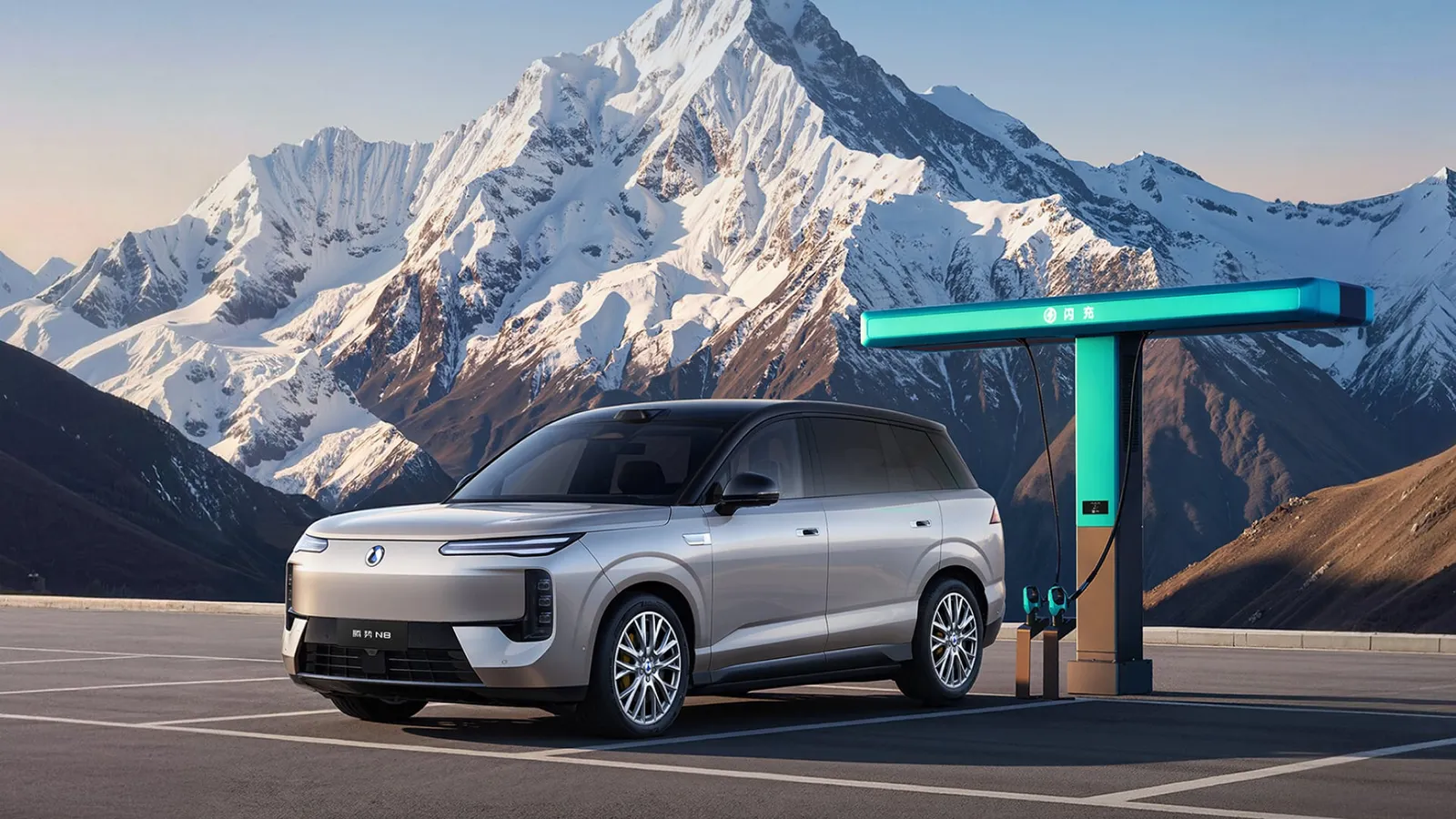
BYD is adding Flash Charging technology to the Denza N8. The manufacturer claims the car can go from 10% to 70% charge in 5 minutes, and from 10% to 97% charge in 9 minutes.
These are numbers that fall into the “sounds absurdly good” category. And that’s exactly why they need to be read with caution. Without complete charging curves, information on peak power, battery temperature, pack preparation, and charger type, it’s hard to fairly assess what the car will deliver beyond a controlled demonstration.
The mere presence of a large 130.15 kWh pack also suggests that BYD is aiming not only for record-breaking peaks but also for maintaining high power over a significant portion of the test session. If this holds true in practice, the N8 could be one of the most interesting large EVs from China. If not, it will remain just a pretty slide show.
For now, all we know is that BYD consistently promotes its narrative around ultra-fast charging and its own Blade 2.0 batteries. The Denza N8 is set to be one of the models that will sell this story to premium segment customers.
The interior focuses on large screens rather than originality
The most noticeable change inside is the abandonment of the circular, central screen typical of many BYD models. The Denza N8 features a 30-inch display stretched across the dashboard and a 43-inch panoramic HUD spanning about 1.1 meters, running along the front windshield.
This is no longer just a detail but the main theme of the cabin. A similar approach can be seen in today’s Xiaomi YU7, Avatra 12, and some new models from Geely and Li Auto. The screens are large, impressive, and designed to make a strong first impression even before anyone asks about the car’s weight or actual fuel consumption.
In addition, the cabin features a more classic premium setup. There are heated, ventilated, and massaging front seats, wireless phone chargers, physical buttons on the tunnel, a storage compartment, seat adjustment buttons on the doors, and a driver monitoring camera mounted near the A-pillar.
Conventional interior handles are also retained, but with electric opening buttons. The steering wheel is three-spoke with a flatter bottom, and the drive mode selector is located behind it. The overall design looks clean and expensive, though not necessarily innovative. It’s more like “Chinese premium 2026” rather than a cabin that will be remembered in five years.
N8 and N8L. Two versions, two interior layouts
Two closely related models will be available in the lineup. The Denza N8 described here is intended to be a 5-seater vehicle. Meanwhile, the Denza N8L, previously introduced as a larger plug-in variant, is also expected to feature all-electric power and a 6-seater configuration.
BYD promises an even 208-liter front trunk for the N8L. It’s a minor detail, but in a large family car, it might be more useful than another screen. Especially when considering trips with 5–6 people, where every liter of space counts.
Both models are set to go on sale in China as early as September. At this stage, there is no information about entering Europe or obtaining approval for our market. However, the Denza brand is becoming increasingly important to BYD, so an European launch isn’t entirely ruled out.
Denza is growing rapidly, but the N8 must improve upon its predecessor’s record
In July 2026, Denza delivered 18,060 vehicles in China, representing a 69% year-on-year increase. The brand is therefore in a completely different position than when its first PHEV-powered N8 failed to make an impact.
The new electric N8 comes at a better time. The Chinese market is now more ready for large premium EVs, and BYD has a stronger position, better technological backing, and significantly greater brand power than it did two years ago.
However, screens and a four-digit CLTC range alone won’t win everything. For a car of this class, comfort, noise reduction, suspension quality, and how long the charging power lasts beyond the press conference also matter. If BYD can deliver on these, the Denza N8 could make a big splash. Otherwise, it will remain just another Chinese SUV with very ambitious specs.
BYD once again shows it can build a powerful vehicle, but now it’s time for the tougher part: driving and charging outside the home. What do you think? Is such a large electric car with a 130 kWh battery worthwhile, or is it just overkill?