
Renault Twingo electric challenge: how low can fuel consumption be per 100 km?
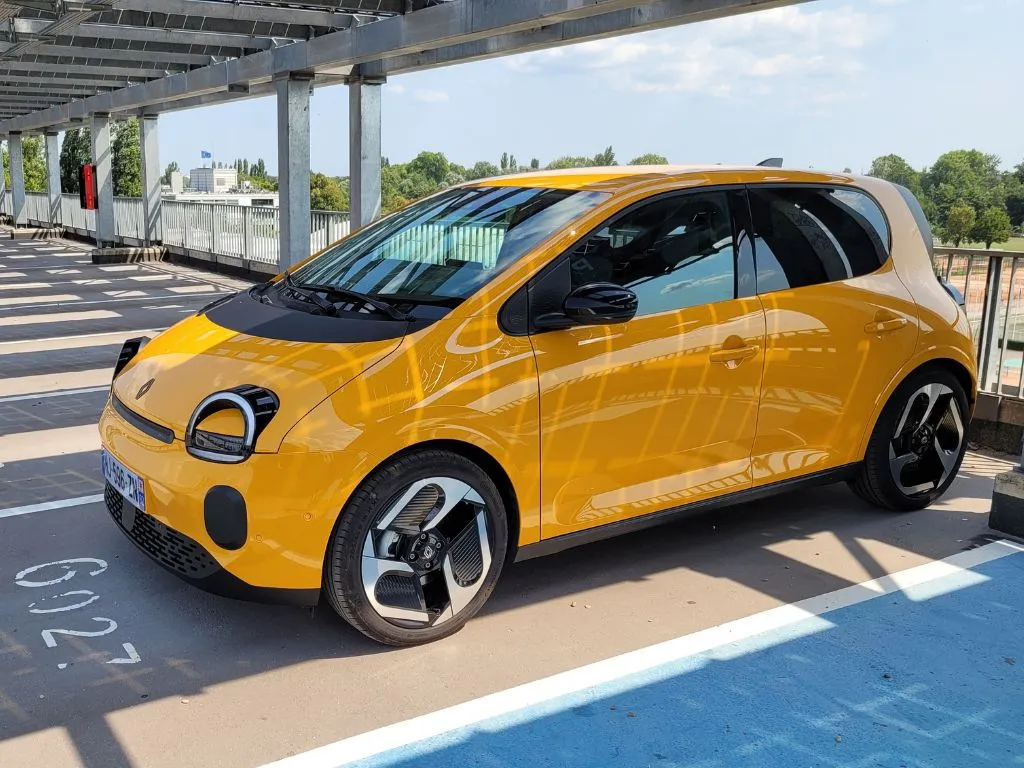
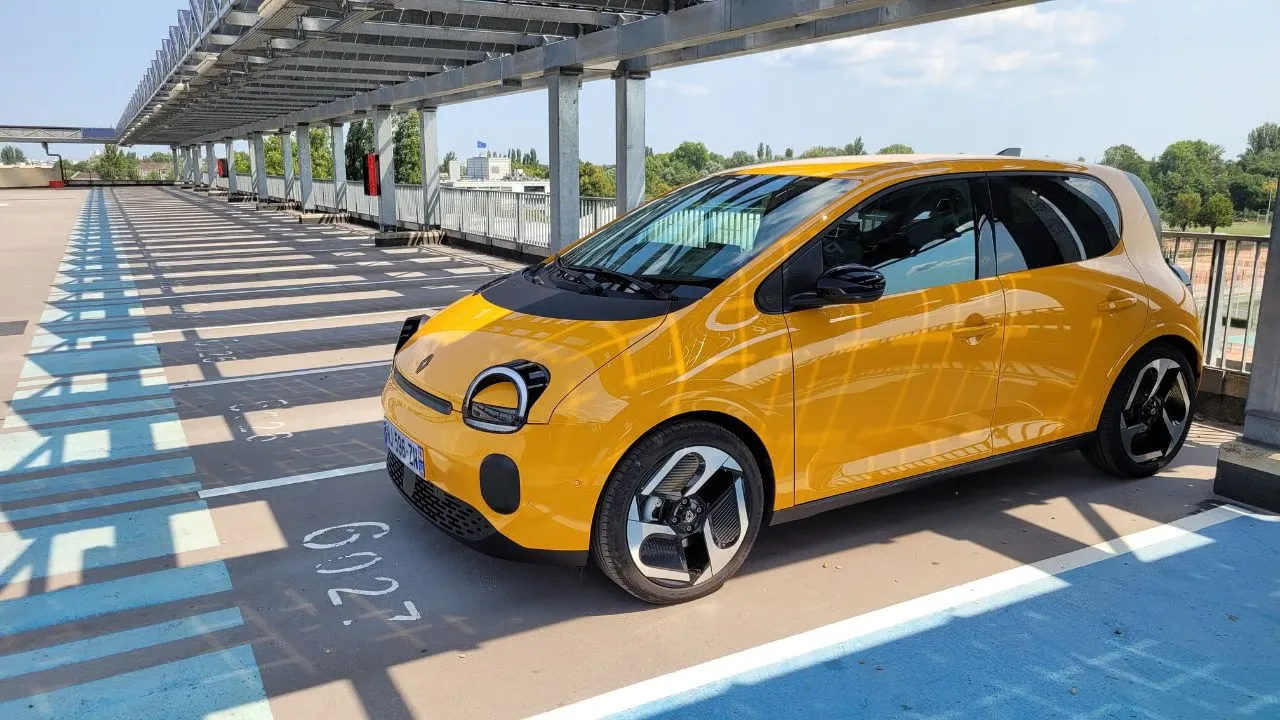
After observing the remarkable fuel efficiency of the new Renault Twingo during our test drive, a question arose: just how low could its consumption really be under ideal conditions? By getting up at dawn, using a carefully planned urban route, having optimal (or nearly optimal) weather conditions, and maintaining maximum focus, we aimed to uncover the full potential of this compact electric city car.
Upon picking up a Renault Twingo in the brand’s historic stronghold of Boulogne-Billancourt, west of Paris, heading toward the Grand Est region requires almost a U-turn on the ring road, from Pont de Sèvres to Bercy, allowing one to fully appreciate the city car’s frugal capabilities in just a few kilometers. When exiting onto the A4, the dashboard displayed a promising average of 7.8 kWh/100 km. The well-calibrated throttle combined with a skilled driver performs excellently in regenerative braking during traffic, but the rest of the journey to Strasbourg via the N4 showed that this Twingo’s performance is far from ending at speeds over 50 km/h, maintaining an extremely moderate fuel consumption even when traveling at a constant speed with cruise control engaged.
Also read
Lunch in Paris, dinner in Strasbourg: 500 km on an electric Renault Twingo with a single charge
Before reaching the Alsace capital, another item was added to the long list of things we wanted to do during this month with the little Renault: to explore just how low in consumption it was possible to go under optimal conditions, with the strong intuition that it would be more like the Mariana Trench than a foot bath. But to give you a glimpse behind the scenes of this challenge, achieving those so-called “optimal conditions” isn’t exactly simple. First, the weather has to cooperate, and the recent intense heat, to which we clearly now have to get used, seemingly allows us to check this box. Apparently. No, the biggest difficulty is finding a suitable route. Strasbourg doesn’t have a proper closed ring road — after all, this city absolutely
Though this fantastic route has some flaws, it had to be created arbitrarily on the major boulevards surrounding the city center. With a bit of experimentation using Google Maps, one can obtain an acceptable loop with a circumference of 12.2 km. This distance will simplify the calculations that will keep my mind occupied constantly, because, at the risk of disappointing some of you who are more sadistic than I am masochistic, the exercise won’t go up to a breakdown point but rather to 100 km. Thus, just over eight laps will be necessary.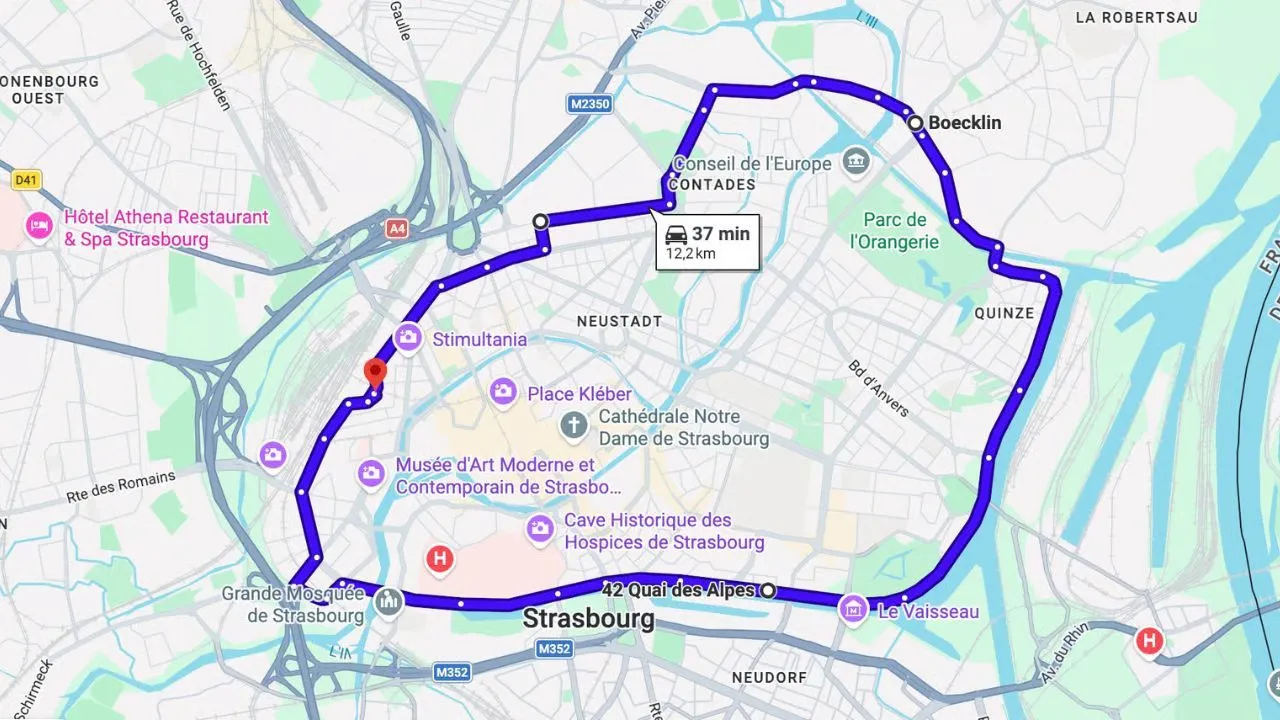
The departure is at 5:00 a.m. on the day of the race. The temperature is 23°C, and although we haven’t seen a drop of rain in weeks, the weather forecast predicts a high chance of rain, even storms, in the coming hours. Another illustration of Finagle’s law. Meanwhile, the consumption (shown in the lower right corner of the screen) plummets rapidly. It drops below 10, then to 9, 8, and finally 7, settling at 6.6 kWh/100 km after completing the second lap at exactly 25.1 km. By the time we reach 30 km, the gauge shows 6.5, though it still displays 50 km when we reach 50 km.
The temperature drops, now at 18°C, the wind picks up, and the promised rain arrives with almost tropical intensity. Periods of clearing occur, but traffic intensifies at the same time, causing long waits at red lights. Trams and buses rightfully take precedence when crossing intersections, while the increasing number of pedestrians and cyclists rightfully demand priority to cross. As I wait for the dashboard computer to finally show a 6.4 after each anxious glance, it assigns me an average of 6.6 kWh/100 km after 63 km, then a 6.7 at 74 km that it maintains until 98 km... before insulting me with a 6.8, which it holds despite all my desperate efforts until I finally reach the dreaded 100 km mark.
Obviously, this performance in the second half leaves a bitter taste: there was potential to do better than what I was able or could achieve, with at least, or rather at most, a 6.5 score that could have been maintained until the end if the starting conditions had stayed the same. Perhaps I should have switched to Eco mode after all, though I avoid doing so due to my aversion to the reduced responsiveness of the pedal. Another configuration for the Twingo, different from our test model, could also improve this score: the optional 18-inch wheels with 205/45 tires reportedly increase fuel consumption by 0.3 kWh per 100 km compared to the standard 185/50R16 tires, and the Techno trim adds another 0.1 kWh to the base Evolution model. In short, you’re left as an unwilling spectator to my tendency to never be satisfied, even when I should be reasonable.
It’s important to acknowledge that an average of 6.8 kWh/100 km is absolutely excellent—quite literally the exact figure needed to theoretically achieve over 400 km of range from Twingo’s small 27.5 kWh battery.Also read
Breakfast in Bordeaux, dinner in Strasbourg: 1,000 km on a Nissan Micra electric without planning
Reaching an average of 5.X km/kWh might be possible by checking all the boxes, but I leave it to others to accomplish this. It could even inspire new initiatives, like that British charity group that set out to beat the range record I achieved driving a Renault Zoé in 2021. Volunteers welcome!
What about the Seat Mii Electric?
Here’s the face of the standard meter, but I needed a reference to properly assess the Twingo’s performance, so I had no choice but to bring out my personal ride – Miireille, my Seat Mii Electric, about which I hardly ever talk to you except here and there – to use for the same test. It didn’t face the same weather conditions as the Twingo, and I admit I stopped after 50 km, but I don’t think that would have changed the final result much: an average of 5.8 kWh/100 km for the champion. In defense of this city car with the diamond pattern, I’ve been driving this little Spanish vehicle consistently in an eco-driving style for almost 35,000 km now, so I know it a bit better. And while Volkswagen’s legendary trio shows exemplary efficiency in the city, I regret that...
To let you know that it becomes more ordinary once outside the urban limits. Of course, there is also the issue of whether or not one can afford to trust the figures provided by the dashboard computer. The same goes for both matters.