
The Dacia Hipster may cost 48,000 zł. It has four seats, a 15 kWh battery, and 20 HP.
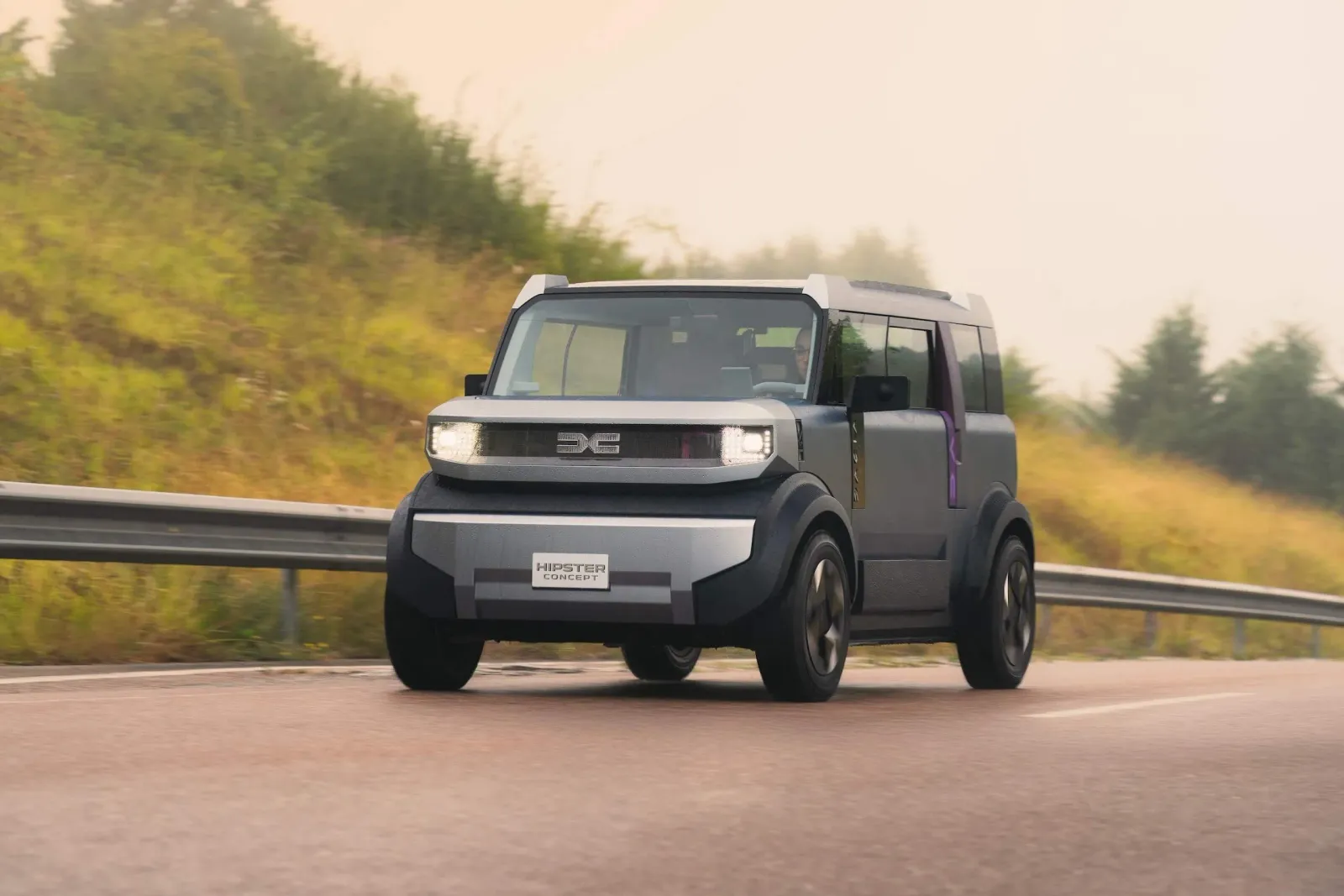
Dacia might bring the Hipster into production in 2027. According to Autocar, the electric four-wheeler is expected to cost around 9,500 pounds in the UK, which is approximately 48,000 zł, and it will be manufactured at the Chinese plant where the first Dacia Spring was produced. However, it won’t be a regular small car but rather a L7e-class vehicle with power limited to 15 kW.
Table of Contents
Show
Hide
Dacia unveiled the concept Hipster in October 2025, but did not confirm series production at that time. The project is still under development and, according to the brand’s design chief David Durand, requires final approval from management. Katrin Adt, who currently heads Dacia, has merely suggested keeping an eye on further developments.
This is still not an official announcement about the car. Information regarding price, battery, and place of production should therefore be viewed as a current plan rather than an finalized pricing list.
Hipster will be a four-wheeler, not a cheaper Spring
The four-seater version of Hipster is set to receive L7e homologation. In this category, the weight of a passenger vehicle without a battery must not exceed 450 kg, with a maximum continuous power of 15 kW, or about 20 horsepower, and a design speed of up to 90 km/h.
On the highway, such a setup isn’t suitable. In the city, 90 km/h is more than sufficient, and the lower weight should reduce energy consumption. Dacia also considered a simpler two-seater version that meets L6 category requirements, but current reports focus on the four-seater variant.
The battery is supposed to have only 15 kWh. That’s roughly one quarter of the capacity found in today’s urban electric cars, but the Hipster doesn’t need to carry tons of body weight and equipment. For the driver, this means a shorter range, but also a lower purchase price, less weight, and faster charging even from a standard outlet.
Dacia hasn’t specified the expected range. With an energy consumption of around 8-10 kWh/100 km, such a battery could theoretically suffice for about 150 km in urban conditions, but this is just an estimate, not a manufacturer’s claim. The range will be lower in winter and during faster driving.
Three meters long with a trunk capacity of 70 to 500 liters
The concept car is 3 meters long, 1.55 meters wide, and 1.53 meters high. It features nearly vertical windows, a boxy body shape, and very short overhangs. Its road footprint resembles that of a classic Mini, although it’s intended to offer four seats.
The concept car’s claimed trunk capacity ranges from 70 to 500 liters. The higher figure assumes the rear seats are folded down, so it should not be compared to trunks in standard four-seater urban cars. With all passengers aboard, there will still be space for small purchases.
The production version will retain the overall proportions of the prototype, but some of its striking features will be removed. Instead of a two-part hatch with the lower section folding like a pickup truck’s bed, a single side-opening door is planned. The side windows are set to be divided, with their lower sections lifting up similar to those in the Citroën Ami.
Savings will also apply to the cabin. The driver’s smartphone will serve as a key, navigation screen, and multimedia hub once connected to a docking station. This is simpler than installing another display, which would still be slower than a phone after a few years.
The comparison of the Hipster to the Japanese kei-car holds true in terms of size and space utilization. Formally, however, the Dacia will not be classified as a kei-car, as this category exists within Japan’s tax system. In Europe, the Hipster is intended to be a heavy four-wheeler, similar to the Citroen Ami, though more powerful, faster, and capable of seating four people.
Production in China may avoid additional EU tariffs
The Hipster is set to be manufactured in Shiyan at the eGT New Energy Automotive plant, a joint venture of Renault, Nissan, and Dongfeng. This is the same factory that produced the first generation of Dacia Spring until July 2026. Its production capacity is around 45,000 vehicles per year.
Chinese teams are to participate in the development of the engine, chassis, and battery. Dacia also wants to use some components from the first Spring. The goal is simple: reduce development costs and utilize elements that have already been proven in a production car.
The new Spring will take a different approach. It is intended to be technically related to the Renault Twingo and produced in Slovenia as a more conventional city car. The Hipster will fill the role below it, rather than completely replacing the existing model.
The L7e homologation could bring another advantage. The EU’s additional tariffs on cars produced in China do not apply to L6 and L7 category vehicles, so the Hipster should be exempt from the duties imposed on Chinese M1 passenger cars. Regular import fees, transportation costs, VAT, and profit margins will still apply, so converting £9,500 to 48,000 zł is not the Polish price tag.
The Hipster might show whether Europeans truly want cheap electric cars or just regular cars sold at a lower price. 20 horsepower and a 15 kWh battery represent genuine savings, but they also come with limitations that the Dacia logo cannot hide. Would you buy a four-seater Hipster for 50,000 zł knowing it is not a full-fledged passenger car?