
Dacia has taken cost-cutting too far: the new cheapest Spring doesn’t even have a screen.
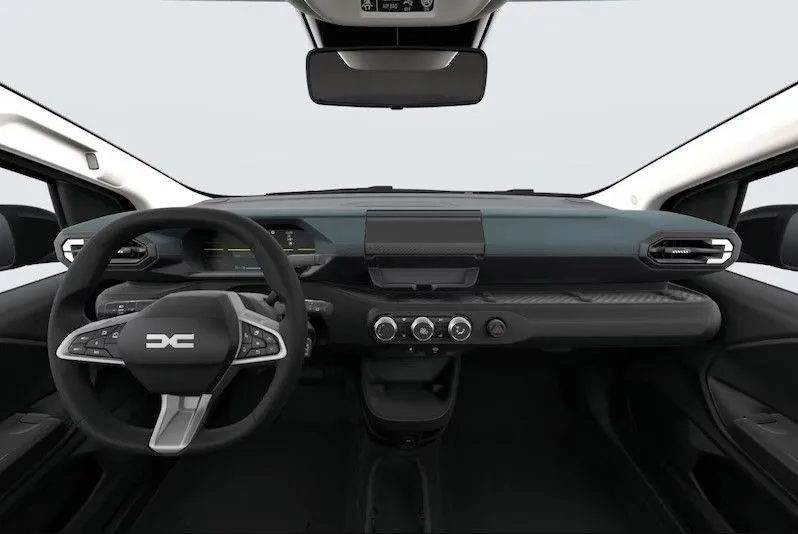
The Dacia Spring has for years adhered to a very simple approach: offering a small, lightweight, and inexpensive electric car by eliminating everything that is not strictly necessary. It’s a car without much personality, designed solely to get from point A to point B and nothing more. That’s precisely why it’s interesting to see how far the brand can take this model with its most basic version. Because if the Spring was already one of the simplest electric cars on the market, its most basic version takes this concept a step further, especially inside.
We still don’t know all the details about its launch in Spain, but in France, the new Spring starts at 17,900 euros before any discounts for its Expression trim level, while the Journey version goes up to 19,400 euros. The key point is that for this price, we’re talking about an electric car that even does without one of the elements that now seem essential in any automobile: a central touchscreen.
The result is a Spring that fits perfectly with Dacia’s historical philosophy—less equipment, less weight, and lower cost. The problem is that the market has changed a lot since the first Spring appeared, and now there are competitors that, without pricing themselves too far above it, offer a much more sophisticated in-car experience.
The simplest Spring comes almost without a screen
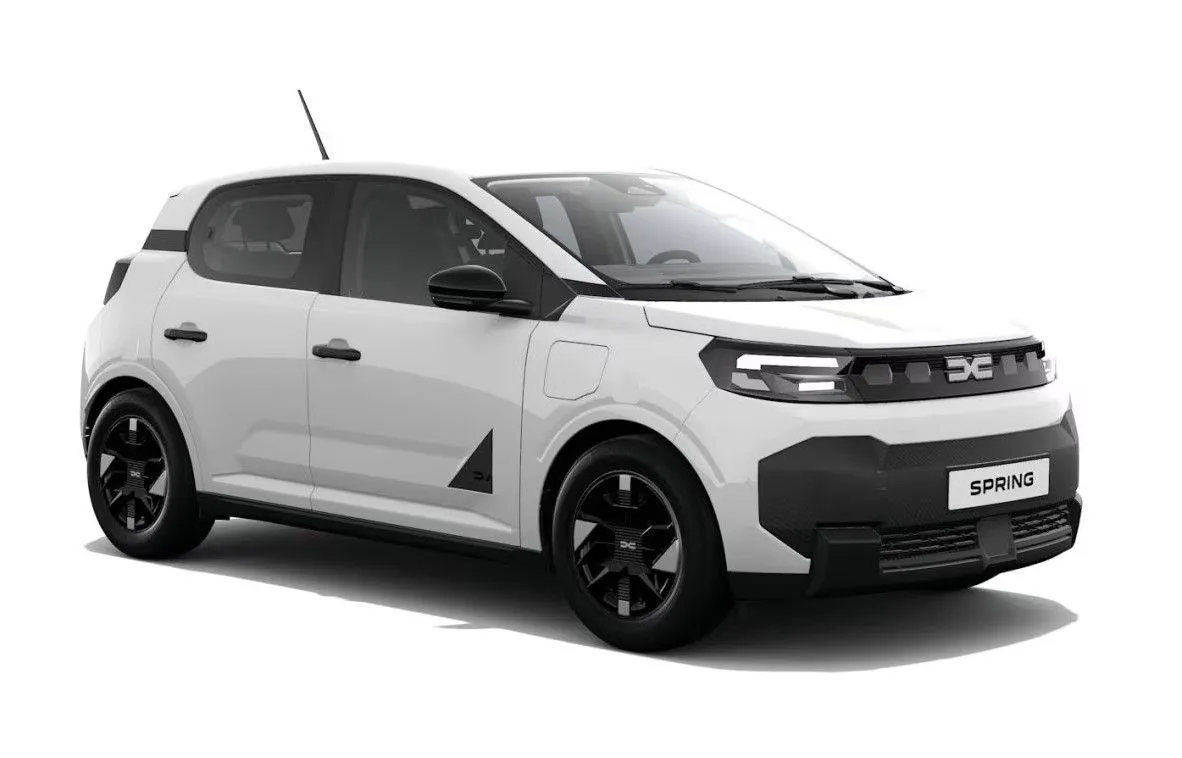
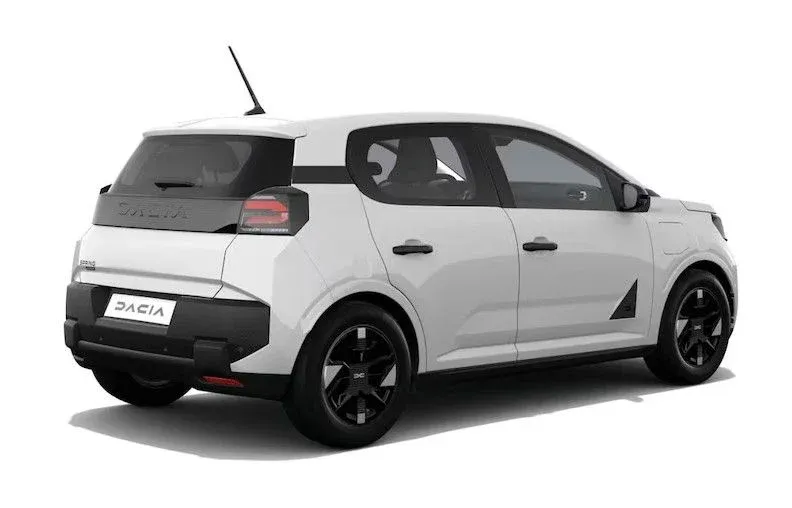
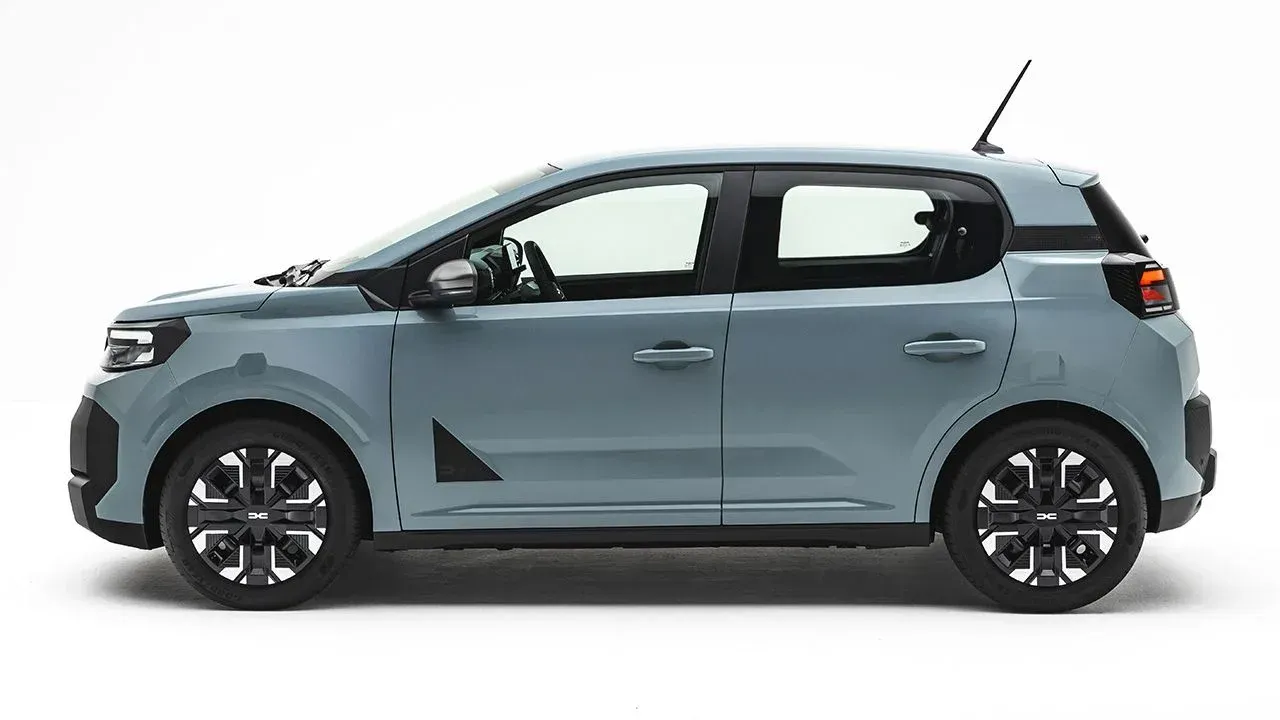
The base version of the Dacia Spring features a very simple exterior design. White is the default color, while other shades require an additional fee. It also comes equipped with 15-inch steel wheels featuring hubcaps that attempt to mimic alloy wheels, a common feature in Dacia’s budget models.
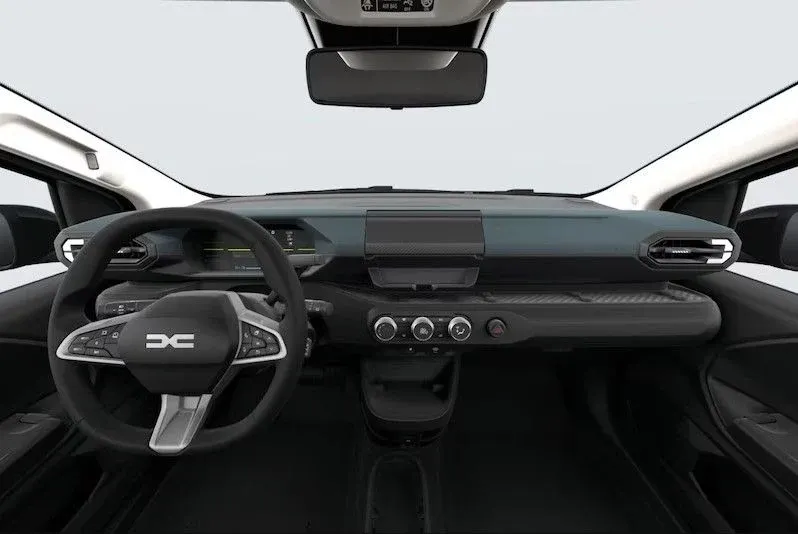
The interior also makes few compromises. The seats are covered in simple black fabric, and the dashboard includes some colored accents to prevent the overall look from being too austere. But the biggest difference compared to the images of the more equipped versions is right in front of the driver: the 10.1-inch central screen is gone.
In its place, there is a holder for the mobile phone. The smartphone thus takes over the role that the multimedia system plays in many cars. Some functions can be controlled from the steering wheel controls, and the relevant information is also displayed on the dashboard. The system still includes a radio and speakers, so this isn’t a car that relies solely on the phone for audio playback.
On paper, the solution makes quite sense. Why pay for a screen when the owner already has a phone that can handle most of the functions? The problem is that Spring’s simplicity starts to stand out too much compared to what its competitors offer.
And here comes a particularly uncomfortable comparison for Dacia: the Renault Twingo E-Tech electric car. Renault’s new model features a 27.5 kWh battery and up to 263 kilometers of WLTP range, along with a much more advanced screen and multimedia system. In Spain, it currently starts at 17,463 euros before applying the 4,050 euro discount from Plan Auto+.
In other words, the Twingo operates in a price range very close to that of the Spring, but with a much more carefully crafted interior and a clearly more modern design. This means the question is no longer simply how much it costs to manufacture an inexpensive electric car, but rather how much equipment we’re willing to sacrifice to achieve that price.
Additionally, there’s another detail that stands out particularly. The small 18-liter front storage compartment isn’t standard but is offered as an option. In a car designed specifically to maximize simplicity and make the most of every euro, charging extra for such a basic storage space is hard to understand from the customer’s perspective.
A similar situation exists with charging. In France, the fast charger is part of an optional package costing 500 euros that is only available with the Journey trim. With it, the Spring can charge via alternating current at 11 kW and via direct current up to 50 kW. Without this option, the AC charging power is limited to 6.6 kW.
For an urban car that likely spends most of its time charging at home, 6.6 kW may be sufficient. However, 11 kW and the ability to use fast charging at 50 kW significantly enhance the Spring’s utility when it is no longer just a second car and is intended for longer trips as well.
In Spain, the situation deserves careful analysis as prices and promotions significantly affect the overall picture. The Spring is currently available in the Spanish range starting at 16,245 euros before applying the announced 3,375 euro discount from Plan Auto+, though the configuration available in our market may not exactly match the basic version shown in France.
And this is where the real problem with the Dacia Spring comes in. Being cheap remains its main selling point, but it’s no longer enough just to be cheap. A few years ago, there were far fewer options to choose from. Now we have small electric cars from China that offer better screens, more refined interiors, greater power, larger battery capacities, and much more comprehensive driver assistance systems.
The BYD Dolphin Surf is probably the most obvious example. At 3.99 meters in length, it offers a much more well-designed interior, a 10.1-inch touchscreen, up to 322 kilometers of WLTP range, batteries of 30 or 43.2 kWh, and fast charging up to 85 kW. It even has a trunk space of 308 liters, which is quite impressive for a car of this size.
With the campaign and Auto+ plan, the Dolphin Surf Active currently costs 15,405 euros in Spain, while it can be offered at 12,955 euros with financing and other commercial terms. Obviously, this isn’t a completely fair comparison, as promotions, financing options, and subsidies have their own conditions, but it helps illustrate how much the market has changed.
The Chinese car is no longer necessarily the cheap and basic vehicle that tries to compete solely on price. In some cases, the opposite is true: it offers more technology and an interior experience closer to that of higher-tier cars.
That doesn’t mean the Spring has lost its relevance. On the contrary. There is a type of buyer for whom Dacia’s offering remains highly attractive: those who want a simple, lightweight, easy-to-handle electric car that is inexpensive to maintain and mainly intended for city use. For such people, a huge screen can be more of a problem than a benefit.
But it must also be acknowledged that the concept of simplicity has its limits. One thing is to eliminate unnecessary elements, but it’s quite another to start giving up features that competitors offer as standard.
From the perspective of a Spanish buyer, the question would be even simpler: Is it worth saving a few thousand euros to get a very basic Spring when, for a similar amount, one can obtain a much more modern Renault Twingo or a BYD Dolphin Surf with clearly superior interior features?
The answer depends on usage. For those who are simply looking for the cheapest new electric car possible, the Spring still makes a lot of sense. For those who want to use it as their only car and value comfort, technology, and the ability to take occasional trips, the advantages of the Dacia are significantly reduced.
And there’s one final issue to consider. Dacia is preparing European production of the Spring at Renault’s plant in Novo Mesto, Slovenia, and the next generation will share its platform with the Renault Twingo electric. This could change things even further, as the gap between the two models will become much smaller.
The appeal of the Spring has always been that it doesn’t try to be a cheap Renault. It’s a Dacia that cuts costs wherever possible to offer electric mobility at a low price. The problem is that competitors have learned how to make cheap cars without them looking cheap. And that’s exactly where the Spring starts to face difficulties.