
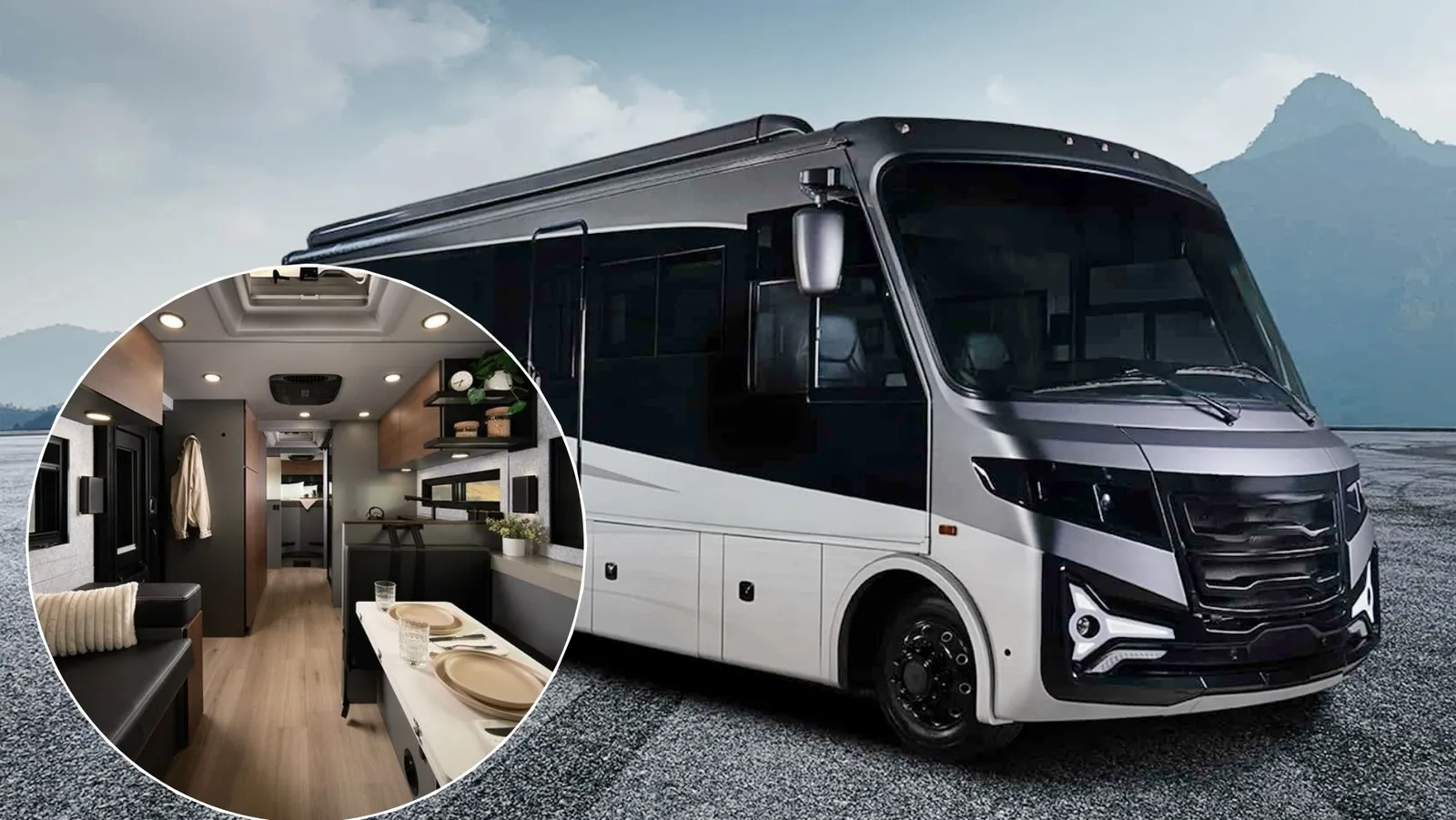
It costs more than a house (and is almost the same size), but it has a range of 742 km thanks to the same technology as a Leapmotor.
31/10/2026 14:00
Updated to
31/10/2026 14:00
There are more and more electric cars on our roads, but few — if any — electric campers. The problem with electric campers is that they are very heavy, consume even more energy, and are not particularly cheap. Now, Thor Industries, the world’s largest camper manufacturer, has come up with a brilliant idea. The same idea that Leapmotor had a few years ago. The result is Embark from Entegra Coach, Thor Industries’ luxury camper division.
Beneath the body, it features a layout familiar from Chinese cars: an extended-range electric vehicle (EREV) setup. The wheels are always driven by an electric motor, while a small gasoline engine acts as a generator to recharge the battery. This approach addresses a major concern for those traveling in electric campers—running out of power far from any outlets.
An electric chassis with 446 horsepower
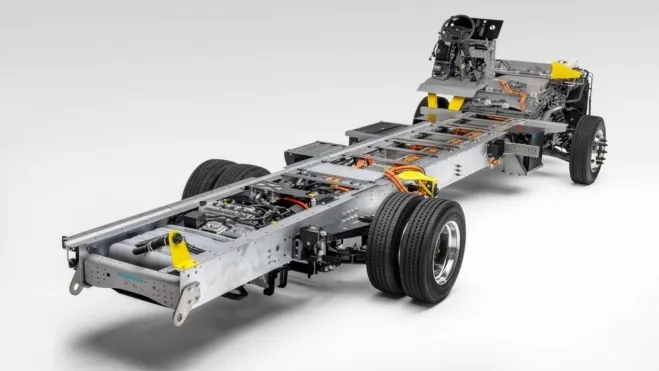
The Embark is a Class A motorhome, the large, all-terrain models that resemble buses and are common in the United States. It is based on a commercial chassis from Harbinger, a California-based company that manufactures electric platforms for delivery trucks. It features a 140 kWh battery and an electric motor with 446 horsepower. According to Harbinger’s official data, the motor’s torque reaches 1,546 Nm, and its 800-volt architecture allows it to recover up to 80% of its battery capacity in one hour using a fast charger.
It can only travel about 177 kilometers on battery power, a short distance for commuting. That’s why a small four-cylinder gasoline engine is used, which is not connected to the wheels and only generates electricity. With both the battery and fuel tank full, the range ranges from 724 to 805 kilometers, according to Entegra Coach’s official figures and the American homologation cycle.
The vehicle’s battery is also from the same company
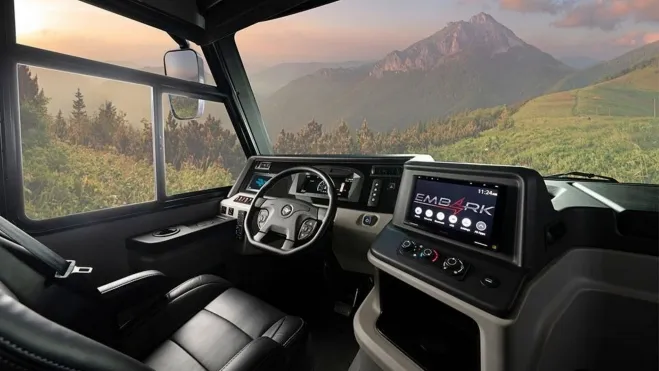
A traditional RV of this size usually comes equipped with a gasoline engine over seven liters, an auxiliary generator for the home’s battery, and a bunch of plugs and inverters to connect to a campground. The Embark simplifies this, as the same battery that powers it also runs the air conditioning, kitchen, or television. According to John Harris, co-founder of Harbinger, it can last a week or more without moving, and recharging it only requires plugging it into a campground or activating Camp mode, which starts the gasoline engine when stationary.
Fuel consumption is also greatly improved. On a trip across the United States, Harris achieved an average of 14.7 liters per 100 kilometers, two to three times less than that of a typical RV. Additionally, regenerative braking recovers some of the energy spent climbing a hill during descents.
No expandable modules for increased range
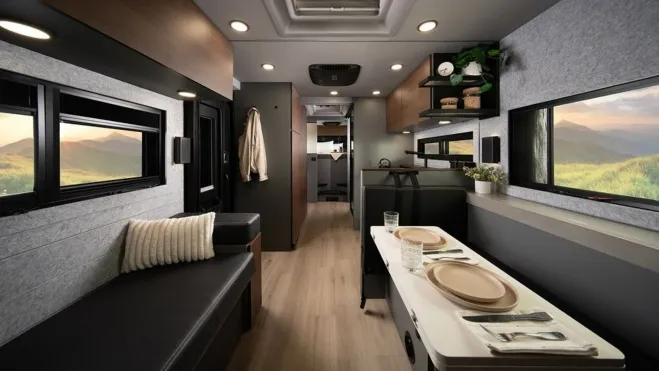
At 9.37 meters in length according to its official specifications and weighing around 8.2 tons, the Embark has space for four people to sleep. However, it lacks the expandable side modules that increase the living area in other RVs of its class. Jayco opted for this design to reduce weight and improve range, as well as to enhance waterproofing and thermal insulation. In exchange, the interior finishes are high-end, and there is no generator running at night, which is appreciated by nearby campers.
Two years of testing before hitting the market
Jayco unveiled the Embark in January 2025, but has chosen not to rush. Its team has used the prototype in dozens of test drives, and two units are available at a rental company in Los Angeles, where any customer can try them out. This allows them to collect real data on how much load users place on the vehicle or to what level they allow the battery to drop. This isn’t the first delay: Thor Industries presented a prototype based on the same Harbinger platform in 2024, then aiming to bring it to market in 2025.
The price, around 357,000 euros, is its most delicate aspect, especially since it is smaller than gasoline-powered RVs in its category. Harris argues that it costs as much as a quality RV and that this is offset by much lower fuel and maintenance costs per kilometer.