
Continental showcased a tire made with 43 percent recycled materials. For now, it is a concept, not a product for sale in stores.
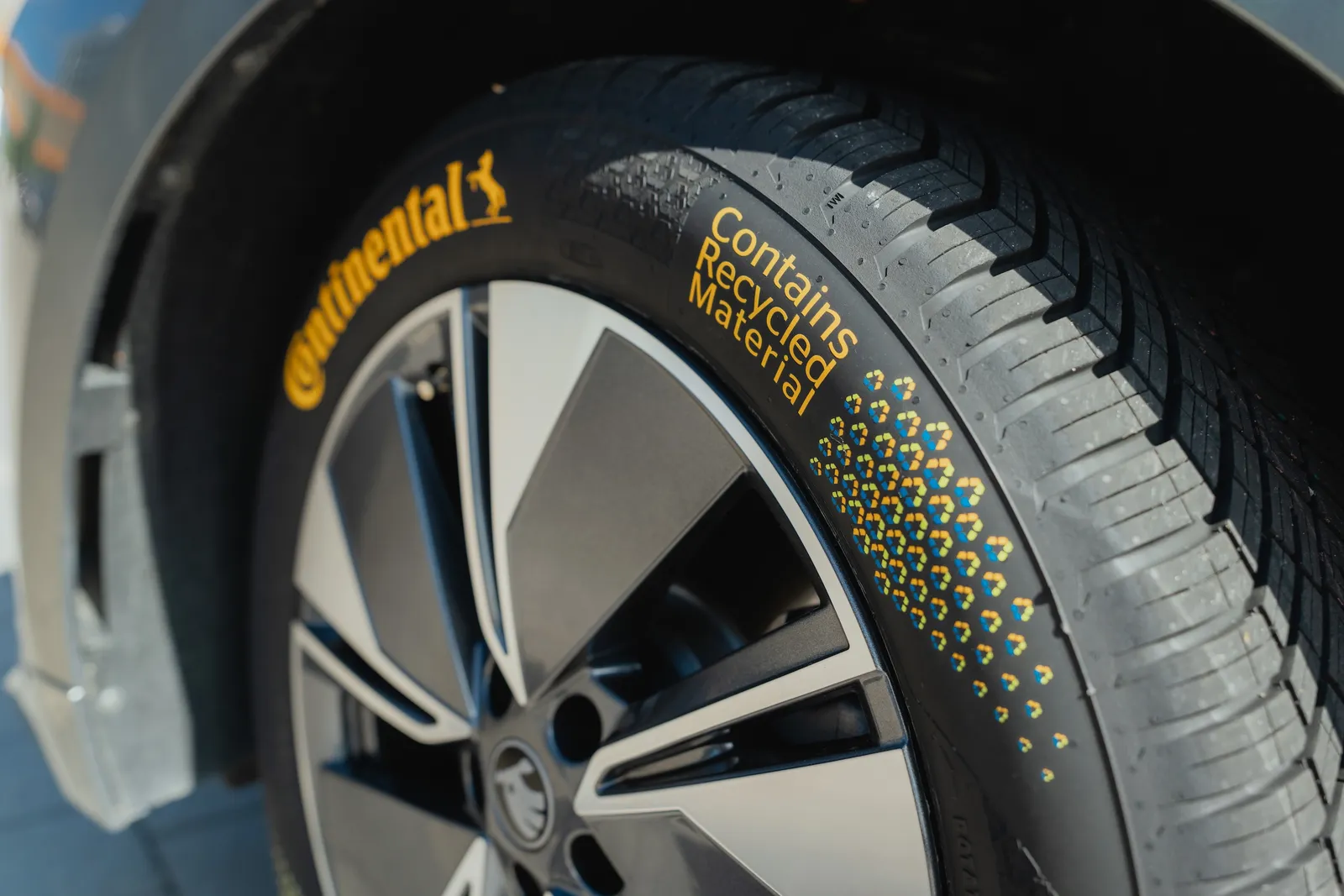
Continental developed a conceptual tire using about 43 percent recycled materials as part of the EU’s ZEvRA project, which ends in 2026. The company claims that despite this high recycling content, the tire still achieves the highest grade for rolling resistance under the EU tire labeling system. This sounds good for EV drivers, but what’s more important than marketing today is whether this can be achieved on a large scale at a reasonable price.
The ZEvRA project expands on the acronym “Zero Emission Electric Vehicles Enabled by Harmonized Circularity” and aims to improve the flow of materials in electric vehicles throughout the supply chain. There are 28 partners in the consortium, with Continental emphasizing that it is the only tire manufacturer involved.
What’s in this tire
We are talking about a conceptual tire, not a mass-produced model for retail shelves. Continental states that the 43 percent mentioned includes steel, rubber from retired tires, polyester fibers from PET bottles, and recycled carbon materials.
Pyrolysis is also involved, which involves recovering materials from used tires, including recovered carbon black, or rCB for short. The company already uses this component in practice. Since 2023, it has been incorporated into all newly produced full-rubber tires at the Korbach facility, primarily used in forklifts. This is an important caveat, as it shows the difference between industrial implementation and a flashy demonstration model for passenger cars.
In addition to this is the so-called rSand, or waste sand from places like foundries, which is used in the production process of alternative silica. Continental also adds about 13 percent renewable raw materials and 25 percent materials certified using mass balance methods. In total, this accounts for over 80 percent of raw materials that are recycled, from renewable sources, or certified through balance methods. It sounds impressive on the slide, but mass balance is not the same as the physical content of recycled materials in each product.
For EVs, rolling resistance is crucial. Here, Continental got it right.
The company claims the tire concept achieves the highest rolling resistance rating on the EU label. This makes sense more in an electric vehicle than in a gasoline car, as lower rolling resistance translates to reduced energy consumption and slightly better range.
Yet calm judgment is still needed here. The rolling resistance label is just one parameter. An EV tire must also handle the vehicle’s weight, torque, and everyday stress from curbs, potholes, and driving on the highway at 140 km/h well. A single statement doesn’t cover all of this.
Continental reminds that since 2022 it has been using recycled PET polyester fibers in selected passenger tires. The 2023 UltraContact NXT was intended to contain up to 65 percent renewable materials, including recycled and certified mass balance materials. In 2025, renewable and recycled materials purchased accounted for 28 percent of the overall portfolio, with a goal of reaching at least 40 percent by 2030.
The problem is not technical but industrial and regulatory
The most interesting part of this announcement does not relate to the tire itself but rather to what is still missing. Continental explicitly mentions three barriers: the availability of high-quality recycled materials, scaling up production processes, and the lack of unified regulatory definitions.
This includes what we formally consider recycled material in Europe, when processed substances become full-fledged secondary raw materials, and how to report material flows between companies. Without this, green marketing is easy to achieve, but comparable data is difficult to obtain. Not good.
For customers in Poland, this news doesn’t change anything for their next purchase of tires for Teslas, BMW i4s, or Kias EV3s. However, it shows the direction that could be adopted in standard models in a few years, if recycled materials are available in sufficient quality without manufacturers facing bureaucratic penalties.
The most honest aspect of this announcement is that Continental isn’t selling it as a ready-made success story, but rather as a test of industry limits. Would you buy tires with a high recycled content if they had the same durability and price as regular ones?
LovEV Newsletter
Want more content like this?
Sign up — we’ll send you a weekly summary once the newsletter starts.