
“Connected Car Innovation 2026”: China is ahead in terms of future readiness
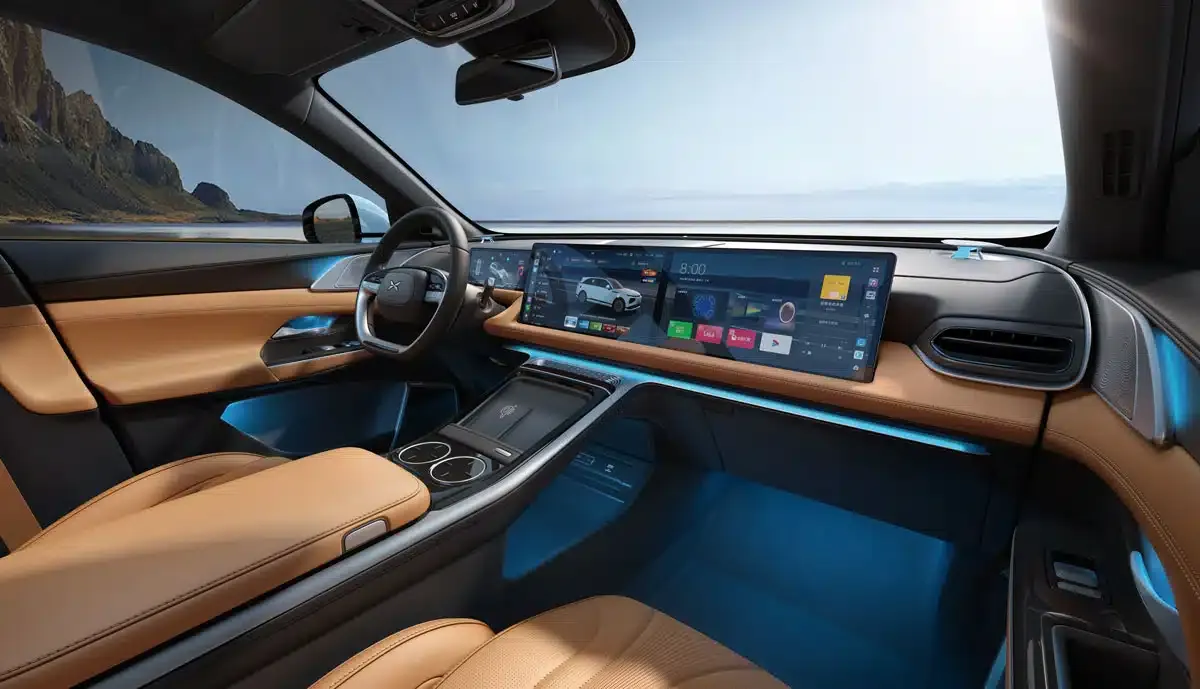
Image: XPeng (illustrative)
Volkswagen, Mercedes-Benz, and BMW lead the rankings for Connected Car innovations from 2021 to 2025, but other manufacturers are ahead in terms of readiness for future innovations. This is shown in the “Connected Car Innovation 2026” study by the Center of Automotive Management (CAM) in collaboration with Cisco.
While Volkswagen ranks first in market-ready innovations, it only comes in 14th place in the Connected Car Readiness (CCR) ranking at 47 percent. BMW is the highest-ranked German manufacturer at 10th place with 80 percent, followed by Mercedes-Benz at 12th place with 73 percent.
According to the analysis, in international comparisons China has surpassed Germany’s automotive industry in terms of innovation strength for connected cars. Manufacturers in the People’s Republic now account for nearly 41 percent of global innovation strength, while German companies hold 35 percent. Chinese manufacturers exhibit strong innovation momentum, especially in areas such as artificial intelligence, digital cockpits, driver assistance systems, and electric vehicle ecosystems. However, Germany was able to catch up again after a decline up to 2023 and further narrow the gap with China by 2025.
XPeng and Xiaomi lead in future readiness
In terms of the future readiness of connected vehicles, software-focused manufacturers are at the forefront. XPeng and Xiaomi lead the CCR ranking with 97 percent each, followed by Tesla, Nio, and Li Auto at 93 percent each, as well as Rivian and the HIMA alliance led by Huawei at 90 percent each. Seven of the top ten manufacturers are from China. The leading companies are characterized by modern software architectures, high levels of AI integration, strong capabilities in over-the-air updates, and software-centric organizational structures, while Tesla remains among the top group despite a recent decline in its innovation momentum.
According to CAM, German premium manufacturers BMW and Mercedes-Benz have created important foundations for further development by introducing new platforms for software-defined vehicles. BMW relies on the Neue Klasse, while Mercedes-Benz uses the MB.OS operating system. “What will be crucial now is how quickly they can apply these architectures across their entire model range and consistently align their organizations around software,” says CAM Director Stefan Bratzel. In contrast, large-volume manufacturers are hindered by complex existing structures, multiple parallel vehicle platforms, and organizational divisions, which make the transition to unified software architectures and the introduction of new functions more difficult.
Cybersecurity Becomes a Challenge for the Automotive Industry
As vehicles become more interconnected, cybersecurity gains increasing importance. Modern cars continuously collect information through cameras, sensors, and location data, while manufacturers can remotely access key vehicle functions via over-the-air updates. CAM Director Bratzel calls for transparent data flows, data storage in Europe, and independent software testing among other measures.
From the customer perspective as well, cybersecurity plays an important role. In a 2024 survey by CAM and Cisco, 77 percent of German respondents cited vehicle cybersecurity as a key issue that manufacturers should address. 40 percent viewed connected vehicles with software updates as a threat. Mercedes-Benz, BMW, and Volkswagen enjoyed the highest trust regarding cybersecurity quality and data protection, while Chinese manufacturers ranked at the bottom of the evaluation.
According to CAM, the study examined over 2,500 market-ready Connected Car innovations from 30 automakers between 2021 and 2025. Additionally, the prerequisites for future innovations were assessed for 20 selected manufacturers using 57 individual factors. The Connected Car Readiness metric takes into account SDV hardware and software at 40 percent weight, while AI integration, partner networks, and culture and organization each account for 20 percent. The authors note that the study distinguishes between already implemented innovations and the technological and organizational prerequisites needed to develop new vehicle functions sustainably, cost-effectively, flexibly, and scalably in the future.
Have you found any errors? Please let us know
by email
about them. Thank you!
Also interesting
About the Author
Thomas Langenbucher is an expert in electromobility with professional experience in the automotive industry and finance sector. Since 2011, he has been covering electric vehicles, sustainable technologies, and mobility solutions for ecomento.de. Learn more.
Reader Interactions