
With a red alert for rain, here is the big question regarding electric cars: what happens if they drive through an flooded area?
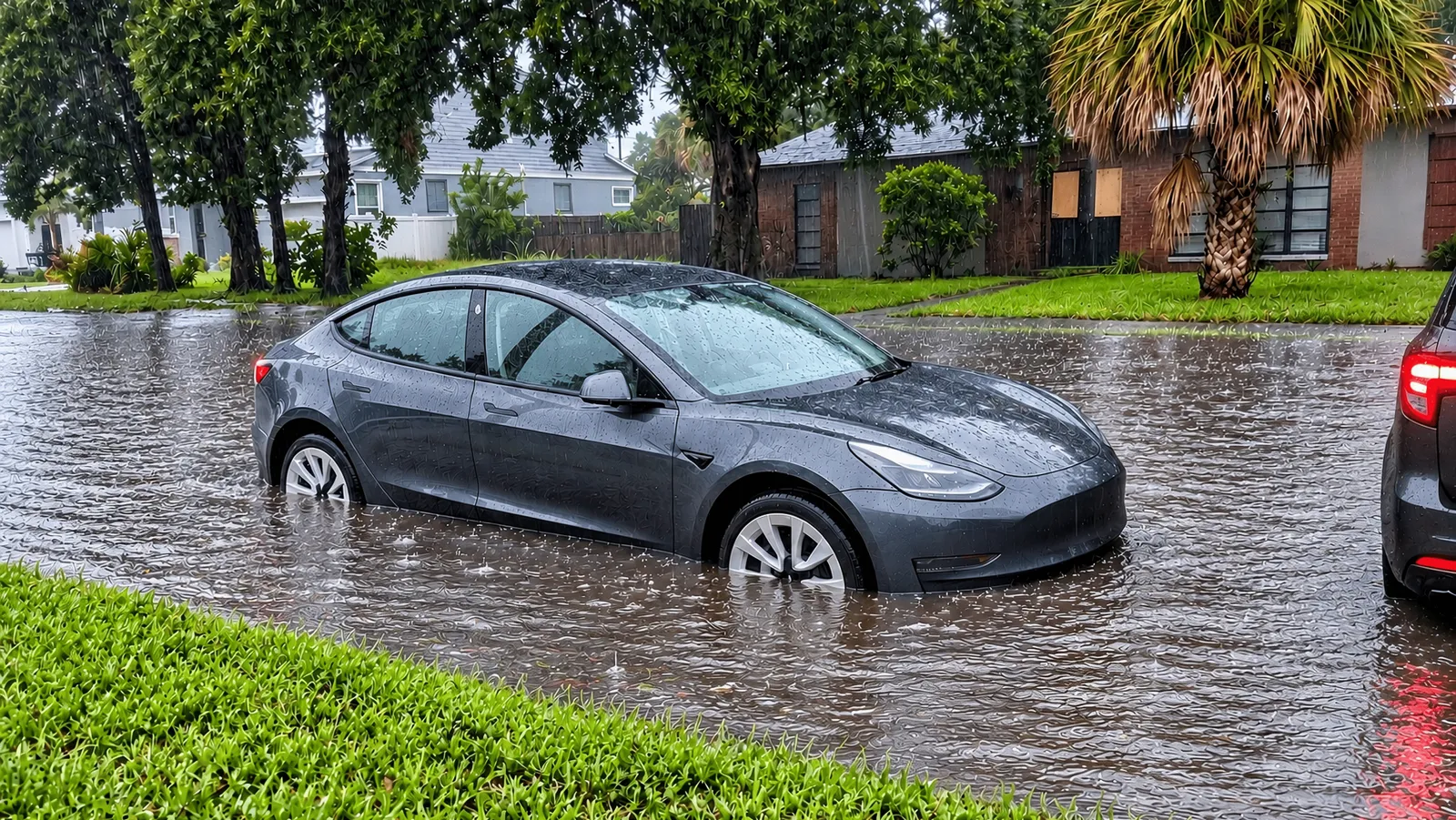
The heavy rains in recent days have once again made flooding and submerged roads among the main risks for drivers. AEMET reports ongoing instability in several areas, especially in the northeast, on this Monday, following a weekend marked by high-level warnings and torrential precipitation.
In this context, one of the most frequently asked questions regarding electric cars arises: What happens if an electric vehicle ends up in an area with a lot of water? The answer has an important nuance. Rain alone does not pose a special problem for an electric car; however, driving through a flooded road can be extremely dangerous regardless of the propulsion system.
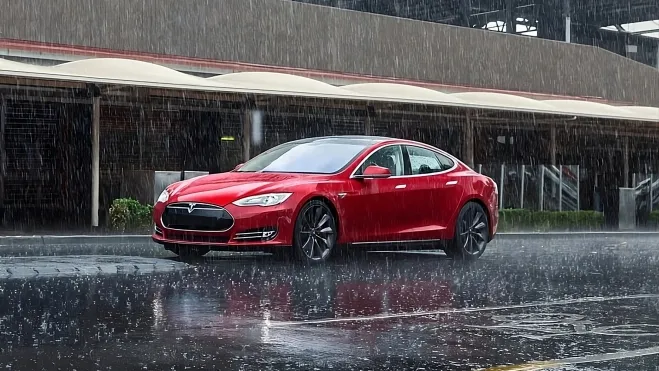
Electric cars are designed to operate in rainy conditions, navigate through normal puddles, and withstand typical road usage scenarios. Their high-voltage systems feature insulation and specific protective measures to prevent water from reaching sensitive electrical components under normal circumstances. Therefore, when water levels start rising, the main danger isn’t electric shock but rather the same issue that affects gasoline or diesel cars: losing traction, becoming stuck, or being swept away by the current.
The problem starts earlier than it seems
The General Directorate of Traffic emphasizes that if a driver encounters an flooded section, the advice is clear: do not attempt to cross it and find an alternative route. Even if the road is well-known, water may have carried away objects or weakened the ground, increasing its depth without being visible from the vehicle.
Moreover, a significant depth is not required for problems to arise. The DGT states that with about 20 centimeters of water, roughly halfway up a wheel depending on the vehicle, it can already become much harder to maintain control due to reduced traction.
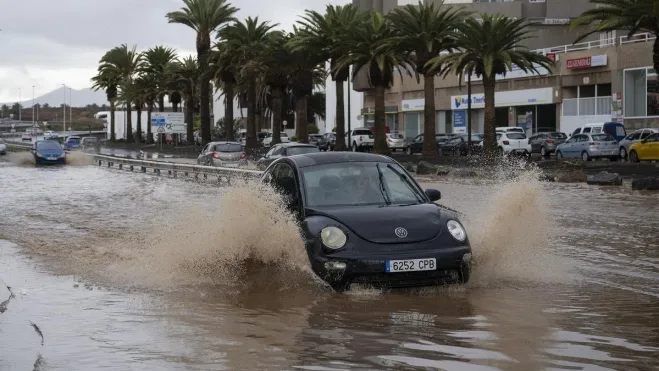
If the water level continues to rise, the risk increases at an extremely rapid pace. According to Tráfico, starting at around 30 centimeters, a vehicle can begin to be carried away by the water under certain conditions. Other factors such as current speed, slope, vehicle weight, or the height of its undercarriage can further exacerbate the situation.
The DGT itself warns that a current approximately half a meter deep flowing at 10 or 20 km/h can be sufficient to sweep away a sedan. It is precisely for this reason that it is not advisable to rely on the fact that another vehicle managed to pass a few minutes earlier.
Civil Protection issues an equally strict recommendation: avoid crossing flooded areas by car or on foot. If the water level exceeds the wheel axles, the vehicle gets stuck, or the water continues rising, the priority becomes leaving the car in a safe condition. These rules apply exactly the same way to electric cars. Just because it has a sealed battery protected from water does not mean the vehicle is suitable for crossing an flood.
What about the battery and charging?
The electric vehicles sold in Europe must meet specific safety requirements for their high-voltage systems, insulation, and protection against electrical contact. For this reason, they can be used normally in heavy rain, pass through wash tunnels, or remain parked outside during storms. What completely changes the situation is deep immersion or flooding. If water reaches components for which the manufacturer has not accounted for such conditions, the vehicle must be inspected before it can be used normally again.
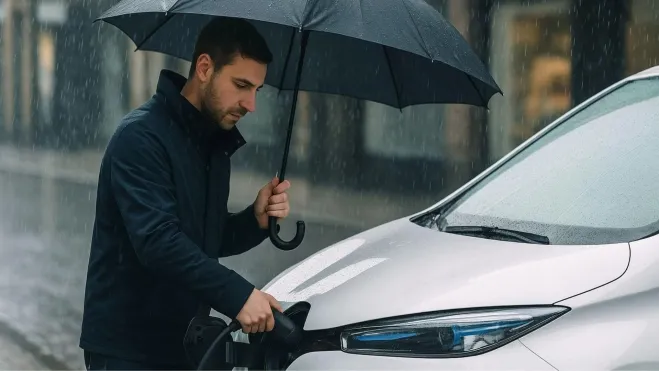
After a vehicle has been partially submerged, it is advisable not to touch any electrical components or attempt to recharge it until it has been inspected by a specialized service. This becomes even more important in the case of saltwater, as it significantly increases the risk of corrosion and can cause damage later on, even if the car appears to still be functioning.
It is also entirely possible to recharge an electric car while it is raining. Charging stations, connectors, and vehicles are designed to operate in outdoor conditions and come equipped with systems that prevent electricity from flowing until the connection is proper.
The situation is different if the charger, cable, or the vehicle itself has been submerged or shows visible damage. In that case, the car should not be connected until it is confirmed that the entire system is in good condition.
The rains of recent days remind us once again that the real limit is not determined by the car’s technology, but by the depth and force of the water. An electric vehicle can drive through heavy rain without any special issues, but an flooded road should never be treated as just a puddle.
The recommendation, therefore, is simple: if the depth is unknown, the water is moving, or there are any doubts about the road condition, one should turn back. The car’s ability to keep its battery isolated does not prevent it from losing contact with the ground or being swept away by currents.
