
Citroën brings wheelchair version of the Ami to Germany
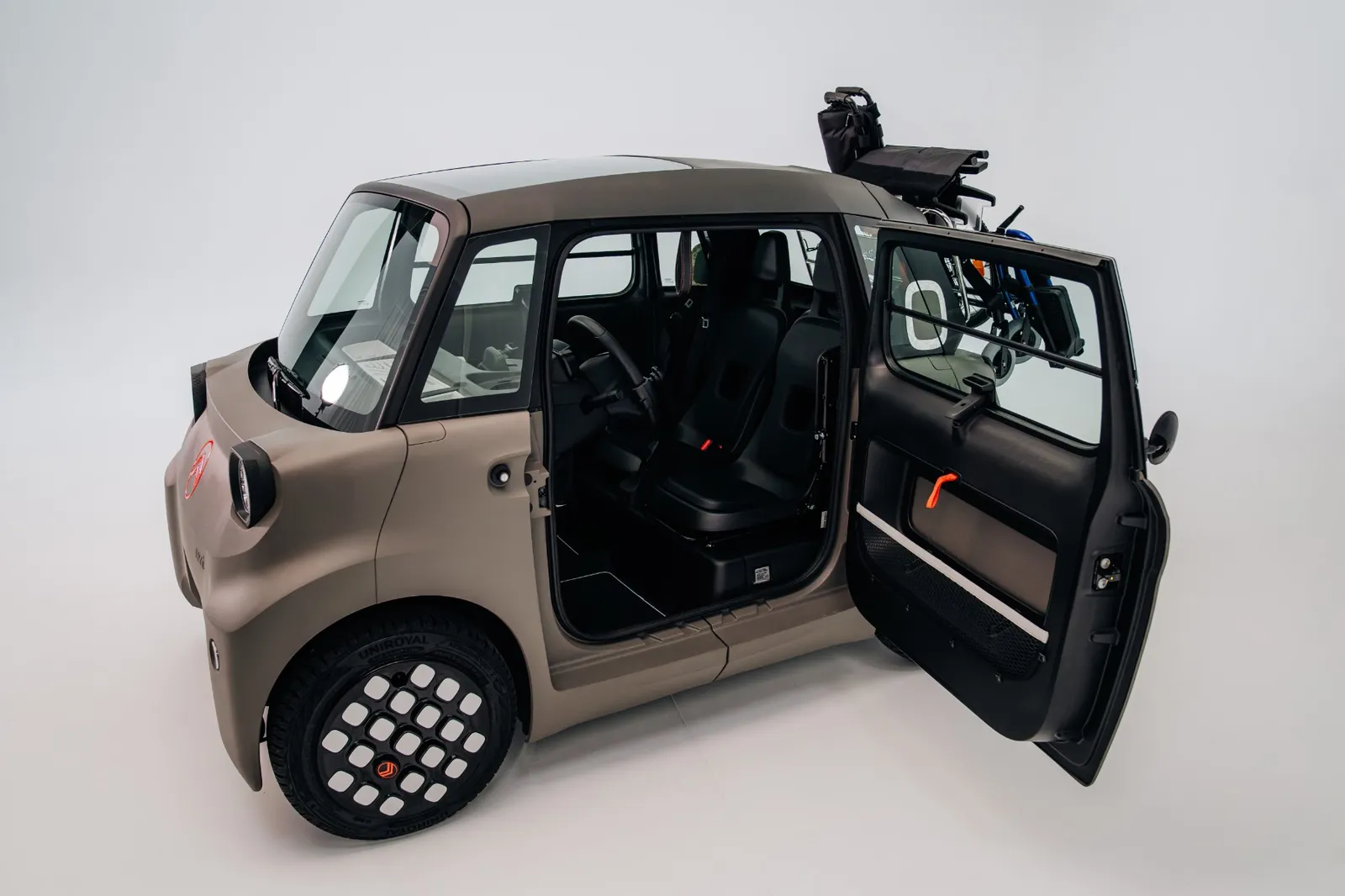
Citroën is bringing a new version of its electric microcar Ami to Germany: the Ami[for]all was developed specifically for wheelchair users who want to operate a vehicle using hand controls. The conversion is carried out by Mobilcenter Zawatzky, a long-established specialist in vehicles adapted for people with disabilities.
Unlike the recently shown accessibility version of the Kia PV5, which focuses on enabling smooth transportation of a wheelchair user in the back seat, the Citroën Ami[for]all is a so-called self-driving solution: it allows people with lower limb disabilities to operate the vehicle independently, with the gas and brake controls being operated by hand instead of using the usual foot pedals — as these are often no longer possible for such individuals.
The basis of the Ami[for]all is the fully electric Ami introduced in 2020, which means “friend” in French. It is not a full-sized car but rather a so-called light vehicle. A Class B driver’s license is not required; instead, the electric two-seater can be driven starting at age 15 with an AM class license, with a speed limit of 45 km/h similar to that of a moped. The range is 75 km — sufficient for urban use.
The Ami[for]all was developed as part of Stellantis’ intrapreneurship program Star*Up, a competition for employees to submit ideas. After its launch in France in 2023, the model is now available in Italy and Germany as well. Citroën provides a conversion kit compatible with all configurable versions of the Ami. The conversion is carried out by the German specialist Mobilcenter Zawatzky, is TÜV-approved, and focuses on practical mechanical adjustments that do not alter the vehicle’s ease of use.
"The Ami[for]all perfectly aligns with the philosophy of the Ami and Citroën: a practical, accessible mobility solution for everyone. We are pleased to now be able to offer this solution to support the mobility of people with disabilities in Germany as well," says Thomas Goldboom, CEO of Citroën Deutschland.
The goal of this model variant is to enable wheelchair users greater independence and autonomy in daily life — such as for short distances, without relying on companions or public transportation. To achieve this, in addition to a hand throttle and a main brake controlled by hand, there are other important features for wheelchair users, including a door opening angle expanded to 90 degrees, a foldable transfer board, and a holding loop to facilitate getting in and out of the vehicle.
There is however one drawback, namely regarding the transfer between the wheelchair and the vehicle seat. The wheelchair can be transported either in the passenger seat when driving alone, or on a rear rack when accompanied by another person. However, there is no special wheelchair loading system that would allow a driver who cannot walk to load and unload the wheelchair into and out of the car. This means that when driving alone, the driver must have the strength to load and unload the wheelchair from the passenger seat by themselves. Or they need help. Loading it onto a rear rack would likely be even more difficult for, for example, people with spinal cord injuries.