
Citroën Ami with 220 km of range: how it has increased its driving distance using LFP cells
The Citroën Ami was conceived with a very specific philosophy: to be a simple, affordable mobility solution designed primarily for urban trips. But some owners, when they receive such a unique vehicle, aren’t satisfied with using it exactly as it leaves the dealership. This is the case with Turkish YouTuber Mert Belevi, who turned his Citroën Ami into a small electric laboratory on wheels.
In a video posted on his channel, Belevi explains how he decided to buy the Ami after realizing that the cost of using his work vehicle—a pickup with a fuel consumption of around 9-10 liters per 100 kilometers—had skyrocketed. At that time, he drove between 100 and 120 kilometers per day and was looking for a third vehicle for home use that would allow him to drastically reduce his commuting expenses.
The choice was a Citroën Ami. The initial idea was simple: to have a small and affordable vehicle for daily trips. However, once he had it at home, Belevi began thinking about everything he could modify. Living in a rural area and possessing relevant skills, he decided to start designing his own solutions.
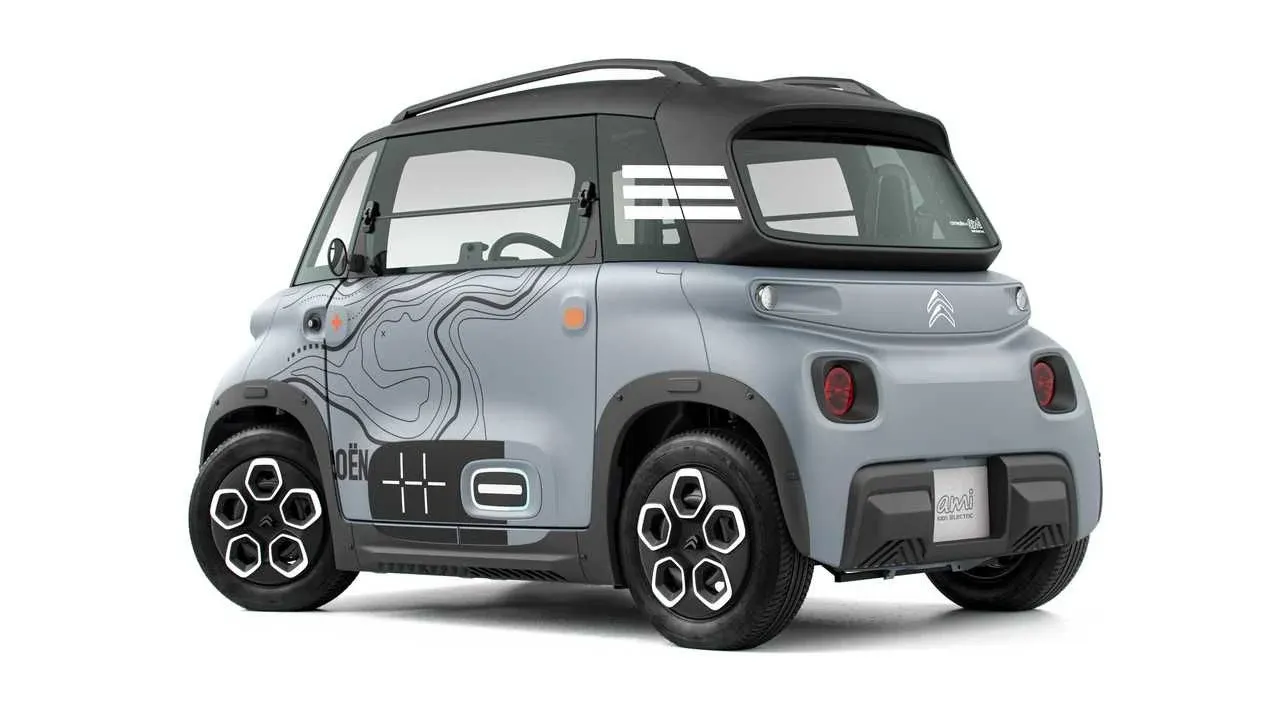
The Citroën Ami is an extremely compact electric quadricycle, measuring 2.41 meters in length, 1.39 meters in width, and 1.52 meters in height. It comes standard with a 6 kW motor and is limited to 45 km/h, while its battery has a capacity of around 5.5 kWh, providing an approved range of up to 75 kilometers. It can be charged using a regular household outlet.
But those figures proved insufficient for Belevi almost from the very beginning. His first major project was to increase range by installing additional batteries in the Ami itself. The problem was that he couldn’t modify the original battery management system, so adding a huge battery didn’t make much sense: once the factory-installed battery ran out, the system would still limit the vehicle’s operation.
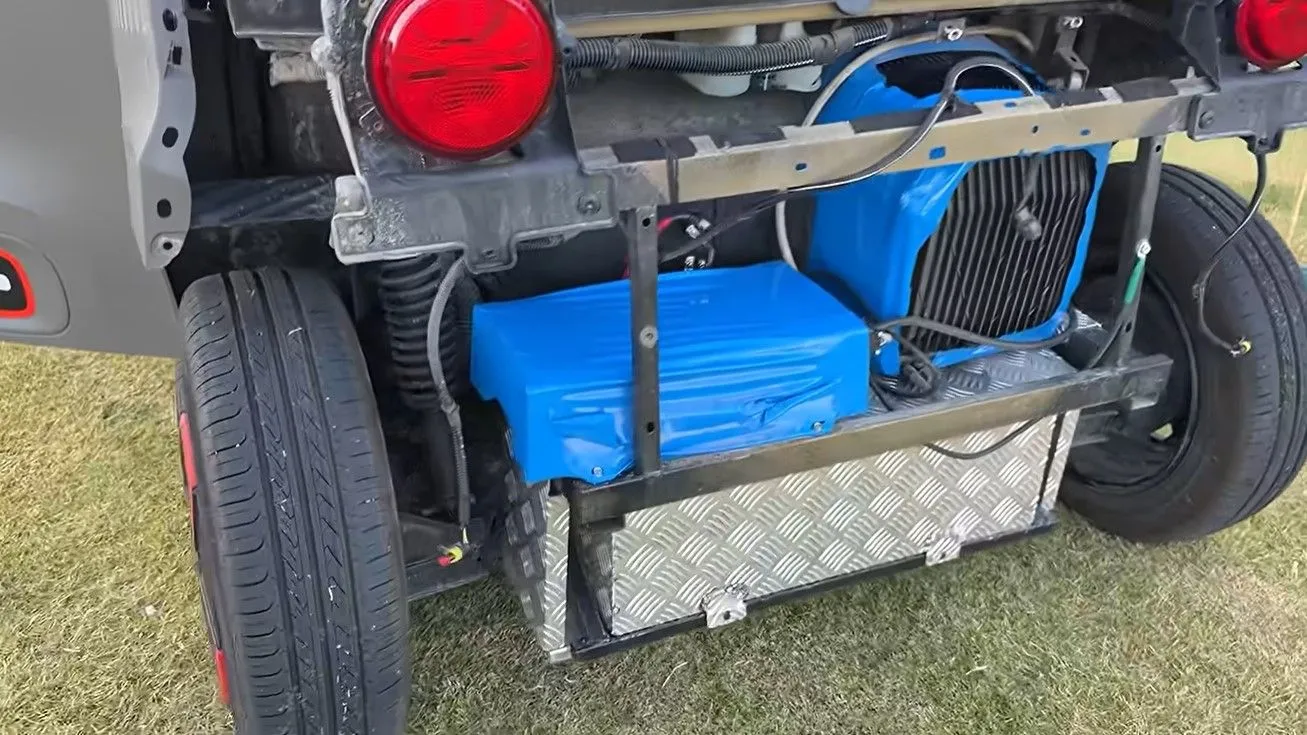
That’s why he decided to create an initial additional pack with a capacity similar to the original battery. After acquiring around 400 cells, he selected 384 that had equivalent voltage and resistance values and arranged them in a 16S configuration. The result was an additional battery of about 7.4 kWh, installed at the back of the Ami.
With it, he was able to practically double the available range, although the limitation of the original battery still existed. In other words, there was still energy available in the additional pack when the original system reached its limit. Belevi’s solution was to continue increasing capacity, but in a more controlled manner.
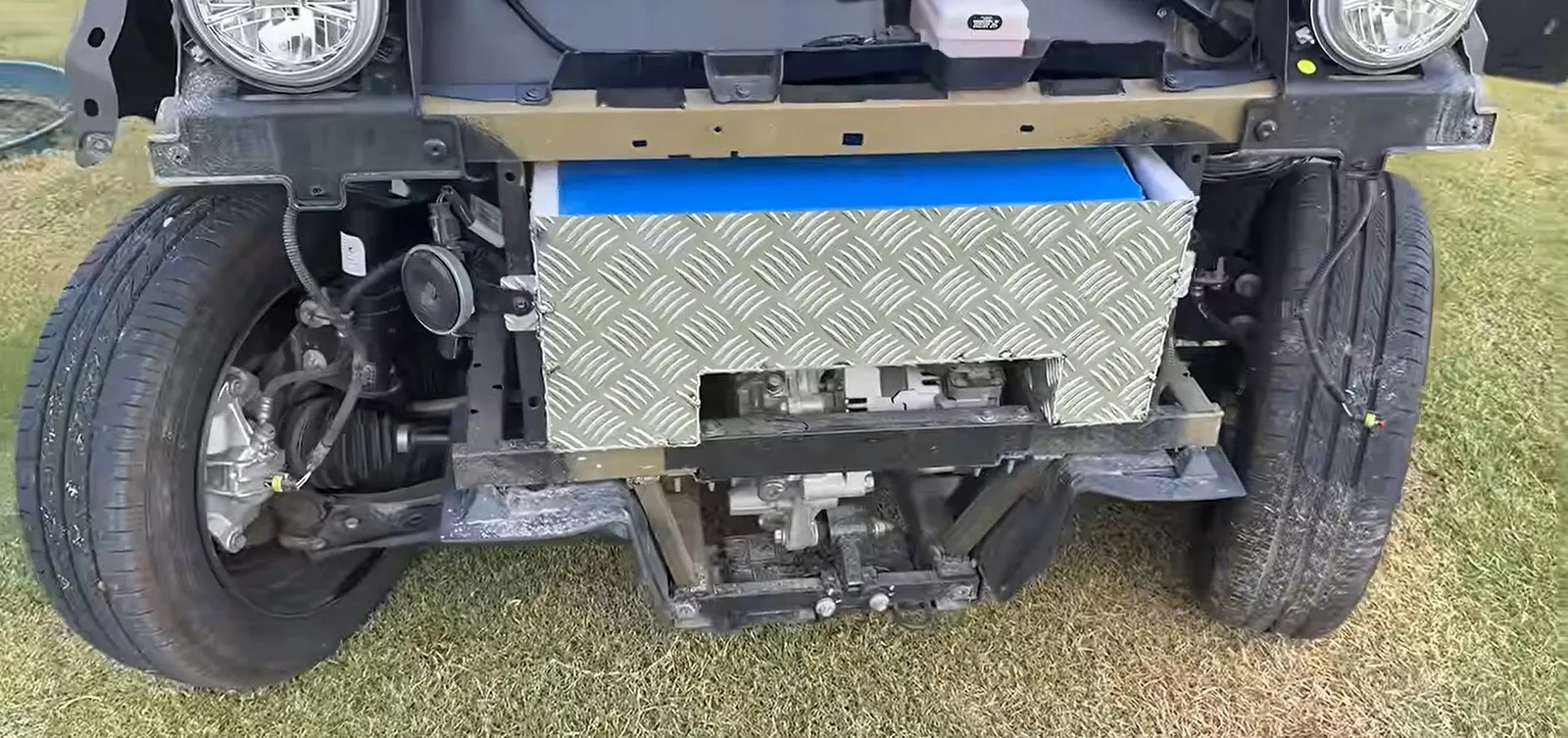
To do this, he built a second pack with 192 cells, roughly half the capacity of the first one, and installed it in the front. The final configuration consisted, according to the video’s creator, of 6 kWh of original battery, 7.4 kWh additional in the back, and another 3.7 kWh in the front.
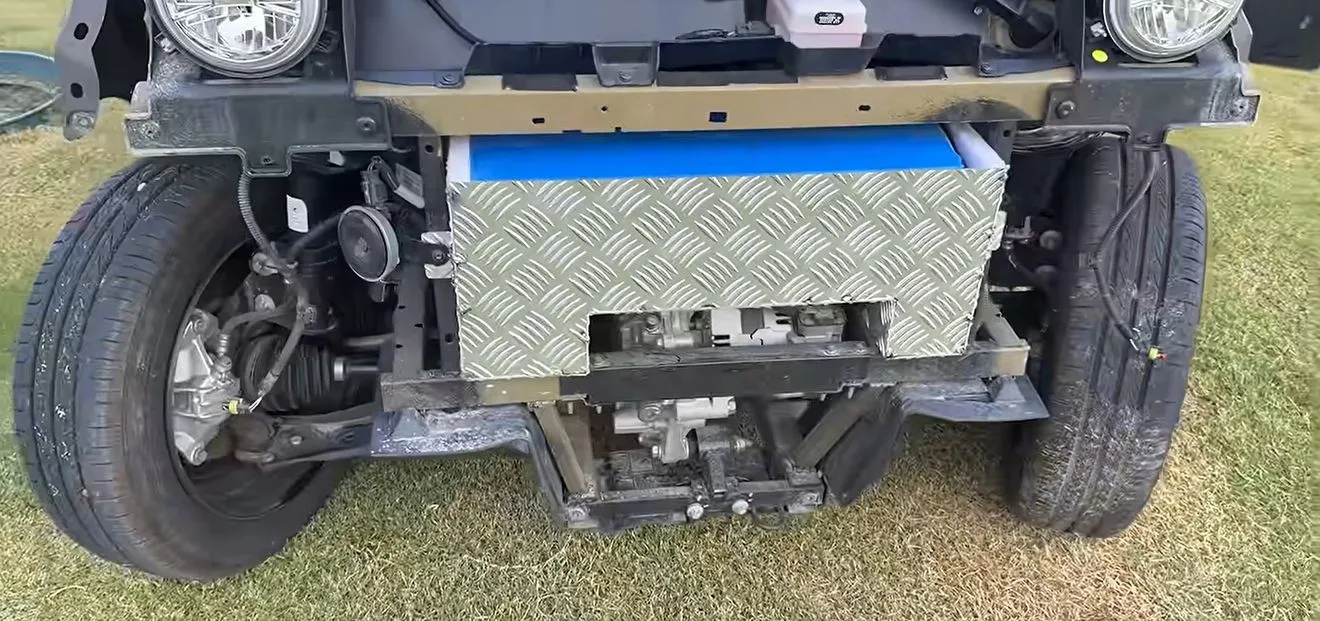
In total, there is about 17.1 kWh of capacity distributed across the three packs connected in parallel. The improvement was significant for a vehicle originally designed to run on a much smaller battery. Belevi claims its range has increased to between 215 and 220 kilometers, a figure that allows it to cover almost all daily trips without worrying about recharging.
The next modification had to address another obvious problem with the Ami: heat. In Izmir, Turkey, where temperatures remain high for much of the year, traveling inside a small, glass-covered cabin without air conditioning can be a challenging experience.
The solution was to install a portable air conditioning and heating system that runs on 48-volt power. Belevi connected it to the same electrical wiring as the additional batteries, enabling climate control for both summer and winter.
The unit officially offers a cooling capacity of 6,100 BTU and a heating capacity of 6,800 BTU. It can also operate using an additional battery and is controlled through a mobile app.
According to the owner, the results aren’t comparable to those of a conventional car because the Ami has virtually no insulation. Still, it’s sufficient for him to make long trips more bearable on hot days. And given the size of the cabin, managing to fit in a climate control system of this type is already a significant modification.
But the list of changes didn’t end there. Belevi also ran into a less noticeable but important issue for daily use: the 12-volt auxiliary battery. As he explains in the video, the service battery ran out after about 3,500 kilometers.
After charging it at home, he decided to install a converter capable of transforming the 48 volts from his auxiliary system into 12 volts. This allowed him to keep the service battery powered and prevent it from running out again during normal use.
And there was still one major issue left. Belevi lives in a rural area of Manisa and explains that with the original Ami, he needed about 33 km/h to climb a certain slope. After installing the additional batteries, that speed increased to around 37 km/h. It might seem like a small improvement, but when the rest of traffic is moving at 80 or 90 km/h, every kilometer per hour counts.
That’s why he decided to add another element that we would hardly expect to find inside a Citroën Ami: a coffee maker. To use it, he needed 220-volt electricity, which is where the Victron Energy MultiPlus 48/1200/13 came in handy. It combines the functions of an inverter and a charger and has a 13 A charger.
Belevi connected the equipment to the Ami’s 220-volt setup and claims he was able to significantly increase the charging speed. He also installed several switches so he could disconnect the additional batteries and the climate control separately when he didn’t need them.
This last aspect makes a lot of practical sense. Since the additional batteries were connected in parallel, he couldn’t just leave them connected permanently and expect everything to work like the original Ami. That’s why he added separate controls that allow him to turn on or off each battery pack individually.
It also features a battery management system with a display that allows you to monitor the charge level and consumption. However, the overall setup stops looking like a simple home modification when you consider the entire assembly: three batteries, control electronics, converters, an inverter, air conditioning, and various protection components.
And there is a clear trade-off. All that equipment adds between 120 and 130 kilograms to the Citroën Ami, according to its owner. The original quadricycle is very lightweight, and its suspension system is designed specifically for that low weight, so this increase ultimately has consequences.
Belevi explains that the rear suspension is already quite soft by default, and with all the equipment installed, the Ami sits approximately four centimeters lower than before. He also acknowledges that the increased weight has likely prolonged braking distance.
This is probably the most important aspect of this whole situation. Increasing the Ami’s range from 75 kilometers to over 200 kilometers is highly attractive, but doing so by adding more than 100 kilograms and modifying the original electrical system also completely changes the conditions for which its components were designed. It isn’t a modification that can be considered equivalent to an official accessory, nor is it something that should be attempted without technical knowledge and proper assessment of safety.