
China has 23.68 million charging points. Poland and the entire Europe look modest in comparison.
The Chinese energy administration reported that by the end of July 2026, the country had 23.683 million electric vehicle charging points, a 41.9 percent increase year-on-year. In July alone, 626 thousand new charging points were added. Given this scale, Poland’s slightly over 14 thousand charging points and Europe’s 1.3 million as of April appear quite modest.
What’s more interesting, however, is that China’s growth is now driven mainly not by public chargers along roads but by private installations.
Private charging dominates, while public charging also grows
In July, 536 thousand of the 626 thousand new charging points were private chargers, accounting for 85.6 percent of the total monthly increase. Public infrastructure saw an addition of 90 thousand charging points during the same period.
By the end of July, there were 18.584 million private charging points in China, accounting for 82.6 percent of the total infrastructure and 48.8 percent more than the previous year. There were 5.099 million public charging points, with a year-on-year increase of 21.3 percent.
This says a lot about the maturity of the market. In the early stages, everyone focuses on chargers along roads and in cities. Later, the focus shifts to homes, offices, and fleets. In China, this phase is already in full swing.
For comparison, all of Europe had over 1.3 million charging points in April, while Poland had just over 14,000. A huge gap. Clearly, China has a different market scale and different car sales figures, but the numbers are still impressive.
Manufacturers are adding their own charging stations, and EV sales exceeded 60 percent
As of the end of July, public chargers in China had a total rated capacity of 255 million kW, with an average capacity per station at 49.97 kW. This is an average for the entire market, so it includes both slower AC chargers and more powerful DC chargers. This should not be confused with the actual fast charging capacity on the road.
Private infrastructure, on the other hand, had an connected capacity of around 160 million kVA.
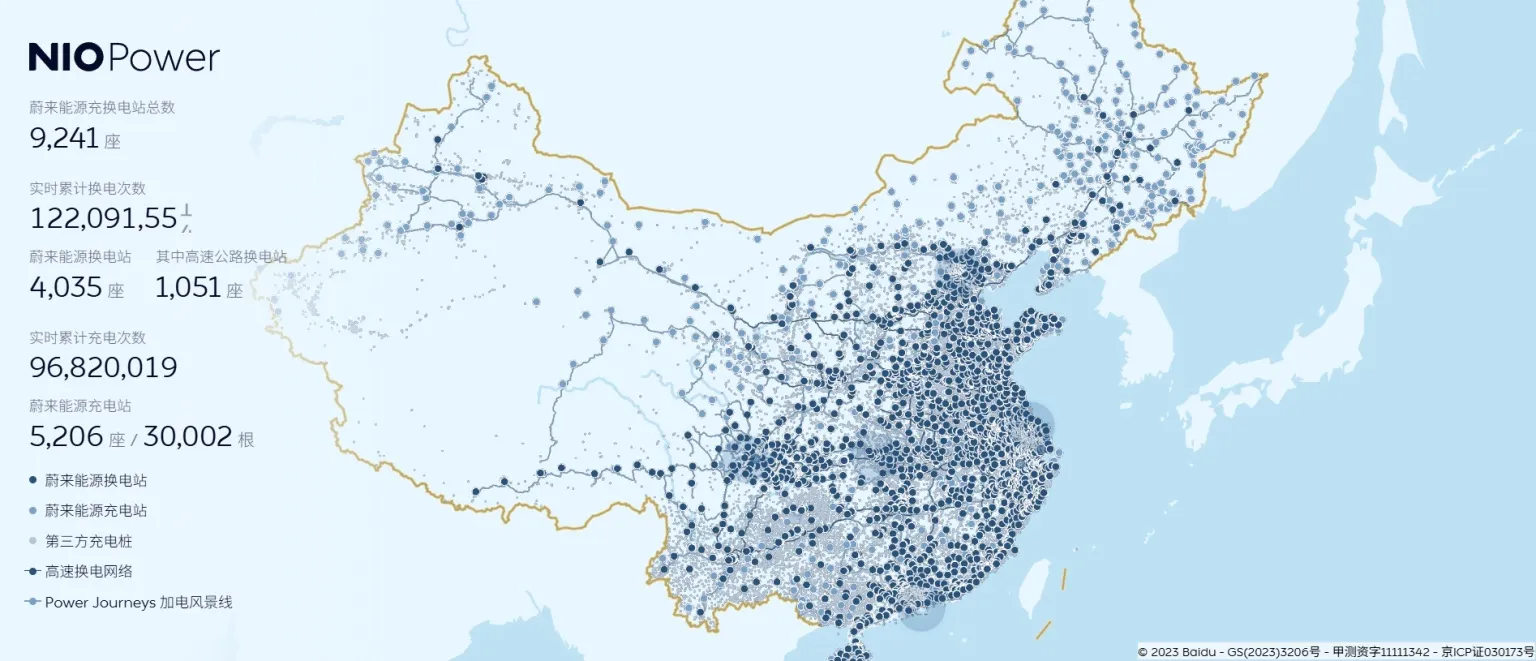
Automakers are also continuing to expand their own charging networks. As of August 24, Nio had 9,241 charging and battery swapping stations, including 5,206 charging stations and 30,002 charging points. BYD already claims to have over 7,000 stations in its flash charging network and aims to reach 20,000 by the end of 2026. It’s ambitious, but given their progress rate, it doesn’t sound like pure marketing.
This is driven by sales. In July, 1.561 million NEVs were sold in China, accounting for 60.4 percent of the overall new car market. It was the first month in which this share exceeded 60 percent. From January to July, a total of 9.007 million NEVs were sold, representing 51.2 percent of the market share. For the first time, more than half on a cumulative basis.
The Chinese market today shows not only how many charging stations can be built but also what the world will look like when electric vehicles are no longer a niche in the market. Do you think Europe can catch up even partially to this pace, or will we remain stuck with discussions about AFIRs and individual HPC hubs?
LovEV Newsletter
Want more content like this?
Sign up — we’ll send you a weekly summary once the newsletter starts.