
China aims to achieve widespread commercial availability of solid-state batteries by 2030. Manufacturers have a tough task ahead.
The Chinese Ministry of Industry and Information Technology (MIIT) tested domestic solid-state batteries in 2025. It turned out they were primarily a marketing gimmick. Therefore, the strategic plan for the next five years includes achieving mass commercialization and use of solid electrolyte batteries. It also mandates continuous development in the electrochemical battery sector, with breakthroughs in electrodes, new electrolytes, and high-quality auxiliary materials, according to CnEVPost.
Chinese companies must advance in the battery sector
The MIIT (along with several other government agencies) is demanding that the research phase be completed, with solid-state batteries needing to be deployed on a large scale by 2030. This is a rather interesting situation, similar to asking a world champion in the 100 and 400 meter races to become a cycling champion, just because “you move your legs there too” and “he claimed to train.” China is currently the absolute leader in the Li-ion battery sector, having managed to achieve certain parameters using lithium-iron-phosphate chemistry that were not even expected in solid-state batteries five years ago (in terms of power and charging time).

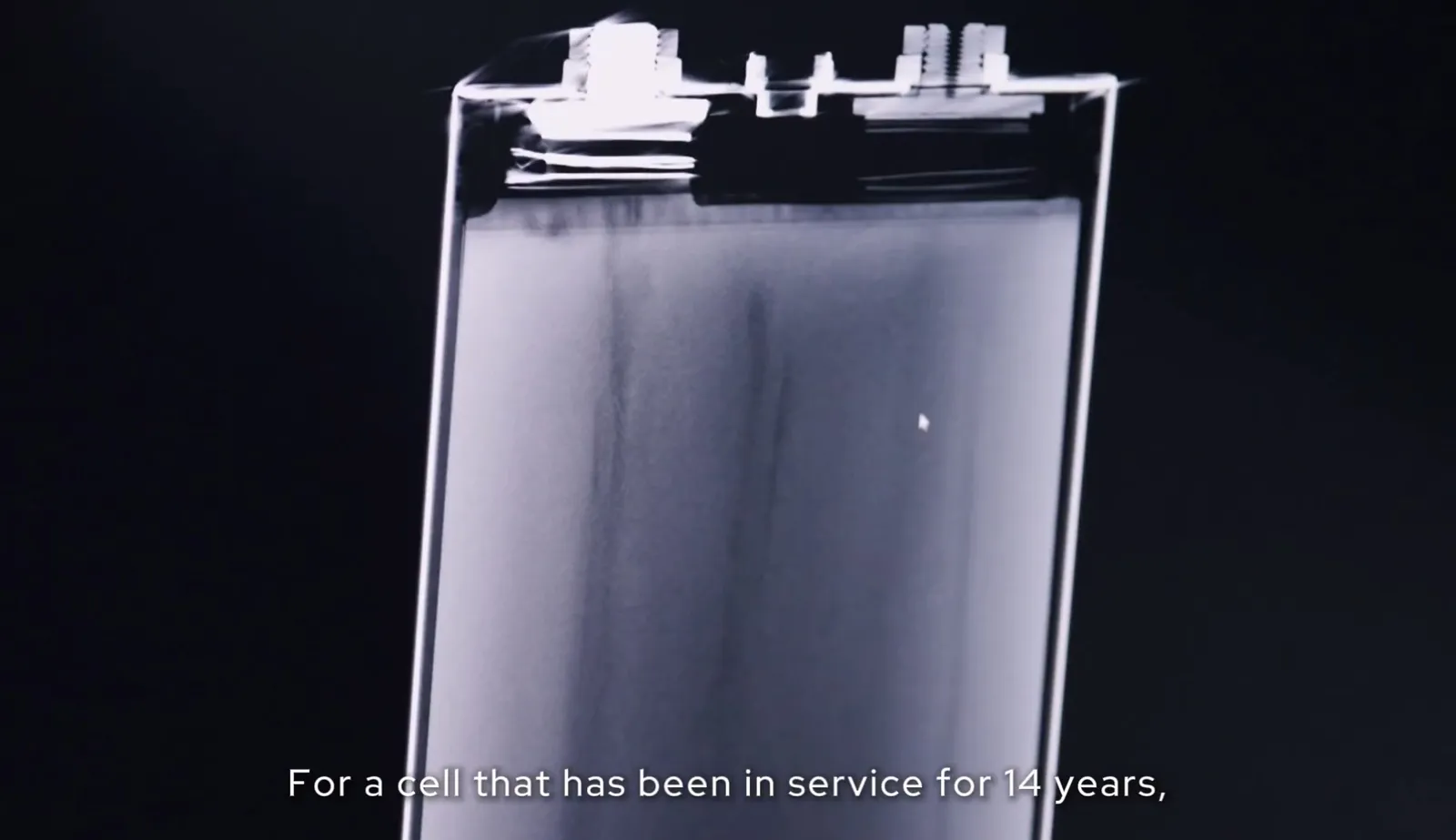
Cathodes and anodes shown in cross-section; illustrative image from a CATL promotional video about testing old batteries (c) CATL / X
Companies in China need to improve the conductivity of solid electrolytes (which is problematic, especially at layer interfaces), enhance their production efficiency, and advance high-pressure system engineering for compressing solid-state cells. To achieve this, they should explore isostatic presses, which operate at high temperatures with pressure applied uniformly from all sides [hence “iso” – editor’s note]. They must experiment with cathode materials having high capacitance, anodes based on metallic lithium, or anode-free cells that are formed from metallic lithium during charging.
Of course, that’s not all. Cell and battery manufacturers in China must keep working hard to achieve breakthroughs (source). They should develop long-lasting lithium cells that can withstand 15,000 cycles of operation. Paradoxically, they might have an easier time here than with solid electrolytes—which do exist and function, but perform worse in every aspect compared to cells using liquid electrolytes—because electrolytes capable of restoring lithium ions from an overly thick passive layer (SEI) have already been created. Jeff Dahn is testing them, having reached 26,809 cycles with only a 10 percent degradation (=90 percent of the original capacity).

Cell after 14 years of use; illustrative image (c) CATL / X
Article rating
Reader ratings
[Total: 3 votes Average: 5]
Don’t miss new content—CLICK and FOLLOW Elektrowoz.pl on Google News. You might also be interested in the following ads:
