
China aims for 70% NEV vehicles by 2030. The plan is ambitious, but the market is already almost there.
The Chinese Ministry of Industry and Information Technology (MIIT) along with eight other departments have released a new plan for the NEV industry for the years 2026–2030. The goal is simple on paper: by 2030, 70% of new passenger cars and 40% of new commercial vehicles should belong to the NEV segment, which includes electric cars, plug-in hybrids, and hydrogen vehicles. What’s more interesting for drivers in Europe is that Beijing now aims not only to boost growth but also to bring order to the chaos, cut excess capacity, and advance autonomy on a larger scale.
Table of Contents
Show
Hide
To clarify, this is not just a casual statement by a minister. The document was issued jointly by 9 government agencies and sets the direction for the next five years.
70% by 2030 sounds ambitious, but China is already close to achieving it
The most prominent target in the plan calls for NEVs to account for 70% of new passenger car sales in the domestic market by 2030. For commercial vehicles, the target is 40%.
The issue, or rather interesting fact, is that the market has already approached this figure. According to CPCA data, as of August 2026, NEVs accounted for 65.2% of China’s retail passenger car sales. This represents a year-on-year increase of 9.9 percentage points. During the same period, sales of gasoline-powered vehicles dropped by 40% year on year.
In short: the target looks impressive in tables, but it isn’t far off. If the current pace continues, 70% could be achieved even before halfway through the plan’s timeline, rather than only at the end of the decade.
In commercial vehicles, the situation is a bit less clear. In July 2026, the monthly penetration of NEVs reached 44.1% there, officially surpassing the target set for 2030. However, the cumulative figure for the first seven months of the year was 35%. This shows the difference between a good single month and a steady trend.
And here, the old problem of heavy transport arises again: charging and refueling energy on long routes. Increased sales alone are not enough if operators cannot keep trucks moving.
Autonomy has a specific deadline, but it remains between testing and deployment
The second pillar of the plan is autonomous driving. China aims to deploy vehicles with autonomous driving capabilities on a large scale by 2030, with high levels of automation operating on highways, urban expressways, and selected city streets.
This sounds more concrete than the company’s slogans about “smart mobility.” You also state outright that the systems must be significantly safer than human drivers, and that mechanisms for evaluating technology maturity and safety will be established. That’s right, because today many manufacturers sell marketing rather than true autonomy.
The plan includes demonstration deployments for:
passenger cars,
buses,
long-distance transportation,
urban delivery services.
This is complemented by organized procedures for vehicle homologation and approval to operate on roads.
There’s another important detail here. In August 2026, China adopted the first mandatory national standards for L3 and L4 autonomy, which will take effect on July 1, 2027. This gives the industry roughly three years for testing, certification, vehicle development, and larger-scale deployments before 2030.
Is it possible? Yes. Will it be easy? Not really. Three years is a long time for software, but short for large-scale implementation in the automotive industry, especially when responsibility, safety, and infrastructure are involved.
Beijing no longer wants just growth. It also wants to clean up the mess left by the investment frenzy.
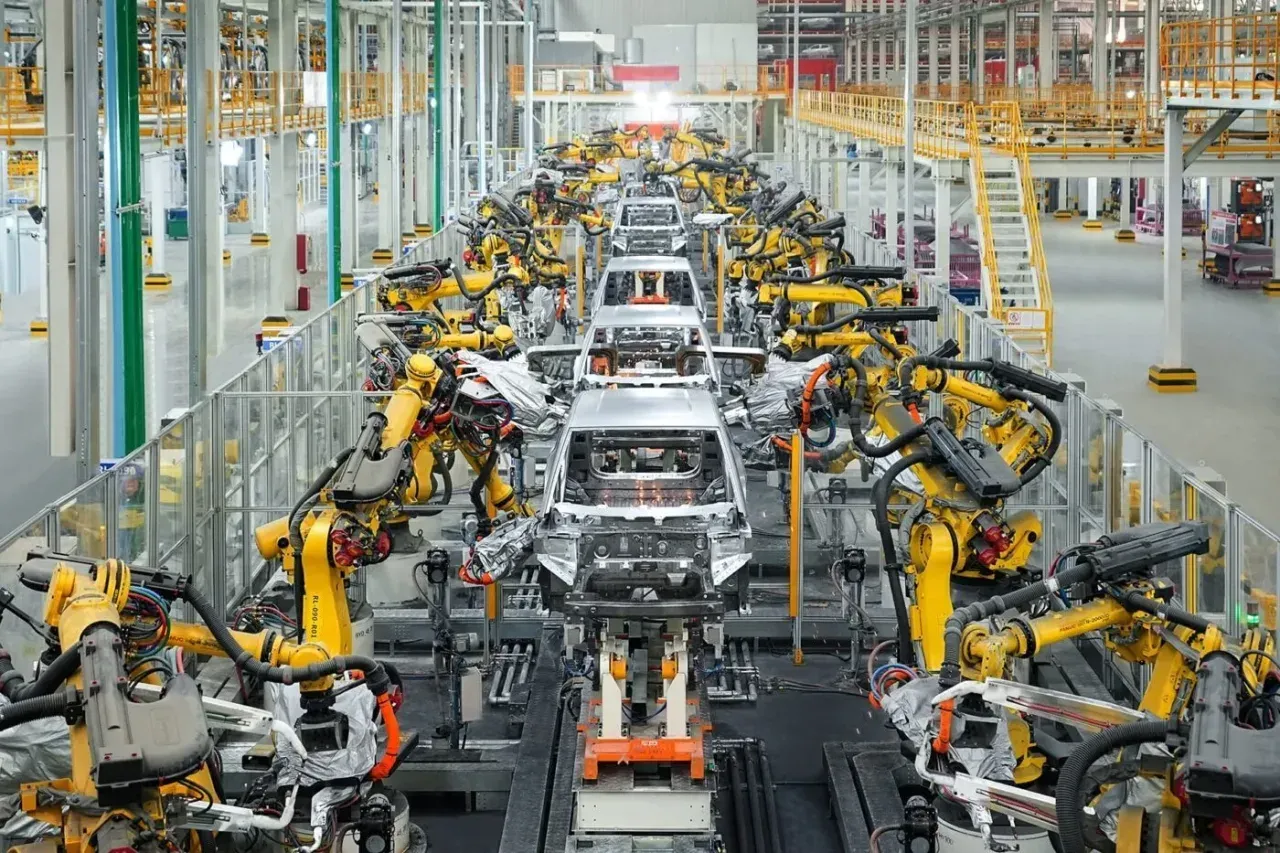
The most interesting part of the plan doesn’t even relate to sales itself. China plans stricter oversight of car and battery production capacities, tougher requirements for projects aiming to create new independent NEV manufacturers, and greater pressure for mergers, restructuring, and consolidation across regions.
This is a signal that Beijing sees an excess of factories, a fragmented market, and local investment wars. The plan also calls for eliminating outdated and inefficient production capacity as well as improving the utilization of existing plants. In other words, fewer new “strategic” factories will be opened just so local authorities can cut ribbons.
The document also targets unfair competition. The government promises stricter enforcement of antitrust laws, a crackdown on price dumping, and restrictions on local investment incentives such as unauthorized subsidies, tax breaks, or preferential land allocations.
This is not accidental. In recent years, China’s EV market has grown rapidly, but along with this growth came price wars, price undercutting, artificial inflation of investments, and pressure on suppliers. Now the government is trying to slow down the pace and clean up the mess. An ambitious task.
The plan also calls for better oversight of industry data disclosure and corporate reporting. For some manufacturers, this could be more painful than additional technical standards.
Less consumption, better batteries, more AI and infrastructure
At the technical level, China has set several specific targets. By 2030, the average energy consumption per battery-powered passenger car is expected to be around 11.5 kWh/100 km, while the average fuel consumption for passenger cars is expected to be around 3.3 l/100 km.
The first target is ambitious but achievable, given the average fleet level and further improvements in aerodynamics, powertrains, and weight. The second target shows that the plan does not assume the immediate disappearance of internal combustion engines. China still thinks broadly about the entire market, not just BEVs.
The document also identifies areas where the country still has gaps. The list includes:
automotive chips,
operating systems,
Industrial programming,
key foundational materials.
In addition, there are improvements in battery safety, charging speed, and performance in low temperatures. These are precisely the areas where marketing ends and the user’s daily experience begins.
You also want to develop the AI plus mobility initiative. In practice, this involves using artificial intelligence for energy management, vehicle motion control, human-machine interaction, and fault prediction. It sounds broad, but some of these applications are already in use. The question is, how much of this will become a real product and how much will remain just a presentation for investors.
Charging, battery swapping, and electric trucks are set to receive further support
The plan also covers infrastructure. China aims to accelerate the development of high-power charging, improve charging networks in rural areas, and increase the scale of vehicle integration with the power grid, such as vehicle-to-grid solutions.
This is particularly important for the commercial market. The document also mentions the development of new electric trucks, the construction of interregional zero-emission transportation corridors, and demonstrations of autonomous trucks.
If these goals are achieved, China’s advantage over Europe could grow even further. In our country, there is much talk about electrifying heavy transportation, but implementations remain limited to specific areas, and infrastructure is often still in the planning stage.
Overseas expansion enters a new phase
The plan also explicitly mentions internationalization. China aims to increase the recognition of its brands, strengthen its influence on international standards and regulations, and support overseas operations through trade, investment, and technological partnerships.
This is no longer the “let’s send car containers to Europe and see” phase. The next step involves local production, own supply chains, spare parts warehouses, compliance with regulations, and after-sales support. The document even mentions joint overseas warehouses for key spare parts.
From Europe’s perspective, and thus Poland’s as well, this could mean an even stronger presence of Chinese brands not only as importers but also as manufacturers and technology providers. Especially if the Union tries to protect the market through tariffs and localization requirements.
Finally, there is the purely industrial indicator. By 2030, productivity in this sector is expected to rise by 15% compared to 2025, with China aiming to have several manufacturers in the global top 10 for sales and component suppliers in the world’s top 100. This is already happening to some extent. In the first half of 2026, BYD, Geely, and Chery entered the global top ranks for sales, while the number of Chinese companies on the list of the 100 largest automotive suppliers increased to 17.
Beijing’s plan doesn’t resemble another piece of propaganda about a green future. It looks more like a set of instructions: maintain the lead, streamline excesses, and achieve autonomy ahead of the rest of the world. My question to you: does Europe have any response other than tariffs and cautious statements today?