
China’s response to the diesel crisis – electric trucks
International energy news: China is rapidly electrifying heavy transportation; data centers have driven small turbines out of the market; Europe’s industry is not in such bad shape; ETS reform under pressure from political changes in the EU.

Table of contents
China is rapidly electrifying heavy transportation
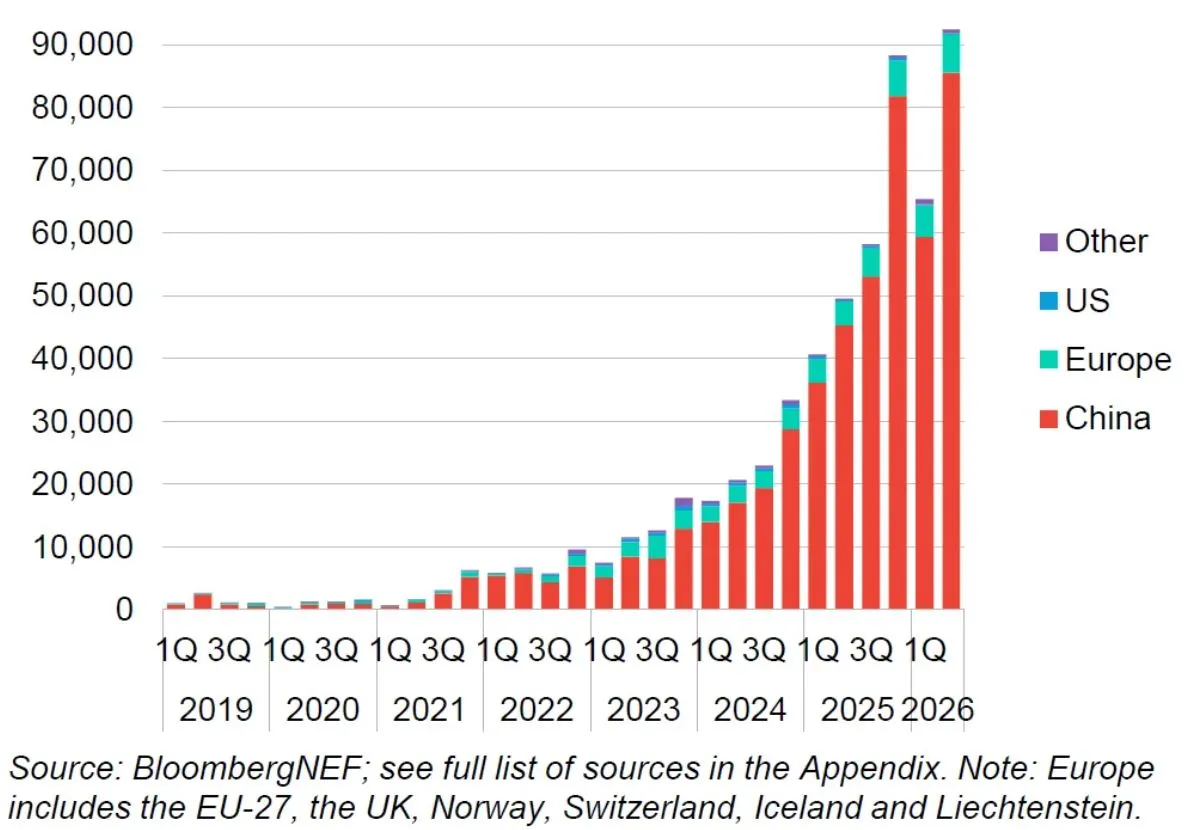
By 2026, about one-third of trucks sold in China will be electric-powered. The expansion of electrification in this transportation sector is part of Beijing’s efforts to ensure energy security, according to Bloomberg.
The agency cites an analysis by BloombergNEF, which shows that in the first half of 2026 global sales of medium and large electric trucks reached a record level of around 158,000 units, representing a 75% increase compared to the same period last year.
China was responsible for over 90% of the sold vehicles. In Europe, electric trucks accounted for about 5% of sales, with countries such as Norway, Switzerland, Denmark, the Netherlands, and Sweden standing out. Meanwhile, the U.S. market, as indicated in the analysis, practically stalled due to costs and policy factors.
Bloomberg notes that interest in electrification in this segment of the automotive industry has risen in China due to the Middle East war, which has led to high fuel prices. Sinopec Economics & Development Research Institute predicts that diesel consumption in China will fall by more than 10% this year.
A reduced demand for diesel helps mitigate the impact of the crisis not only in China but also in global markets. Meanwhile, electrification of freight transportation could reduce global demand for crude oil in the long term.
According to estimates from Chinese consulting firm SCI99, an electric truck with a large payload costs around 600,000 yuan, compared to about 400,000 yuan for a diesel-powered model. The higher purchase cost is offset by significantly lower electricity prices compared to diesel fuel.
Driving 200 kilometers in a diesel truck in the U.S. would cost around $101 today, while doing the same distance in an electric vehicle in China, charged outside peak hours, would cost only $21.
Bloomberg notes that for Beijing, a key aspect of developing the electric truck market is energy security. This reduces the need for imported oil and fuels in favor of domestic electricity generated from renewable sources or domestic coal resources. According to an official goal, by 2030 electric trucks are expected to account for one-fifth of the fleet in this sector and at least 40% of sales.
See also: How to lightly electrify heavy transportation
Data centers have driven small turbines out of the market
In the U.S., demand for small open-cycle gas turbines and those derived from aviation has surged. This is due to the needs of artificial intelligence (AI) data center projects, according to Reuters.
The agency explains that interest in these types of devices has increased because the delivery time for orders is much shorter than that for large gas turbines. Major data center developers want to ensure access to energy as quickly as possible.
According to Enverus Intelligence Research, by 2030, nearly 30 GW of on-demand power generation capacity will be built in the U.S. Despite their lower efficiency and higher emissions, investors are willing to purchase them to take advantage of the boom in artificial intelligence development.
This is supported by the relatively short delivery time of 2-3 years. For comparison, large combined cycle gas turbine (CCGT) plants require up to six years of waiting. Additionally, the modular design of these small turbines allows for gradual expansion of the power supply to data centers.
The energy sector is competing with other industries for orders of data center turbines. According to Global Energy Monitor’s calculations, there are currently gas power projects under development in the U.S. with a total capacity of over 150 GW for which suppliers have been contracted, as well as over 120 GW of projects that still lack technology providers.
The companies that have received the most orders include GE Vernova (61 GW), Siemens Energy (33 GW), Mitsubishi Power (17 GW), and Caterpillar (16 GW). Among the smaller suppliers are Baker Hughes, Innio Jenbacher, Wärtsilä, Bergen, and Rolls-Royce.
Reuters cites examples of recent contracts, including Crusoe, which ordered 29 aviation-derived turbines with a capacity of 35 MW from GE Vernova for its data centers, as well as piston engines with a total capacity of 750 MW from Bergen.
In response to market demand, some manufacturers plan to expand their U.S. factories. GE Vernova says it will invest $160 million by 2028 in a factory in Greenville, South Carolina, where it will hire 650 new workers. By the same deadline, Siemens Energy plans to restart turbine production in Charlotte, North Carolina, which was halted in 2020 due to low demand.
See also: Is a surge in investment in heating possible?
The European industry is not in such bad shape
The problems facing Europe’s industry, related to high energy costs and increasing competition from companies in China, are a reality. However, this does not mean the downturn is as deep as it might seem, as some sectors are still experiencing very good conditions — writes The Economist.
The weekly magazine acknowledges that recent years have been extremely difficult for European industry. Two main factors contribute to this. The first is significantly higher energy prices compared to the U.S. or Asia, as well as energy crises caused by Russia’s aggression against Ukraine and this year’s war in the Middle East.
As a result, it is much harder to compete on cost terms with American or Asian rivals. This especially applies to China, which is the second major reason for the difficult situation in European industry — particularly in sectors such as automotive, steel manufacturing, and chemicals.
European companies are finding it increasingly difficult to sell their products in China, which used to be a key export market for many of them. Chinese manufacturers benefit from cheaper energy, advanced technologies, and supply chains, while government support facilitates their expansion into foreign markets. As a result, the EU’s trade deficit with China has more than doubled since 2019, reaching over 400 billion euros.
Nevertheless, according to “The Economist,” the overall situation of industry in the EU is not as dramatic as it might seem. The share of industrial production in total gross value added has remained around 16% in recent years. Industrial employment stands at about 28 million people and has declined by around 2% since 2023, with Germany playing a major role in this decline.
Although the condition of the heavy industry and automotive sector is weak, employment in the pharmaceutical, aviation, defense, and electrical engineering industries is increasing at the same time.
Companies such as Schneider Electric and Siemens Energy have orders for several years thanks to the boom in data centers. Meanwhile, firms like Rheinmetall and Leonardo, along with other defense manufacturers, benefit from higher spending on defense. Overall, exports from EU countries in 2024 amounted to $460 billion—21% more than in 2022.
According to “The Economist,” Europe’s industry must rely more on automation, as well as AI and other emerging technologies, to boost productivity. At the same time, the weekly magazine emphasizes that Europe “should stop mourning old industrial sectors,” because in the future, falling behind China and the U.S. in AI development could pose a greater threat to European industry than energy costs.
See also: Delayed and overregulated support for energy-intensive industries
ETS reform under pressure from political changes in the EU
The shifting political landscape in the European Union is increasing pressure to quickly reach an agreement on reforming the CO2 emissions trading system (EU ETS). This risks resulting in solutions that benefit neither industry nor the climate, according to Montel.
The portal emphasizes that the energy crises faced by EU countries in recent years, along with problems in key industrial sectors, have paved the way for changes to EU ETS. Following the calls from industries such as automotive, chemicals, and steelmaking, countries where industry plays a major role in the economy are also raising their expectations.
Among the countries most strongly calling for a relaxation of current rules are Poland, Hungary, the Czech Republic, Slovakia, and Italy. The Italian defense minister even described EU ETS as a “diabolic mechanism” that equates to “industrial suicide.”
In July, the European Commission proposed changes aimed at reducing pressure on industry and helping it decarbonize — without abandoning the EU’s overall goals of achieving climate neutrality by 2050 and cutting CO2 emissions by 90% by 2040 (compared to 1990 levels). These include a slower phase-out of free allowances and additional funding for industry investments.
See more: ETS Reform: Brussels eases the pace but keeps the goal
Currently, the European Parliament and the Council of the EU are working on the final shape of the reform. Under an optimistic scenario, member states are expected to reach a consensus by early 2027. However, this assumption faces pressure from political situations in various EU countries and the growing influence of eurosceptic groups opposed to climate policy.
This applies especially to Germany, where the AfD achieves high results in elections in various states, as well as France, where the National Rally is the favorite in the upcoming parliamentary elections. Elections will also take place in Poland next year, where the current opposition demands more radical actions regarding EU ETS than the ruling coalition.
“On one hand, we have the Nordic countries, the Netherlands, Spain, and Portugal, which are strong supporters of EU ETS. On the other hand, we have Poland, Italy, Hungary, the Czech Republic, and Slovakia, which want to significantly soften the ambitions of climate policy. France and Germany, meanwhile, are in the middle ground,” says Henry Lush, a CO2 emissions market analyst at consulting firm Veyt, as quoted by Montel, who adds that it is this middle ground that has become the most fragile at present.
See also: Electricity trading permits fees rise 1000 percent. The impact on the market could be catastrophic
