
Chinese manufacturers hold 56.4% of the EV battery market outside of China. SNE Research data
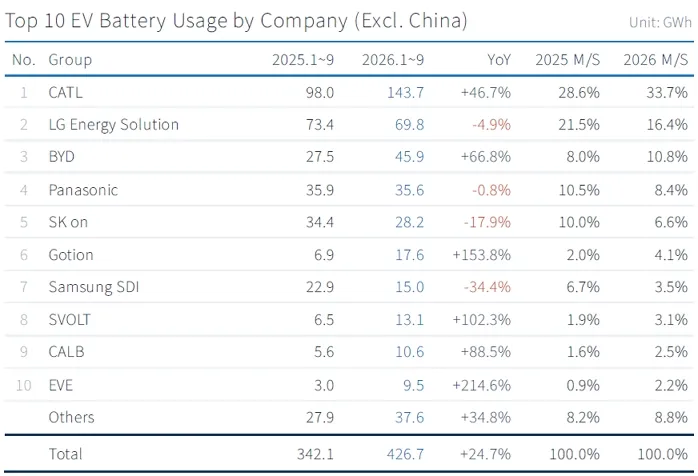
From January to September 2026, batteries with a total capacity of 426.7 GWh were used in electric and hybrid vehicles sold outside China, representing a 24.7% increase from the previous year. According to an analysis by South Korean firm SNE Research, six Chinese manufacturers now hold 56.4% of this market, up from 43.1% a year earlier. South Koreans and Panasonic are losing ground, particularly in North America.
Table of Contents
Show
Hide
SNE Research includes CATL, BYD, Gotion, SVOLT, CALB, and EVE Energy in China’s top six manufacturers. CATL and BYD alone account for 44.5% of the market, compared to 36.7% the previous year. The analysis covers batteries for fully electric vehicles (BEV), plug-in hybrids (PHEV), and other hybrids. Interestingly, when China’s market is included, the global market grew by only 19.7%, indicating a clear slowdown in China itself.
CATL holds one-third of the market, while Samsung SDI falls behind Gotion
The leader in the rankings, CATL, installed 143.7 GWh outside of China (a 47% increase), accounting for 33.7% of total capacity, which is 5.1 percentage points higher than the previous year. In Europe, the company’s capacity grew from 71.5 GWh to 96.8 GWh, while in Asia it doubled to 27.1 GWh. In September, CATL began pilot production of batteries in Debrecen, with the target capacity for this facility set at 100 GWh per year—more than the company’s total European capacity after nine months of this year.
LG Energy Solution retained second place with 69.8 GWh (a 4.9% decrease). In Europe, the Korean company’s capacity increased by 13% to 38.6 GWh, while in Asia it rose by 49% to 11.1 GWh. However, this was not enough, as sales in North America dropped from 29.9 GWh to 16.5 GWh, reducing LGES’s share to 16.4% from 21.5%.
The third-ranked BYD increased its volume by 67% to 45.9 GWh, while its share rose from 8.0% to 10.8%. The growth was distributed across Europe (17.4 GWh, a 67% increase), Asia (14.8 GWh, a 41% increase), and South America (7.1 GWh, a 136% increase).
Panasonic is in fourth place with 35.6 GWh (a 0.8% decrease) and an 8.4% share. Analysts at SNE Research note, “Tesla’s volumes in North America maintained strong performance, but the growth was significantly weaker than in markets outside China.” SK On, which supplies batteries to companies such as Hyundai, Ford, Volkswagen, and Mercedes, saw a 18% decline to 28.2 GWh. Its battery usage dropped by 46.7% in North America and 2.2% in Europe. The company’s share fell from 10.0% to 6.6%.
Samsung SDI fared worst among the top ten, with 15.0 GWh — a 34.4% decline — and its share dropping from 6.7% to 3.5%. Sales remained steady at 9.4 GWh in Europe, but declined in North America from 12.0 GWh to 4.1 GWh. Gotion, a partner of Volkswagen, surpassed Samsung, growing by 153.8% to 17.6 GWh.
The top ten are completed by SVOLT (13.1 GWh, +102%), CALB (10.6 GWh, +88.5%), and EVE Energy (9.5 GWh, +215%).
In total, the three Korean companies supplied 113.0 GWh, 13.5% less than the previous year, with their combined share falling from 38.2% to 26.5%. Their output in North America nearly halved, from 56.1 GWh to 28.1 GWh, while it increased in Europe from 58.7 GWh to 63.0 GWh and in Asia from 13.1 GWh to 17.5 GWh.
LFP and regulations in Europe
The share of LFP (lithium-iron-phosphate) cells in markets outside China rose from 15.8% to 27.7%, with Chinese companies leading in this chemistry sector. In Europe, according to SNE Research, LFP is “primarily used in base models, making price competitiveness the key criterion for choosing a supplier.”
Analysts believe that local regulations and varying demand will now determine the position of suppliers. Some manufacturers, especially in North America, are shifting focus to batteries for energy storage. In Europe, SNE Research identifies the EU’s Auto Package with incentives for phasing out internal combustion engines, along with possible “Made in Europe” rules, as decisive factors.