China’s auto exporters are becoming more profitable, while the global automotive industry faces margin pressure
The profitability of the global automotive industry remains strained in the first half of 2026, with major Chinese manufacturers improving their financial performance through a sharply rising export share. This is according to the “AutomotivePerformance Report” by the Center of Automotive Management (CAM). The study examines the financial performance of 25 leading global automakers based on revenue, group EBIT, EBIT margin, and EBIT per vehicle delivered.
The current analysis also includes major Chinese manufacturers such as Chery, BYD, Geely, SAIC, Great Wall Motor, Changan, Nio, XPeng, and Li Auto. Across all the manufacturers studied, combined EBIT decreased by 16.3% compared to the previous year, while sales fell by only 1.0%. The EBIT margin on a sales basis was 3.5%, down from 4.4% in the prior period. The average group EBIT per delivered car also came under pressure, dropping from 1199 euros to 1027 euros, a decline of 14.3%.
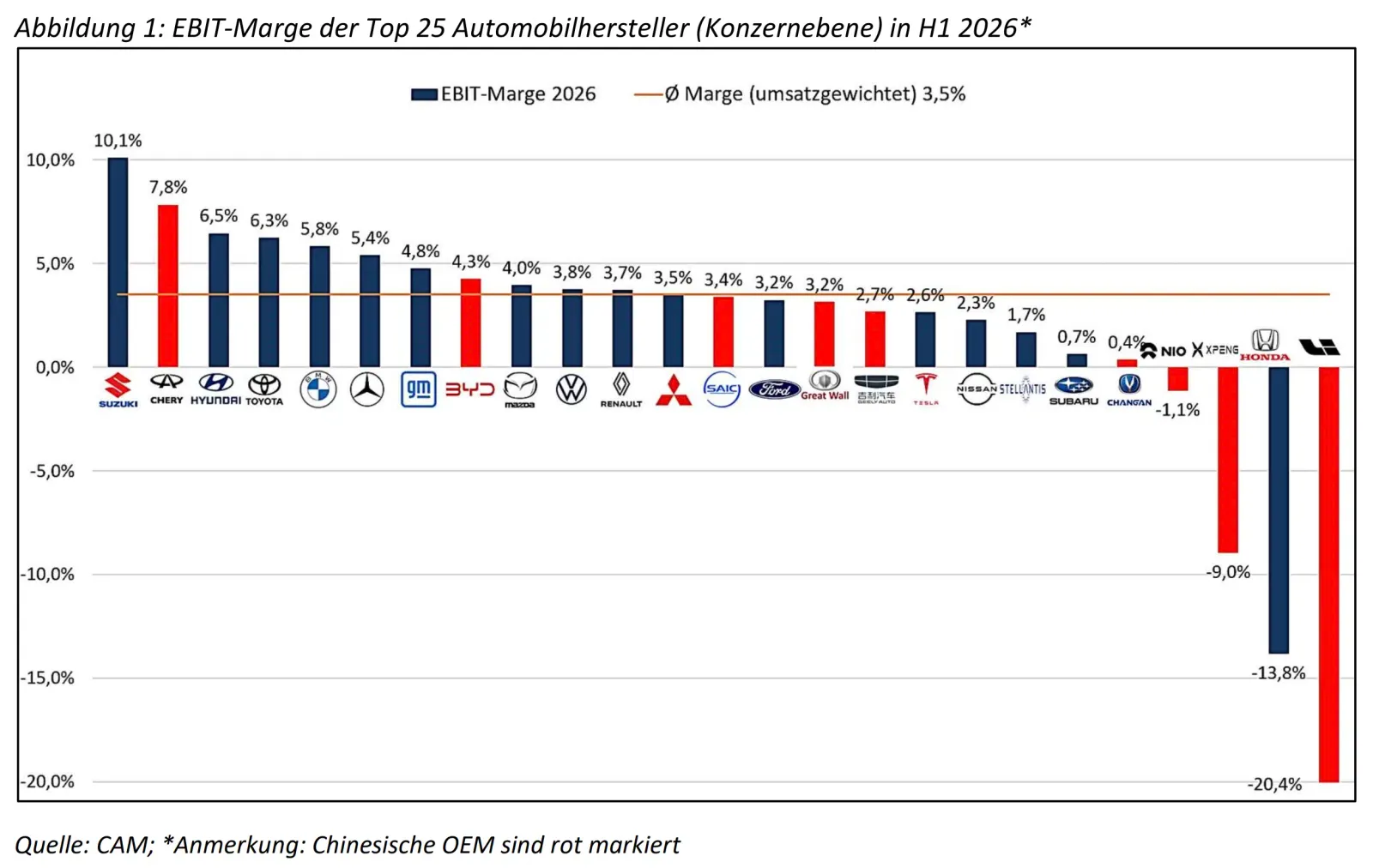
Of particular note is the position of Chinese manufacturers: Several of China’s top export-oriented automakers exhibit relatively high EBIT margins. Chery achieves the second-highest EBIT margin overall at 7.8 percent, while BYD, SAIC, Great Wall Motor, and Geely also operate profitably. This reveals a clear overlap between international export strength and operational profitability.¹
Study leader Stefan Bratzel said, “The new analysis of financial results confirms the basic findings of the previous study. Automaker revenues remain relatively stable, whereas operational profitability has declined significantly. At the same time, it is evident that some Chinese manufacturers are now competitive not only in terms of volume and growth but also in profitability.”
The inclusion of Chinese manufacturers slightly changes the overall picture. An earlier CAM interim analysis, which initially covered 15 established global automakers, had shown an EBIT decline of 17.5 percent, a sales drop of 1.4 percent, and a decline in EBIT per car of 16 percent. The broader data set thus indicates a slightly smaller decline in results, but it still confirms the overall finding of a much sharper drop in profitability compared to sales trends.
Chinese export leaders with positive margins
Chinese automakers have so far not yet reached the scale of the leading established automotive conglomerates in terms of revenue and absolute EBIT. An exception is BYD, which has revenue equivalent to around 43.3 billion euros and is already on par with Tesla, and with EBIT of around 1.85 billion euros, it ranks among the more profitable Chinese manufacturers. Chery, with significantly lower revenue of around 18 billion euros, achieves an EBIT of 1.41 billion euros, indicating above-average profitability. In terms of EBIT per car, Chery at around 1,040 euros and BYD at around 1,025 euros are close to the average of 1,027 euros among the manufacturers analyzed, while SAIC, Geely, and Great Wall fall below this average, and newer electric vehicle manufacturers such as Nio, XPeng, and Li Auto still show negative values.
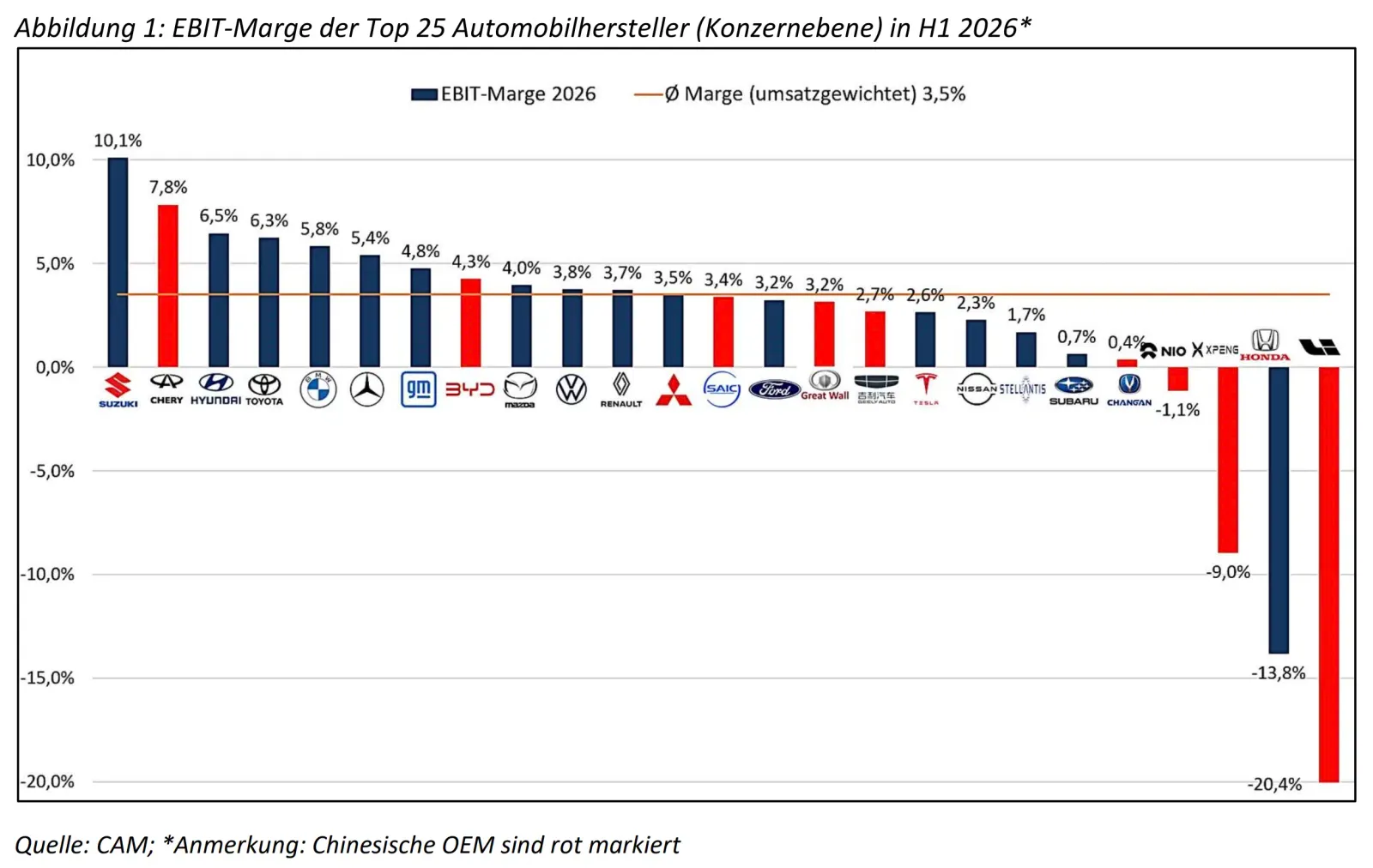
According to CAM analysts, what is particularly interesting is the performance of some highly internationalized Chinese manufacturers such as Chery, BYD, and Geely. Chery has the highest EBIT margin among the surveyed Chinese manufacturers at 7.8 percent, ranking only behind Suzuki with 10.1 percent in the overall comparison of automotive manufacturers. Followed by BYD at 4.3 percent, SAIC at 3.4 percent, Great Wall Motor at 3.2 percent, and Geely Auto at 2.7 percent. In contrast, electric vehicle manufacturers like Nio, XPeng, and Li Auto, which focus more on their domestic market, still exhibit negative operating margins.
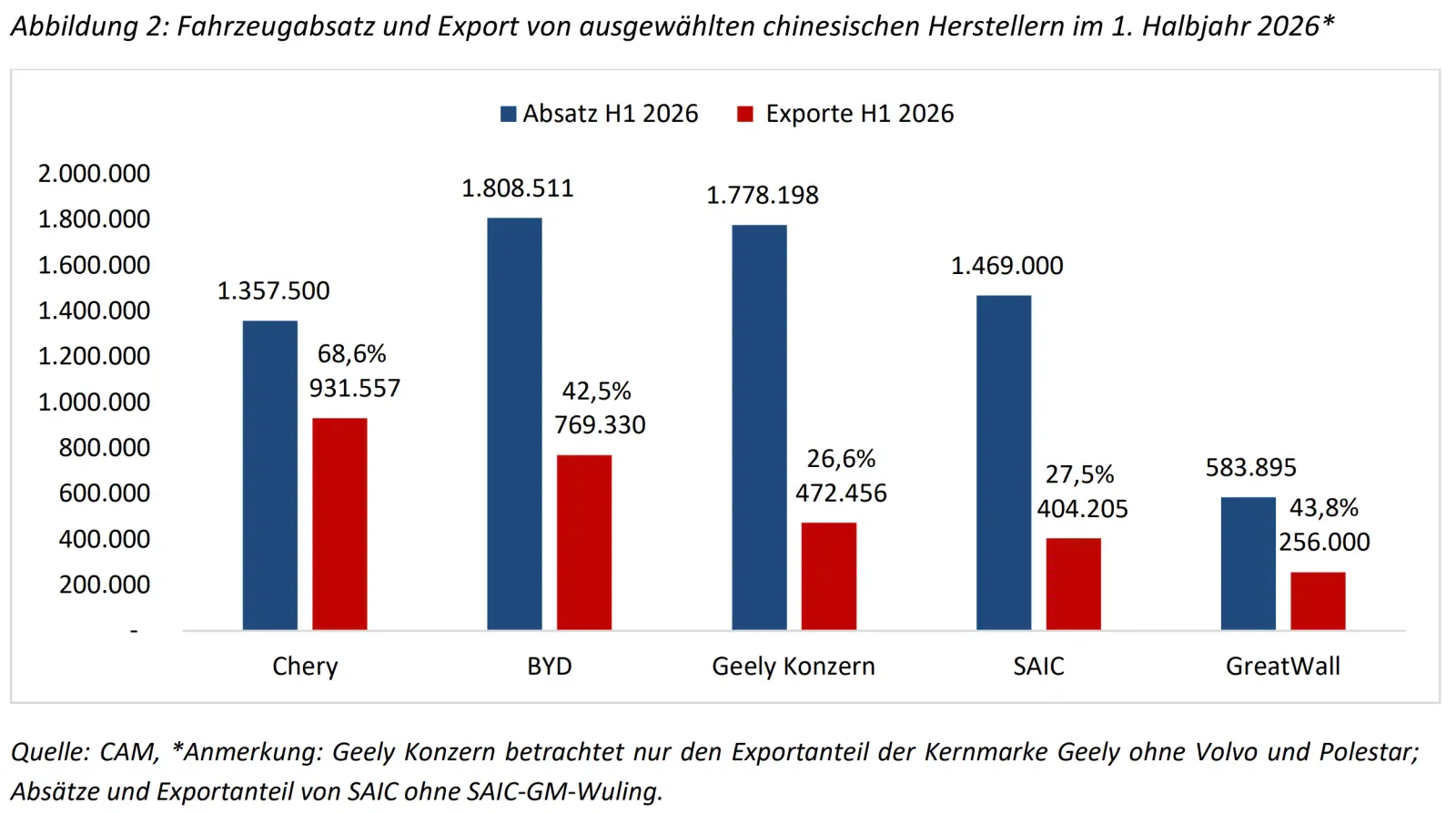
The profitability structure shows a notable overlap with export strength. According to the latest figures from the China Passenger Car Association (CPCA) for January to June 2026, Chery is the largest Chinese automobile exporter with 931,557 exported vehicles (21.9%), followed by BYD with 769,330 vehicles (18.1%), Geely with 472,456 vehicles (11.1%), SAIC with 404,205 vehicles (9.5%), and Great Wall Motor (GWM) with 256,000 vehicles (6.0%). Together, these five largest exporters account for approximately 66.6% of all recorded Chinese automobile exports.
At Chery, the strong internationalization is evident in its sales figures as well: Of a total of 1,357,500 units sold worldwide, exports accounted for around 68.8 percent, while in the first half of 2025 this figure was approximately 43.3 percent. BYD is also accelerating its international expansion significantly. BYD aims to export around 1.9 to 2.0 million vehicles by 2026, with exports currently making up about 42.5 percent of total sales (around 20.7 percent in the first half of 2025). According to unconfirmed reports, the company plans to export even more than 2.5 million units by 2027.
This development gains significance against the backdrop of a weaker Chinese domestic market, which is projected to drop by about 4 million vehicles to 19.5 million by 2026 according to CAM estimates. In the first half of 2026 alone, retail vehicle sales in China declined by around 20.4 percent to 8.8 million vehicles, while vehicle exports increased by approximately 70.6 percent to 4.28 million units. As a result, overseas markets are becoming increasingly crucial growth and profitability drivers for Chinese manufacturers.
"The data show a remarkable correlation: Some of China’s largest exporters are also among the most profitable manufacturers," explains Bratzel. "Chery is a key example in this regard. While a high export share does not guarantee high margins, internationalization gains significant strategic importance given the challenging Chinese domestic market."
Competitive pressure is increasingly shifting to Europe
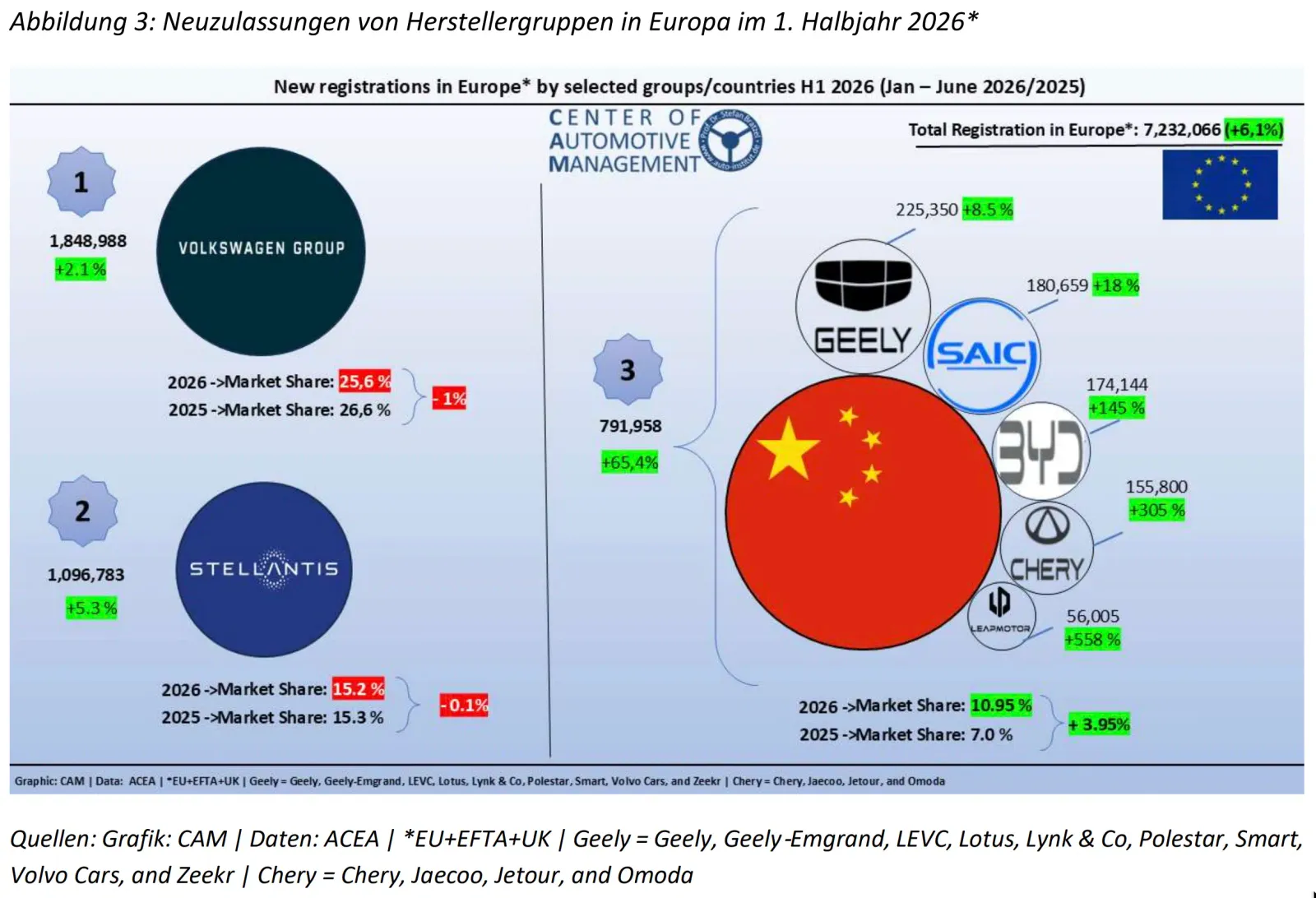
International expansion is likely to further increase competitive pressure in the European automotive market. Chinese automakers managed to boost new car sales in Europe by over 65 percent in the first half of 2026, raising their cumulative market share from 7 percent to 11 percent. Chinese brands are also gaining significance in Germany. A analysis shows a market share of around 6 percent for Chinese brands in H1 2026. Chinese manufacturers accounted for about 10 percent of electric vehicle registrations. Other manufacturers are set to expand their activities in Europe.
Bratzel: “For European manufacturers, this marks the beginning of a new competitive phase. Chinese suppliers are increasingly entering Europe with scale advantages, competitive cost structures, and a wider range of models. It will be crucial whether established manufacturers can quickly improve their cost base while maintaining their differentiation in terms of technology, software, and product appeal. At the same time, the European Commission should ensure that the growing entry of Chinese manufacturers into the market occurs under fair and rule-compliant competitive conditions.”