
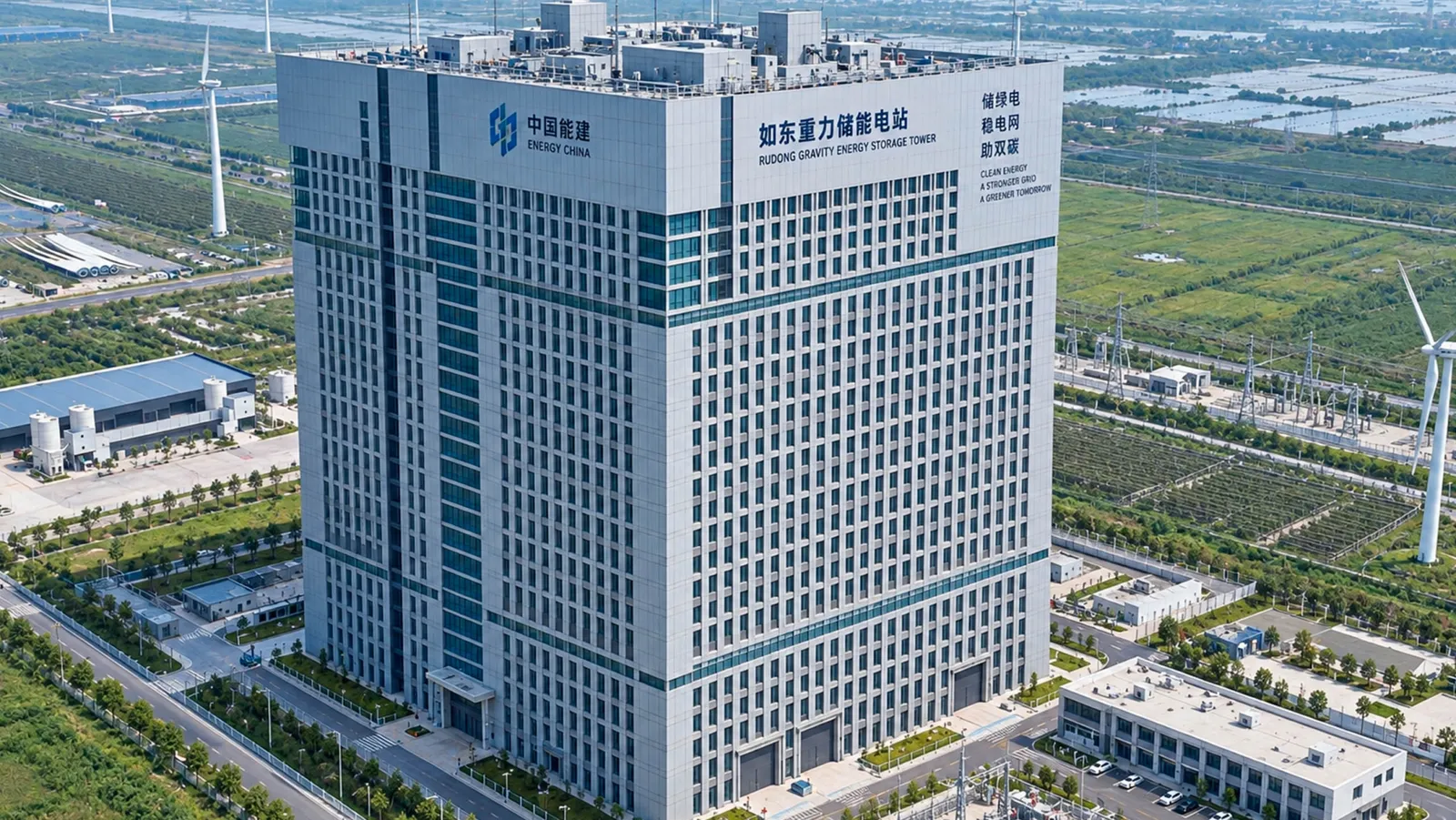
China is building a battery as large as a 50-story skyscraper with one goal: extracting every last drop of energy from renewable sources.
21/09/2026 15:30
Updated to
21/09/2026 15:30
The expansion of renewable energy is forcing China to seek systems capable of storing increasing amounts of electricity. Wind and solar power generation does not always align with peak consumption times, making storage essential to prevent wasted energy.
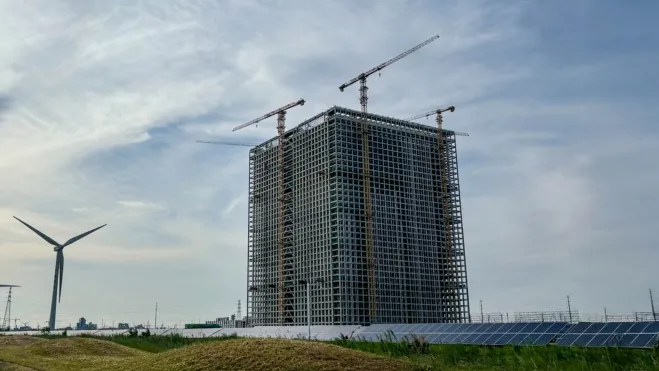
One of the solutions being tested in the country completely transforms the traditional concept of batteries. In Rudong, Jiangsu province, a structure about 148 meters tall has been built to convert excess electricity into potential energy by lifting massive weights, then recover it when the grid needs it again.
100 MWh Stored Using Only Gravity
The project utilizes EVx technology developed by Energy Vault and built in China by China Tianying. The facility has a capacity of 25 MW and 100 MWh, enough to maintain its maximum power output for about four hours. It is also located near a wind farm and connected to the electrical grid, specifically to transfer part of that energy production to other times of day.
The process begins when there is more electricity available than the grid needs. This energy powers a series of motors responsible for lifting large blocks into the structure, storing them as potential energy. When demand increases, the masses begin to descend in a controlled manner, and the system reverses the process to generate electricity again.
The concept relies on the same physical principle as a pumped hydroelectric plant, but it eliminates the need for two reservoirs and an appropriate elevation difference. Instead of moving water between different heights, EVx uses solid blocks that, according to Energy Vault, can be manufactured using local materials and certain waste products, including concrete debris, ash, or materials from mining activities.
China Has Already Tested the System Connected to Its Power Grid
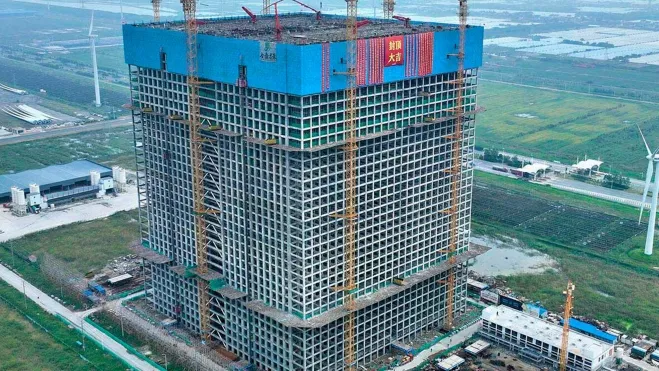
The mechanical construction of Rudong was completed in September 2023, and the installation was connected to the national grid in December of the same year. Subsequently, on May 4, 2024, China Tianying finished the loading and unloading tests for the 25 MW and 100 MWh system, a necessary step to verify its operation at commercial scale.
Energy Vault estimates that this technology can achieve over 80% overall cycle efficiency. In other words, for every 100 units of electricity used during storage, slightly more than 80 can be recovered later. However, this is a projection by the company itself and not an average performance achieved after several years of commercial operation.
The company also estimates a operational life of around 35 years and claims that the material used as the storage medium does not suffer from the usual chemical degradation of electrochemical batteries. Maintenance therefore focuses on the mechanical and electrical components that enable the movement of masses, including motors, lifting systems, and moving parts.
Rudong won’t be China’s only gravity battery
The project is part of a broader strategy to integrate new storage technologies into China’s grid. Rudong and another facility that Energy Vault is developing in Zhangye were selected in 2024 as pilot demonstration projects by China’s National Energy Administration, with additional developments of this technology announced in various provinces.
The goal is not to completely replace lithium batteries or hydroelectric storage, but to add another option for managing large volumes of renewable energy over several hours. In the case of Rudong, its main purpose will be to absorb excess power from nearby wind farms and supply that electricity back when grid demand is higher.