
China aims to produce solid-state batteries at 400 Wh/kg by 2027: what range would they enable?
The Chinese industry has identified ten technologies that could make significant progress over the next year. Batteries, autonomous driving, and new manufacturing processes are at the center of forecasts that include pilot production, initial commercial applications, and expansion of existing systems.
China aims to continue advancing in automotive development, and its engineers have already indicated where they expect the next developments to occur. Some affect electric vehicles directly, while others focus on components, manufacturing, or freight transportation. However, each technology progresses at its own pace, and not all are ready for widespread use yet.
The China Society of Automotive Engineers presented its ten technological trends for 2027 on October 28th, during the opening of the SAECCE 2026 conference. Zheng Yali, the organization’s vice-general secretary and executive director of the Guoqi Strategy Institute, was responsible for outlining them.
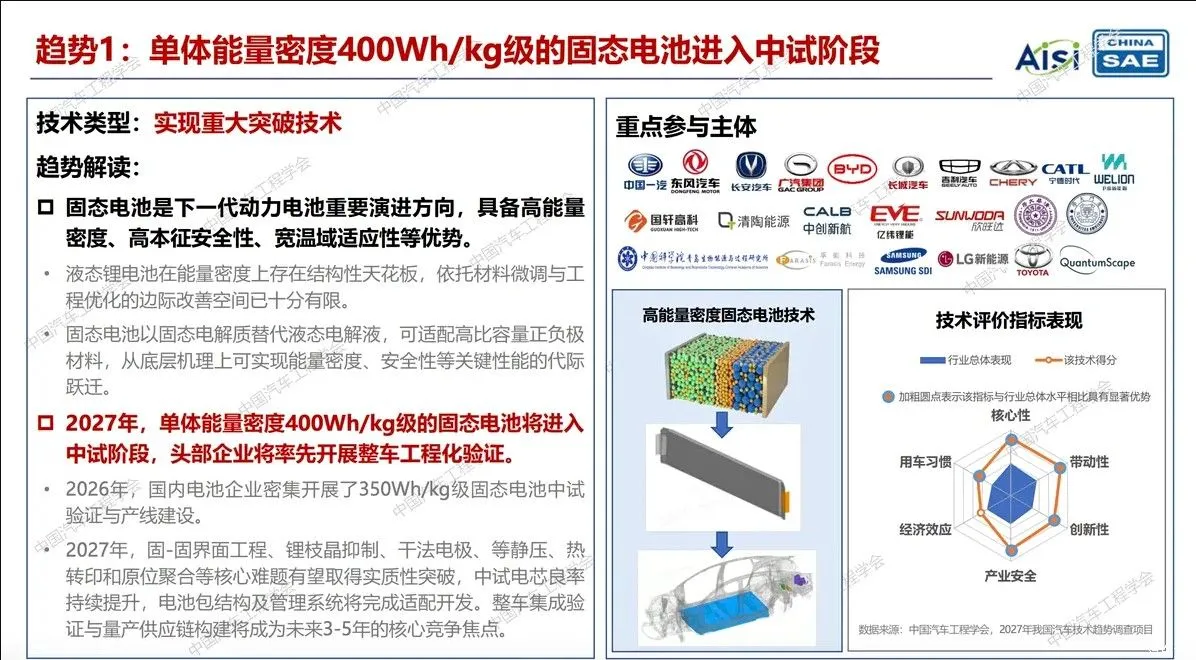
The list distinguishes between technologies that could achieve significant advancements, others set to enter production soon, and solutions whose use is expected to grow substantially. It represents a sectoral forecast, not a confirmed launch schedule from manufacturers. This distinction is particularly important in the area likely to generate the most headlines: solid-state electrolyte batteries.
Solid-State Batteries, Microcontrollers, and Advanced Manufacturing
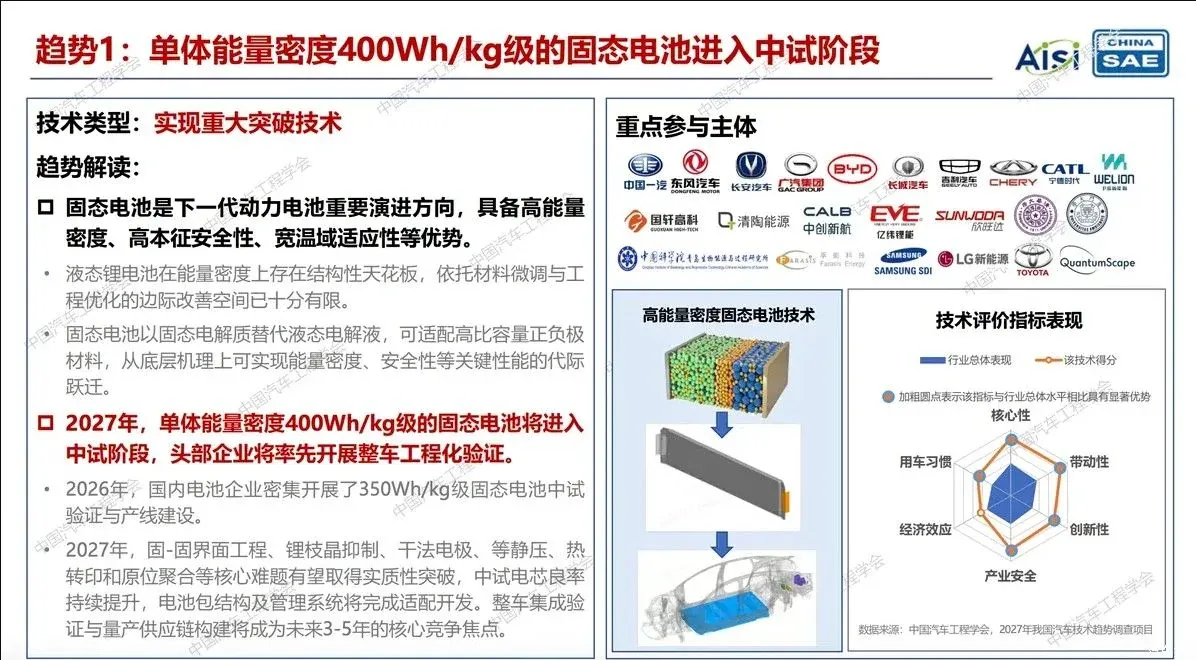
The first estimates suggest that solid-electrolyte cells with around 400 Wh/kg capacity will enter pilot phase by 2027. This improvement in energy density will allow for cars with longer ranges or models featuring lighter batteries.
To put this improvement in perspective, if a current battery with 250 Wh/kg cells and a 75 kWh capacity can provide around 500 km of real-world range, cells with 400 Wh/kg capacity could increase the capacity to 120 kWh and extend the range to around 800 km of real-world driving, while maintaining the same cell weight.
China is pushing for further advancements beyond batteries
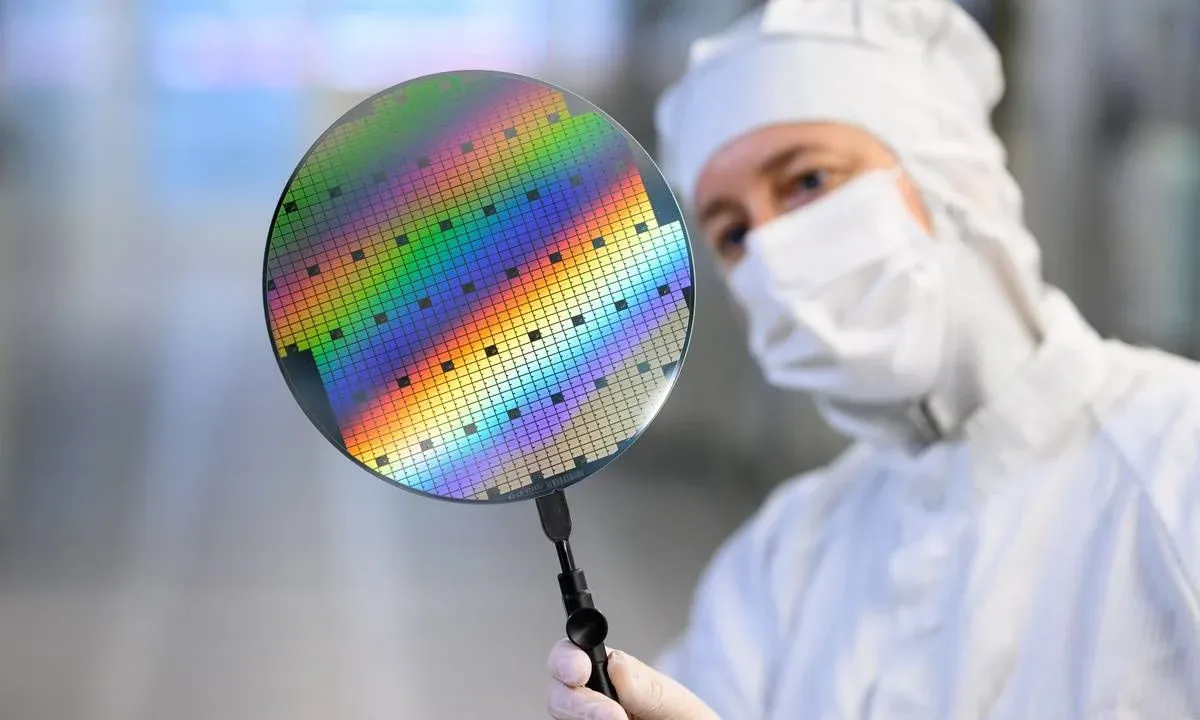
Solid-state batteries share the spotlight with a less visible technology to consumers: automotive microcontrollers based on RISC-V that have high security requirements. The association expects 2027 to mark the start of their mass production in this category. These are electronic components designed for control tasks, unrelated to the marketing focus on large screens, but essential for the car’s operation.
The third trend is greater adoption of integrated motion control. The approach involves coordinating systems such as propulsion, braking, steering, and suspension more effectively, rather than handling their responses in isolation. It is anticipated that these solutions will spread to more models and help improve the overall performance of the vehicle.
The connection between electric vehicles and the grid through V2G, the technology that allows electricity to be fed back from batteries, is also mentioned. The report forecasts an average daily flexible regulation capacity in reverse direction of around one million kilowatts, equivalent to 1 GW. This refers to the aggregate power available to support the grid, not the energy supplied or the capacity of a single vehicle.
Currently in development, one of the focuses is on large magnesium alloy body panels produced through die casting. Plans call for small-scale applications at this stage, so widespread adoption is not yet anticipated. The goal is to develop structures that utilize this material and reduce the need to assemble multiple parts.
Goods transportation occupies another prominent position. The company expects the fleets of demonstration trucks featuring advanced autonomous driving and platooning capabilities to reach a scale of around 1,000 units. This figure refers to the deployment of these operations as a whole, not a single convoy or permission to operate driverless on any road.
Another technology that will continue to undergo testing is distributed propulsion with engines integrated into the wheels. The expected trend is an acceleration in its engineering validation, a necessary phase to determine how well the solution performs in real-world applications. The announcement does not yet indicate a widespread introduction to production vehicles.
Artificial intelligence also has its place. The association predicts that models run locally in the systems of mass-produced cars will exceed 14 billion parameters. This figure describes the size of the model but does not guarantee on its own that an assistant will perform better. The expected advancement is bringing models of this scale directly into the cars themselves.
The ninth trend relates to connected driving assistance, which should move from demonstrations to factory installation in small batches. The focus here is on using connectivity to support driving. It should not be confused with autonomous truck driving: the list itself presents them as separate development paths.
Finally, metal 3D printing is among the technologies poised to advance together in terms of materials, design, and efficiency. The forecast does not suggest it will replace traditional processes, but rather improvements that could expand its applications within the automotive industry.
Higher-density batteries are the most obvious benefit, but much of the work planned for 2027 will focus on components and processes that drivers will not see. For solid-state batteries, the decisive challenge remains turning a good cell into a product that can be manufactured consistently at an affordable cost.